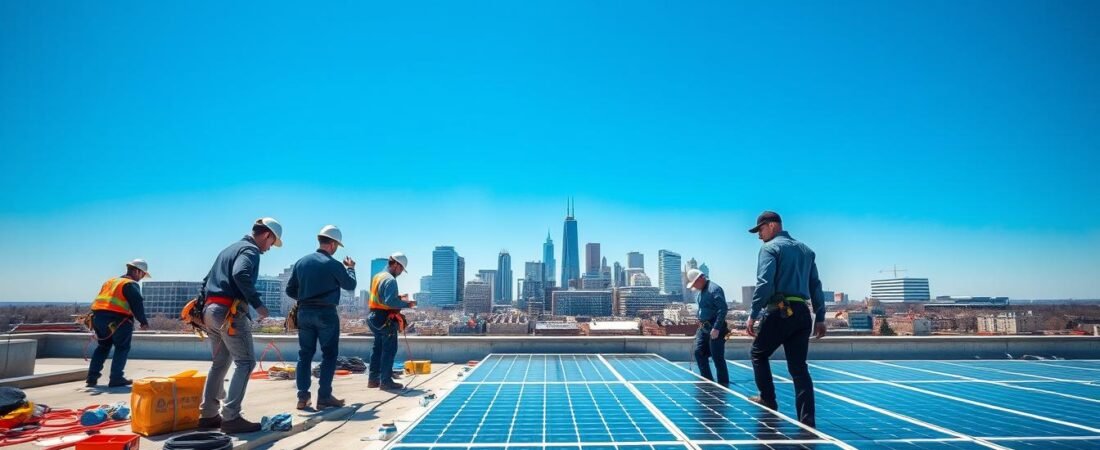
Welcome to the local hub for businesses in Greensboro and North Carolina seeking real savings and reliable energy solutions. Colite Technologies offers tailored distributed energy designs that combine panels, batteries, and hybrid systems to cut operating costs and boost resilience.
Top installers mean deep commercial experience, sound engineering, safe construction, and long-term support — not just selling equipment. Large roofs, warehouses, and manufacturing loads call for systems sized for demand charges and utility coordination.
This guide walks decision-makers from assessment to quote-ready steps: solutions, industries served, the installation process, incentives, and ongoing maintenance. System design and build quality drive predictable savings and protect roofs and investments.
We handle permitting, paperwork, and interconnection to save facilities and finance teams time. Ready to compare options? Request a quote and savings analysis to confirm fit before construction begins.
Commercial Solar Built for Greensboro Businesses
Local businesses can cut operating costs and gain energy resilience with systems sized to their needs.
Lower operating costs while supporting sustainability goals
Offset purchased energy to reduce monthly bills and smooth exposure to rate changes. That makes forecasting expenses easier and helps teams plan capital and operating budgets.
Improve resilience during outages, grid strain, and peak-demand periods
Pairing a battery with panels keeps critical equipment online during outages or brownouts. This reduces downtime and the risk to operations when the grid is under stress.
Designed for long-term performance and predictable energy savings
Systems sized around weekday, weekend, and seasonal loads deliver more value. Quality components, good engineering, and monitoring protect savings over years.
- Reduced exposure to demand charges through right-sized design and efficiency upgrades.
- Aligns sustainability targets with practical cost control and improved cash flow.
- “Switching solar” is a strategic move to protect against rising energy costs and save money.
| Outcome | How it helps | Business impact |
|---|---|---|
| Lower energy costs | Offset grid purchases, reduce bills | Better cash flow, predictable forecasts |
| Improved resilience | Battery backup for critical loads | Less downtime, lower operational risk |
| Long-term savings | Quality parts + monitoring | Sustained ROI over years |
Next: roof type, mounting approach, and permitting will affect project speed, risk, and total investment.
commercial solar panel installation services greensboro
Businesses get clear, predictable project scopes that limit surprises during build.
Rooftop solutions for flat and low-slope roofs
Flat and low-slope roofs need different planning than homes. Ballast, tilt, and row spacing are laid out to avoid roof damage and to maximize production.
Non-penetrative mounts to protect roof integrity
Non-penetrative mounting uses weight and clever layout so crews do not pierce waterproof membranes. That lowers leak risk and keeps warranties intact.
Ground-mounted options for expansion
When land is available, ground arrays offer easier access and room to grow. They complement rooftop capacity limits and can simplify maintenance.
Permitting and utility interconnection management
A single team handles permits, interconnection paperwork, and utility coordination. This reduces admin time and helps avoid schedule delays.
| Option | Best for | Key benefit |
|---|---|---|
| Rooftop (flat/low-slope) | Limited ground space | Uses existing roof area with planned ballast or mounts |
| Non-penetrative mounts | Minimize roof risk | Protects membrane and simplifies repairs |
| Ground-mounted | Available land or future growth | Higher access, easier expansion, steady production |
Complete Commercial Solar & Battery Solutions
An integrated energy strategy makes it easier for facility teams to meet needs and control costs. Colite Technologies bundles design, storage, controls, and long-term upkeep so you work with one partner rather than several vendors.
Commercial solar system design tailored to your usage, goals, and budget
System design starts with interval usage and operational priorities. We size a solar system to capture the most value for your rates, demand profile, and budget.
Energy storage solutions to store surplus solar power for later use
Battery and storage options store midday surplus power for peak periods. That reduces demand exposure and improves continuity during outages.
Hybrid energy systems that optimize how power is produced, stored, and used
Hybrid controls decide when to produce, store, or dispatch power. Smart controls protect savings and improve resilience across multiple buildings.
Maintenance and monitoring services to keep systems operating at peak efficiency
Ongoing monitoring detects issues early. Regular maintenance preserves production and directly supports ROI over the system life.
Renewable lighting options powered by solar energy for site efficiency
Renewable lighting for lots and remote areas cuts site energy use and extends the value of on‑site generation. It’s a low-risk efficiency upgrade that pairs well with panels and batteries.
“A coordinated energy plan reduces vendor friction and makes performance predictable.”
- One-partner approach: design through maintenance handled together.
- Tailored sizing: based on usage, goals, and budget for real value.
- Outcome: clearer forecasts, lower risk, and better uptime.
| Offer | Benefit | Business impact |
|---|---|---|
| Design + storage | Right-sized system | Reduced demand charges |
| Hybrid controls | Optimized dispatch | Improved continuity |
| Monitoring & maintenance | Performance protection | Long-term ROI |
These options can be configured differently for manufacturing, logistics, agriculture, or multi-building portfolios to match specific operational needs.
Industries We Serve Across Greensboro and North Carolina
Matching the right energy design to each site’s rhythm produces better savings and more reliable uptime than a one-size-fits-all approach.
Manufacturing facilities and industrial operations
Reliability and peak-demand control matter most for production lines. Systems are engineered to shave demand charges and protect uptime.
Warehouses, distribution centers, and logistics sites
Large, flat roofs and predictable daytime loads make these sites ideal for arrays that turn idle roof space into steady savings.
Agricultural operations and rural businesses
Ground-mount flexibility suits farms and rural sites. Reliable power keeps pumps, refrigeration, and critical equipment running.
Corporate campuses, offices, and multi-building portfolios
Scalable systems and centralized monitoring enable portfolio-wide reporting and consistent efficiency across multiple buildings.
Retail, self-storage, and other commercial properties
Reducing operating costs improves property value and meets tenant expectations for sustainability and lower overhead.
We tailor designs around load profiles, hours, and risk tolerance so customers get a system that fits operations. For local comparisons and vetted firms, see a trusted reference for North Carolina projects: top local company listings.
“The goal is to match the right system to the way each site uses energy, not force a one-size-fits-all plan.”
Our Commercial Solar Installation Process
A clear, step-by-step process helps facility leaders track progress from audit to live operation.
Energy savings analysis and site evaluation
We start with your utility history, demand patterns, and physical constraints to estimate savings and right-size the system. This defines realistic output and sets expectations for payback.
Custom engineering and production modeling
Engineering turns goals into plans. Our team models expected production, selects equipment, and designs systems that match your needs and boost efficiency.
Roof inspections and risk reduction
Pre- and post-installation roof checks document condition and protect long-term roof integrity. That reduces rework and supports warranty claims if needed.
Construction, commissioning, and utility coordination
Construction focuses on safety, staging, and minimizing downtime. Commissioning validates performance and the utility interconnection paperwork is handled end-to-end by our team.
| Stage | What you provide | What we own |
|---|---|---|
| Audit & model | Utility data | Production estimate |
| Build | Access windows | Safety & construction |
| Handoff | Final approvals | Commissioning & utility sign-off |
Experience matters. Tight coordination prevents delays, protects savings, and ensures timelines and documentation line up with incentive rules.
Incentives, Tax Credits, and Financing That Can Reduce Your Investment
Smart incentive planning can cut a project’s net cost and speed return on investment. For many businesses, tax credits and credits at the state and federal level materially lower the upfront investment and shorten payback.
How federal and state incentive navigation works
The process is documentation‑heavy. Accurate records, timelines, and compliance steps protect eligibility for tax credits and other benefits.
Colite Technologies helps North Carolina clients gather paperwork, model pro forma returns, and position projects to be safe‑harbored by July 5, 2026 where applicable. This planning reduces the risk of missed requirements.
Grants, loans, and utility rebates
Availability varies by program and timing. Grants and low‑interest loans can lower net costs, while utility rebates trim equipment expense.
Paperwork accuracy matters: application errors or missed deadlines can remove savings. Work with a team that tracks program windows and filing rules.
Timeline and ROI factors
Timing affects credits and investment decisions. Schedule projects to capture current incentives and avoid future rule changes.
- Energy rates and demand charges drive annual savings.
- System efficiency and operational hours determine how much energy you offset.
- How on‑site power is managed changes payback—batteries can shift economics by lowering peak charges and providing outage value.
“A clear, incentive‑informed quote lets leaders compare net costs and choose the best path forward.”
Request a quote that includes incentive modeling and a clear view of net investment and projected savings. That way decision‑makers can move confidently and evaluate whether adding storage improves the business case.
Energy Storage and Backup Power for Business Continuity
Storing energy on-site turns midday generation into a tool for peak demand and outage protection.
How it works: systems capture surplus power during daytime production and discharge it when facility loads spike or the grid falters. This strategy reduces purchased energy during peak hours and preserves operations during outages.
Store energy during the day and use it when you need it most
Batteries absorb excess output and release it on demand. That lowers peak charges and shifts usage to lower‑cost periods.
Battery-backed resilience for storms, brownouts, and operational risk reduction
Storms and brownouts cause production slowdowns and equipment risk. A dedicated battery offers seconds-to-hours of backup for critical circuits.
Common drivers: outage protection, demand management, continuity for production lines, and reduced exposure to grid events.
Microgrid-ready strategies for greater energy independence
Microgrid-ready systems coordinate generation, storage, and controls so sites can prioritize essential loads. This gives facility teams more control over on-site energy and power flows.
| Need | Typical solution | Expected outcome |
|---|---|---|
| Short-duration outage protection | Smaller battery sized for critical loads | Minutes to hours of continuity for essential equipment |
| Peak shaving / demand charge reduction | Battery + controls tuned to utility peaks | Lower monthly bills and improved savings |
| Extended resilience | Larger storage with microgrid controls | Multi-hour backup and prioritized load shedding |
Storage sizing depends on goals—backup duration vs. peak shaving—so modeling aligns systems to each facility. Real-time monitoring and routine O&M are vital when batteries and generation work as a coordinated solution.
Operations, Maintenance, and Real-Time Monitoring to Protect Performance
Timely checks and live alerts help teams fix small faults before they become costly downtime. Ongoing care keeps systems producing near their expected output and preserves projected savings.
Proactive monitoring that detects issues before they disrupt operations
Real-time monitoring gives continuous visibility into energy production and equipment health. Alerts flag underperformance, so teams can investigate before a high-bill month reveals a hidden fault.
Troubleshooting and repair support, including existing systems
Fast response matters. Colite Technologies dispatches technicians to troubleshoot and repair faults quickly. The team also supports systems installed by third parties, which helps new owners and portfolio managers avoid long gaps in coverage.
Ongoing maintenance plans to maximize production and extend equipment life
Typical plans include scheduled checks, periodic performance reviews, and corrective maintenance when issues arise. Routine work prevents small problems from eroding output over time.
“A system that is monitored and maintained is an asset that keeps delivering value.”
| Focus | What it includes | Business benefit |
|---|---|---|
| Monitoring | 24/7 alerts, performance dashboards | Early issue detection, steady production |
| Troubleshooting | Remote diagnostics, field response | Faster repairs, less downtime |
| Ongoing maintenance | Inspections, cleaning, corrective work | Longer equipment life, sustained efficiency |
Accountability matters: installers and service teams should stay engaged after handoff, document work, and provide reports for customers tracking sustainability and operational goals.
Long-term support is what turns an installation into a reliable energy asset and protects projected savings over the system’s life.
Conclusion
Turn rooftop and land resources into predictable on-site power that strengthens operations and cuts energy exposure for businesses across North Carolina.
Colite Technologies frames the case simply: reduce risk, support sustainability, and boost uptime with tailored commercial solar solutions. Options include rooftop and ground-mount arrays, battery storage, hybrid controls, and renewable lighting to suit each site.
A predictable process—evaluation, engineering, permitting, construction, commissioning, and ongoing support—keeps projects on track. Choose a team that protects roofs, manages utility steps, and stands behind system performance over time.
Ready to confirm expected savings and the right system size? Request a consultation and savings analysis to turn available space and sunlight into dependable power and a lasting asset.