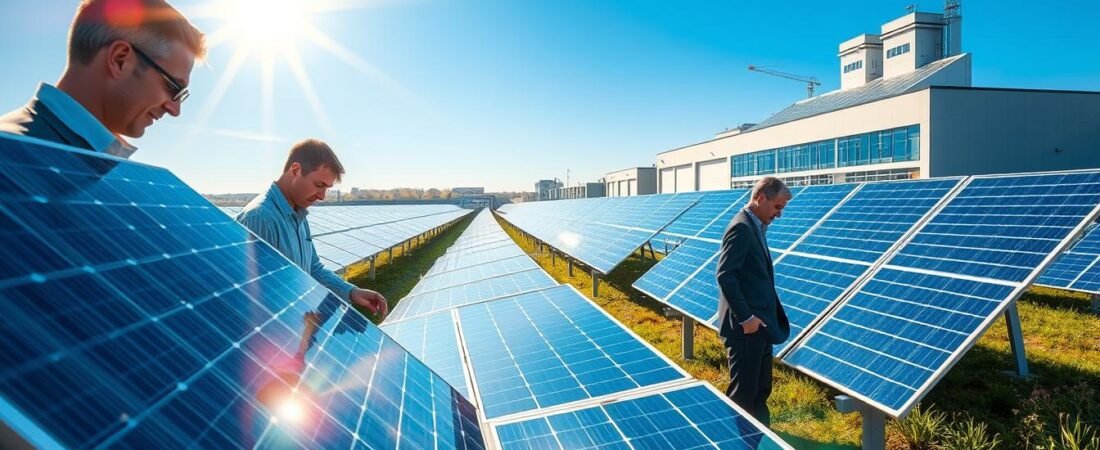
Modern renewable energy has reshaped how the United States and the world meet power needs. From 2007 to 2016, grid-connected PV rose from 7.7 GW to 320 GW, and module capacity hit 460 GW by 2021, with crystalline silicon making up 98% of production.
The largest manufacturers drove that growth by scaling production and cutting costs. They made panels more reliable and affordable for homes and businesses.
These leaders pushed technology forward, raising conversion efficiency and expanding factory output. Their work helped clean energy become practical for millions.
For a deeper look at how leading firms evolved and expanded capacity, see a review of leading solar energy firms and their strategies.
The Evolution of the Biggest Solar Panel Companies
The industry’s path was shaped by early movers who combined volume with technical progress.
Suntech Power led in the early 2010s, shipping over 1.5 GW of cells and proving that large-scale production could lower costs. By 2016, about 93% of global PV cell capacity used crystalline silicon, marking a major shift in manufacturing strategy.
As demand for clean energy grew, many a company expanded into battery storage and integrated systems. This move made rooftop installations more reliable and helped homeowners treat solar power as a real alternative to grid electricity.
- Early volume leaders enabled cost declines and wider market adoption.
- Integration of storage turned intermittent panels into steady power systems.
- Competition pushed manufacturers to innovate and increase annual revenue.
Historical Milestones in Photovoltaic Manufacturing
Foundational advances in cell design and factory scale transformed photovoltaic manufacturing into a global industry.
Early Market Dominance
In the early years, a few firms scaled up production and set the standard for mass adoption. Rapid adoption of crystalline methods drove cost declines and wider deployment.
By 2016, crystalline silicon made up about 93% of global PV cell manufacture. Regions like China and Taiwan provided roughly 68% of module demand that year, concentrating capacity and supply.
The Shift Toward Crystalline Silicon
The move to crystalline silicon improved both efficiency and reliability. Manufacturers that embraced this technology increased market share as panels became more cost-effective.
By 2021, crystalline silicon accounted for about 98% of module production capacity worldwide. That shift enabled mass production of solar cells and made clean energy deployment practical at scale.
- Standardized cell designs raised module efficiency and cut unit costs.
- Concentrated production capacity helped supply global demand quickly.
Current Global Leaders in Solar Production
A compact group of firms now shapes worldwide output and the reach of clean energy systems. Their choices on capacity, research, and product mix steer market trends and installations.
The Dominance of Chinese Manufacturers
China still drives module and cell output. In 2021 the country produced roughly 80% of polysilicon, 95% of wafers, 80% of cells, and 70% of modules.
This scale helps manufacturers meet global demand and control costs.
Emerging Industry Giants
Some firms post striking shipment volumes. JinkoSolar led the world list, shipping 47.2GWp in H1 2024.
Trina Solar, founded in 1997, shipped 34GWp in the same period and uses research to boost efficiency across panels and storage products.
Diversified Product Portfolios
Top manufacturers now bundle modules with storage and services. Canadian Solar focuses on homes and multi-country manufacturing, while First Solar targets high-capacity utility installations.
- Research and efficiency: companies invest in cells and modules to raise output per area.
- Storage integration: firms add batteries to offer steady electricity and new revenue streams.
- Market reach: diversified products help reach residential and utility projects worldwide.
The Rise of American Solar Manufacturing
A new wave of American plants now builds critical components for clean power systems.
First Solar leads U.S. production as the largest manufacturer of solar panels in the country. The Inflation Reduction Act ignited a manufacturing boom, driving a 619% jump in domestic capacity.
Global names like Canadian Solar and Jinko Solar have set up U.S. facilities. Trina Solar and others are also eyeing local production to balance global revenue with regional supply.
“The surge in domestic production means the U.S. can make competitive products while protecting supply chains and jobs.”
What this means: American output now covers cells, modules, and balance-of-system parts. That broad production base helps the market compete with world largest producers and supports long-term industry growth next year.
| Manufacturer | U.S. Presence | Primary Products |
|---|---|---|
| First Solar | Multiple plants | Modules, thin-film cells |
| Canadian Solar | Manufacturing & assembly | Modules, inverters |
| Jinko / Trina | Growing facilities | Cells, modules |
Technological Innovations Driving Efficiency
Recent breakthroughs in cell chemistry and module layout are lifting efficiency while cutting weight for rooftop and utility use.
Advancements in Cell and Module Design
Phosphorus-doped n-type cells now reduce recombination and boost conversion. This tweak helps cells run cooler and stay efficient longer.
Lightweight modules are another step forward. DAS Solar developed a 10.2kg product with 20.8% efficiency, ideal for a standard home roof where load and ease of install matter.
Manufacturers pair these cells with thinner frames and smarter wiring. The result: more power per square foot and simpler integration with battery storage systems.
| Innovation | Benefit | Example |
|---|---|---|
| Phosphorus n-type cell | Higher efficiency & longevity | Improved conversion rates in production |
| Lightweight modules | Faster installs, lower roof load | 10.2kg modules at ~20.8% efficiency |
| Integrated systems design | Reliable electricity with storage | Modules paired with batteries for homes |
Research and new manufacturing steps are helping producers meet growing global demand for clean energy. These innovations raise product value and open new revenue paths.
Supply Chain Dynamics and Global Competition
Global supply chains now decide which manufacturers can scale capacity and reach new markets. China controls over 80% of key inputs, so many firms watch that flow closely.
Some top names have diversified to reduce risk. Canadian Solar runs factories in Brazil, Indonesia, and the U.S. to keep production steady across countries.
First Solar and Trina Solar also moved capacity to other regions. That helps secure cells and modules when demand spikes or logistics slow down.
“Managing storage and logistics for modules is as important as product design for annual revenue.”
Manufacturers that link technology choices with solid supply networks win more contracts. In this market, ability to manage storage and quick delivery often beats a minor efficiency edge.
- Market reach: Local plants lower transport times and costs.
- Resilience: Multiple sites cut the impact of disruptions.
- Revenue: Reliable supply chains support steady sales growth.
As global competition tightens, the smartest manufacturers adapt both production and logistics. That balance shapes who leads the world market for panels, modules, and related products.
Challenges Facing the Modern Solar Industry
Uncertainty in rules and chokepoints in supply chains are the industry’s twin headaches. Policymakers and market planners must react fast when incentives shift.
Policy uncertainty and tax credits affect planning for plants, production, and installations. The U.S. residential tax credit ends after December 31, 2025, and some commercial credits require projects in service by the end of 2027.
That timeline makes it hard for manufacturers to commit capacity. First Solar and Trina Solar must time shipments and contracts to keep projects profitable.
Managing Global Supply Disruptions
Global supply disruptions can slow module and cell delivery. Companies often stockpile modules and panels to avoid delays, but that ties up cash and hurts short-term revenue.
Large names like Jinko Solar and Canadian Solar balance regional revenue and risk by spreading manufacturing across countries.
“Policy shifts and logistics delays can turn a ready project into a missed window.”
- Impact: Changing tax rules alter demand curves and ordering behavior.
- Response: Diversify plants and suppliers to keep production steady.
- Research into more efficient systems continues, but supply risk slows some work.
| Challenge | Effect on Market | Typical Response |
|---|---|---|
| Tax credit expiration | Short-term rushes; project timing risk | Accelerate installations; adjust capacity plans |
| Supply chain bottlenecks | Delivery delays; higher inventory costs | Multi-country sourcing; stockholding |
| Policy shifts across countries | Revenue uncertainty for manufacturers | Regional diversification; flexible contracts |
Conclusion
Ongoing factory upgrades and research investments are what keep production climbing worldwide.
These manufacturers turned early innovation into broad capacity growth. That shift cut costs and gave more homes access to reliable panels and clean energy.
The market still faces policy and supply risks, yet firms adapt with smarter manufacturing and diversified sites. New entrants keep the list of leaders in flux and push efficiency higher.
For anyone considering an installation, choosing a reputable company that pairs good panels with solid support matters. Continued innovation will help renewable energy keep its central role in the world’s power mix.