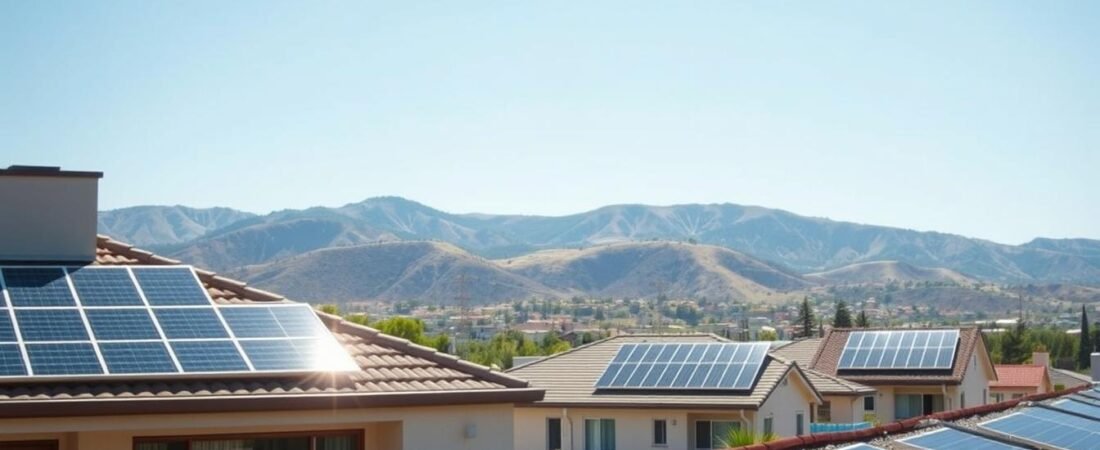
Numbers first: As of February 2026 the average installed price in Glendale, CA is $2.37 per watt. For a typical 13.03 kW system that works out to about $30,919 before incentives, with a common range of $26,281 to $35,557.
This guide is a practical, numbers-first way to budget before you talk to an installer. Installed here means equipment, design, labor, permits, and inspections so you won’t be surprised by extra line items.
Glendale pricing is not one fixed number. Cities with the same name exist in different states, and even ZIP codes and utility territories inside one state can change final pricing.
Two metrics matter most: total installed price and price per watt ($/W). We’ll also show which choices move the price — system size, equipment tier, roof complexity, and add-ons like batteries or EV charging.
Goal: pick a right-sized system for your home, then validate it with multiple quotes and clear assumptions. This is a buyer’s guide with quote-comparison tips, payback logic, and financing pathways to help you decide with confidence.
What “Glendale” solar pricing means in 2026 and why quotes can look so different
A $/W number is a starting point, not the whole story. Location, utility rules, sunshine, and local incentives all shift how that number turns into a real bill and payback.
Glendale, CA example: $2.37 per watt and what that includes
$2.37 per watt (Feb 2026) usually covers panels, inverter(s), racking, labor, and standard permitting and inspection fees. That figure reflects typical installation scopes used by local installers.
Glendale, AZ example: sunshine, local rates, and incentives
In Arizona, similar systems land near ~$2.84/W. High solar resource (about 6.5 peak sun hours/day) plus utility rates—APS (~15.30¢/kWh) or SRP (~12.50¢/kWh)—and a $1,000 state tax credit with tax exemptions make economics stronger.
Glendale, CO reality check and anchoring your estimate
In Colorado, prices can reach ~$4.00/W with longer payback (around 14 years) because of market, labor, and production differences. National averages can mislead.
Why two quotes differ: equipment brand, workmanship warranty, production assumptions, financing fees, and included add‑ons.
Anchor checklist:
- ZIP code and utility name
- Last 12 months kWh usage
- Roof layout and shading
- Desired offset (70% vs 100%)
Bottom line: the most accurate estimate ties to your home’s electricity use and local rates — not just a headline per watt figure.
solar panel cost glendale: current price benchmarks and realistic ranges
Use local benchmarks to turn headline rates into a realistic budget for your home.
Average installed cost per watt and what “installed” covers
Installed cost per watt means the total quoted price divided by system kilowatts. It bundles equipment, labor, permits, racking, inverter(s), and standard inspections.
Watch for missing items: interconnection fees, panel-level optimizers, roof flashing, or panel removal and reset.
Typical total price range for an average-sized system
Using Glendale, CA as a benchmark: at $2.37/W a 13.03 kW system ≈ $30,919 before incentives. Typical local ranges run $26,281 to $35,557 because site specifics change labor and hardware needs.
By contrast, in Glendale, CO averages can approach ~$4.00/W (a 5.1 kW job ≈ $14,252 with ~14-year payback), showing how markets vary.
How to compare quotes apples-to-apples using $/W
Normalize every bid to $/W and confirm system size, inverter type, expected annual kWh, and warranty terms.
| Metric | Example A | Example B |
|---|---|---|
| System kW | 13.03 | 5.10 |
| Total price (pre-incentive) | $30,919 | $14,252 |
| $ per watt | $2.37 | $4.00 |
| Key variables | Complex roof, premium modules | Market and labor differences |
| Expected payback | Varies by utility | ~14 years |
What raises price: premium modules, complex roof work, main panel upgrades, long conduit runs, and battery backup.
What lowers price: simple roof planes, standard bundles, easy interconnection, and competitive bids.
Treat the purchase as a long-term investment. The lowest bid may not deliver the best long-term production or warranties. Track every quote in a simple table and compare using normalized $/W metrics.
For local reference and recent averages, see Glendale pricing data.
System size and your electric bill: how many panels you actually need
Your utility bills hold the answer. Start by adding up the last 12 months of electricity (kWh). That annual total converts directly into a target system size using local production numbers.
How to use past bills to estimate size
Divide annual kWh by your area’s annual production per kW. The result is the system size in kW you need to meet 100% of usage. Choose a lower offset (70–90%) to save money and avoid oversizing.
Cost examples and scaling
Below are Glendale, CA examples to show scaling and why $/W matters more than total price.
| System size (kW) | Approx price (pre-incentive) | Notes |
|---|---|---|
| 3 kW | $7,117 | Small home loads |
| 5 kW | $11,861 | Common starter system |
| 8.5 kW | $20,110 | Typical medium home (Glendale, AZ ≈ $24,173 pre-credit) |
| 10 kW | $23,723 | Larger households or EV loads |
Home size scenarios and limits
Small, medium, or large homes give quick context, but habits and HVAC/EV use drive true needs.
“Match proposed kW to your annual kWh. If a quote is far higher, ask why.”
How many panels? That depends on panel wattage and roof layout. Higher-watt modules cut panel count when space is tight.
Production limits—roof area, shading, fire setbacks, HOA rules, or interconnection caps—can reduce achievable offset. Always sanity-check proposed kW against your real annual usage and local production assumptions.
What drives solar panel system costs beyond size
Equipment choices and add-ons often explain why two similar-sized systems come with very different price tags. Understanding these factors helps you compare bids like a pro.
Panel efficiency and brand tiers
Higher-efficiency modules cost more up front but produce more energy per square foot. That matters when roof space is tight.
Premium brands often offer longer warranties and slightly better output. For small roofs, paying more can be worth it.
Inverters, racking, and hidden balance-of-system items
String inverters are cheaper. Microinverters and optimizers improve shade performance and monitoring but raise the price.
Don’t forget racking quality, roof attachments, flashing, and monitoring subscriptions. These hidden items add up fast.
Add-ons that change the budget fast
- Battery storage increases self-consumption and backup capability, but it’s a large incremental expense.
- EV chargers are a common bundle that raises the project scope and wiring needs.
Prioritize—right-size first, match equipment to roof and utility plan, then add storage if it fits your goals. Ask every installer for an itemized proposal so the panel system, inverter, and extras are shown line by line.
Roof and installation realities that affect your final price
Your roof and how crews work on it directly shape the final price and schedule for a home installation. Small differences in material, age, or structure can turn a simple job into a multi‑step project.
Roof condition, material, and structure
If a roof has limited remaining life, pairing a re-roof with the install often saves money over two separate removals and resets. Ask for a quote that shows re-roofing line items so you can compare bundled vs staged approaches.
Asphalt shingle roofs are fastest and cheapest to work on. Tile, slate, or metal require more labor and special attachments, which raise labor time and final installation fees.
Older rafters, long spans, or signs of rot can trigger structural reviews or engineering letters. Those add both time and explicit line items to the proposal.
Shading, tilt, and orientation
Shade, roof pitch, and orientation directly cut production. If your roof loses output, installers may propose a larger system — more modules — to hit your offset goal.
Microinverters, optimizers, or different module layouts can mitigate shade but increase upfront costs. Compare energy estimates to see which tradeoffs make sense for your roof and budget.
Permits, inspections, and realistic timelines
Typical sequence: site survey → design → permits → install → inspection → utility PTO. Permitting and inspections are standard and should be listed in proposals.
- Get a written timeline and ask who files permits and pays re-inspection fees.
- Local permit backlogs and seasons can add weeks of delay; plan project time around them.
- Confirm expected time to PTO in the contract so you know when the system will start earning savings.
“Ask installers to itemize work and show who handles permits — that prevents surprises and keeps the project on schedule.”
Incentives, tax credits, and exemptions that reduce upfront solar costs
Knowing which credits and exemptions apply will change your net out‑of‑pocket number fast. These benefits fall into three groups that affect payment timing and long‑term savings.
How rebates, credits, and exemptions differ
Rebates reduce the price at purchase or come as a post‑install check. They lower your upfront payment directly.
Tax credits reduce your state or federal tax bill. They lower what you owe, not your refund if the credit is nonrefundable.
Tax exemptions remove value from your assessed property or sales tax, protecting long‑term savings or cutting the final purchase charge.
Arizona’s $1,000 state tax credit
Key rule: the Arizona Credit for Solar Energy Devices is the lesser of $1,000 or 25% of the installed price. It is nonrefundable, so it can only reduce state tax liability to zero.
Sales tax vs property tax exemptions
Arizona waives state sales tax (state rate ~5.6%) on eligible systems, which trims the upfront bill. Local taxes may still apply.
The property tax exemption keeps added system value off your home assessment, preserving long‑term savings and avoiding higher annual taxes.
Practical tips for homeowners
- Incentives vary by city, county, and utility—verify at your exact address and utility territory.
- Ownership matters: if you lease or sign a PPA, the provider may claim credits and pass some savings to you.
- Ask installers for a clear “net cost” summary: pre‑incentive price, each assumed credit, and the final net price.
“Get an itemized net cost and keep copies of contracts and receipts for tax time.”
Quick document checklist for tax filings: contracts, paid invoices, receipts, and relevant state forms (Arizona Form 310 or current equivalent).
Net metering vs net billing: how Glendale utilities impact savings
How your utility credits exported power has a big impact on long‑term savings.
Net metering gives exports a 1:1 retail credit. Net billing credits exports below retail, reducing monthly savings and changing design choices.
Core takeaway: under net billing, maximize onsite use of generated power rather than exporting it for a lower credit. Increasing self‑consumption often beats exporting to the grid.
APS example
APS uses net billing. Exports are credited at $0.06857/kWh with a 10‑year lock on that rate. There is also a Grid Access Charge of $0.242 per kW DC monthly, billed by system size. Those fees and the lower export rate cut expected savings compared with full retail credits.
SRP example
SRP export credits vary by season and TOU plan, roughly $0.02–$0.06/kWh. The value you get depends on when you export and which rate schedule you choose.
Why time-of-use rates change the best design
TOU plans shift value to certain hours. West‑facing arrays or storage can add value by producing or discharging when electricity rates are highest.
“Ask installers which rate plan, export credit, and utility fees they modeled — assumptions change savings a lot.”
- Ask: which rate plan is assumed?
- Ask: what export credit did you model?
- Ask: are grid charges or annual true‑ups included in projections?
Remember annual true‑ups and limited rollover policies. Monthly credits may not accumulate indefinitely, so verify how credits reset or pay out each year.
Payback period and long-term savings: what to expect over 25 to 30 years
A realistic payback estimate helps you judge whether an installation is a solid long‑term investment for your home. It shows when cumulative bill reductions exceed the net price you paid and frames that purchase as an investment, not just a purchase.
Typical payback ranges and example outcomes
Actual payback periods vary a lot by market and assumptions. For one local California example, the payback period is about 5.43 years with estimated 25‑year savings near $268,903.
By contrast, a Colorado example shows a payback near 14.0 years and roughly $15,839 in 25‑year savings on a smaller system. These contrasts show how location and rates shift returns.
Why rising rates improve returns
When electricity prices rise, each kilowatt-hour you offset becomes more valuable. Arizona rates climbed about 19% since 2021, which helps shorten the payback and boost long‑term savings in many projections.
Reading savings projections: the assumptions that matter
Payback measures when cumulative savings exceed net investment. It is useful but not the whole story. Look for the escalation rate, modeled rate plan, degradation, and replacement costs used in any projection.
- Production estimates and shading.
- System degradation and inverter replacements.
- Export credit changes and utility fee patterns.
- Future household usage (for example, adding an EV).
“Compare conservative and optimistic scenarios so you don’t rely on best‑case modeling alone.”
Think in 25–30 year terms: panels often run that long, so this is about long‑term money management. Ask installers for both baseline and conservative models before you decide.
Paying for solar: cash, solar loans, leases, and PPAs
Your payment choice matters. It determines who owns the system, who claims tax benefits, and how your monthly bills change.
Cash purchase
Buying with cash gives the largest lifetime savings. You pay no interest, own the equipment, and claim federal tax credit and other incentives directly.
Solar loans
$0‑down loans start immediate savings by reducing your utility bill day one. Expect interest and possible dealer fees that raise total paid versus cash.
Leases and PPAs
Leases and PPAs offer low or no upfront payments and often include maintenance. A third‑party company owns the system and usually claims the tax credit, then may pass some value to you.
Example: Palmetto and similar providers offer lease options in parts of APS and SRP territories.
Incentive flow and bill comparison
Who gets incentives: owner gets tax credit and rebates; third‑party owners claim them in lease/PPA deals.
“Compare current electric bill to expected post‑installation utility charges plus any loan or lease payment.”
Ask every installer for a financing disclosure showing APR, term, total paid, and any escalators before signing.
Choosing a solar installer and getting the best price
Getting several bids uncovers hidden scope items and gives you real market leverage. Multiple quotes help you validate $/W, compare equipment, and spot vague line items before signing.
Why multiple quotes matter
Competition reveals true market price and prevents overpaying. It also shows which companies include full installation, permits, and inspections versus raises later.
What to check in each proposal
- Equipment: panel model, inverter model, and monitoring details.
- System size (kW DC) and estimated annual production (kWh).
- Full “installed” inclusions: permits, inspections, racking, and labor.
- Workmanship warranty length and response expectations.
- Ask for examples from the same utility area (NRG Clean Power, Sunergy, Solar Optimum, Evolution Energy, American Array Solar and Roofing).
Contract red flags and local vs national tradeoffs
Watch for escalator clauses, vague allowances, surprise permitting fees, or unclear change‑order triggers for electrical upgrades.
National companies may have price leverage. Local companies often give faster service and tailored installs. Balance price, service, and warranty when you choose a company.
“Score each bid by $/W, equipment quality, warranty/service, production realism, and contract clarity.”
Want one place to compare options? See service options to explore local offerings and next steps.
Conclusion
A good purchase starts with three numbers you can verify in minutes: your annual kWh, a best $/W quote, and a realistic payback under your utility’s export rules.
Match the system to your roof, usage, and rate plan rather than chasing averages. Confirm shading, modeled export credits, and any local incentives before signing.
Remember incentives and billing rules vary by location and utility. Arizona credits and sales/property exemptions can boost savings, while different net billing rules change value fast.
Next steps: gather 2–4 quotes, compare them apples‑to‑apples, and pick the design that helps you save money over 25–30 years. Leave room for future expansion if you expect more EV or appliance electrification.
FAQ
What does Glendale solar pricing mean in 2026 and why do quotes vary so much?
How does the .37 per watt example for Glendale, CA break down?
How do assumptions for Glendale, AZ affect projected savings?
Why are prices higher and payback periods longer in Glendale, CO examples?
How can I anchor every estimate to my ZIP code, utility, and usage?
What does "installed cost per watt" include?
What is a typical total price range for an average residential system?
How do I compare quotes apples-to-apples using $/W?
How many panels will my home need to offset my electric bill?
How do cost examples change by system kW size?
What typical kW targets match different home sizes?
Why might roof space or local rules cap my system size?
How do panel efficiency and brand affect price and production?
Where do hidden costs like inverters and racking show up?
How do batteries and EV chargers change the budget?
How does roof condition affect final pricing?
How do shading, tilt, and orientation impact how many modules I need?
What permitting and inspection steps affect project timeline?
How does Arizona’s
What does Glendale solar pricing mean in 2026 and why do quotes vary so much?
Pricing in 2026 reflects local utility rates, labor, permit fees, equipment brand and efficiency, and available incentives. Quotes differ because installers use different panel and inverter brands, assume different system sizes, and apply varying labor and permitting costs. Always ask vendors to break down equipment, labor, permits, and incentives so you can compare line-by-line.How does the .37 per watt example for Glendale, CA break down?That $/W example typically includes modules, inverter, racking, basic electrical work, permitting, and standard installation labor. It may exclude upgrades like structural reinforcement, batteries, or EV chargers. Confirm whether it includes sales tax, interconnection fees, and the federal investment tax credit application support.How do assumptions for Glendale, AZ affect projected savings?Glendale, AZ estimates assume higher sun hours, which boosts output, plus state incentives and local utility export rules. They also factor in utility rates—higher retail rates improve payback. Ask how many sun hours and what utility rate the installer used to model production and savings.Why are prices higher and payback periods longer in Glendale, CO examples?Colder climates or higher labor and permit costs can raise per-watt prices. Fewer annual sun hours reduce energy production, which lengthens payback. Local incentives or net-metering rules may also be less favorable, affecting returns.How can I anchor every estimate to my ZIP code, utility, and usage?Provide installers your ZIP code and 12 months of utility bills. This lets them model production with local irradiance data and apply your exact tariff, fees, and incentives. Ask for a performance estimate in kWh and a financial summary using your current rates.What does "installed cost per watt" include?Installed $/W usually covers modules, inverter, racking, wiring, labor, permits, and standard interconnection paperwork. It often excludes optional upgrades, structural work, batteries, and extended warranties. Verify what’s included in each quote.What is a typical total price range for an average residential system?A typical range depends on system size, equipment tier, and roof complexity. For many homes the installed total can vary widely. Key drivers are panel efficiency, inverter type, roof accessibility, and added components like batteries or EV chargers.How do I compare quotes apples-to-apples using $/W?Ensure each quote uses the same system kW size, includes the same equipment tiers, and lists the same inclusions—permits, warranties, monitoring, and taxes. Compare net price after incentives to see true out-of-pocket cost and ask for modeled annual kWh production.How many panels will my home need to offset my electric bill?Use your annual kWh usage from past bills to estimate system size. Divide annual usage by expected annual production per kW in your area (kWh/kW). Installers can model this precisely using address-based sunlight and shading data to recommend a kW target and panel count.How do cost examples change by system kW size?Per-watt prices often decline slightly as system size increases due to fixed costs spreading over more watts. Small systems can show higher $/W. Ask for sample pricing for 4 kW, 6 kW, and 10 kW scenarios to see scaling effects and estimated annual production.What typical kW targets match different home sizes?A small home with low usage might target 3–5 kW. Average households often aim for 5–8 kW. Large or high-usage homes may need 8–12 kW or more. Your installer should tailor the size to your bills, roof space, and budget.Why might roof space or local rules cap my system size?Roof orientation, shading, and available square footage limit how many modules you can install. Local zoning, HOA rules, or utility interconnection caps can also restrict system size. In constrained cases, higher-efficiency modules or ground-mounted systems may help.How do panel efficiency and brand affect price and production?Higher-efficiency and premium-brand modules cost more but produce more power per square foot and may degrade slower. Lower-cost modules reduce upfront price but may need more roof area for the same output. Balance budget with long-term production needs.Where do hidden costs like inverters and racking show up?Inverters, rapid shutdown devices, performance monitoring, and durable racking add to the bill. Microinverters or power optimizers cost more than string inverters but can improve shade performance. Ensure proposals list inverter model, warranty, and replacement terms.How do batteries and EV chargers change the budget?Batteries add significant upfront cost but increase self-consumption and backup capability. EV chargers are a modest add-on that supports home electrification. Both can improve utility bill savings depending on time-of-use rates and vehicle charging habits.How does roof condition affect final pricing?If your roof needs repair or replacement, installers may pause installation until it’s fixed, or include a reroof in the quote. Structural reinforcement for heavy systems raises cost. A pre-install roof inspection can prevent surprise upgrade charges.How do shading, tilt, and orientation impact how many modules I need?Shading reduces output and may require more modules or different module/inverter choices to meet goals. Optimal tilt and southern orientation yield higher production; sites with poor orientation need more capacity to reach the same annual kWh.What permitting and inspection steps affect project timeline?Typical steps: site survey, permit submission, utility interconnection application, installation, inspection, and final utility approval. Permit and utility review times vary by jurisdiction and can add several weeks to the schedule.How does Arizona’s
FAQ
What does Glendale solar pricing mean in 2026 and why do quotes vary so much?
Pricing in 2026 reflects local utility rates, labor, permit fees, equipment brand and efficiency, and available incentives. Quotes differ because installers use different panel and inverter brands, assume different system sizes, and apply varying labor and permitting costs. Always ask vendors to break down equipment, labor, permits, and incentives so you can compare line-by-line.
How does the .37 per watt example for Glendale, CA break down?
That $/W example typically includes modules, inverter, racking, basic electrical work, permitting, and standard installation labor. It may exclude upgrades like structural reinforcement, batteries, or EV chargers. Confirm whether it includes sales tax, interconnection fees, and the federal investment tax credit application support.
How do assumptions for Glendale, AZ affect projected savings?
Glendale, AZ estimates assume higher sun hours, which boosts output, plus state incentives and local utility export rules. They also factor in utility rates—higher retail rates improve payback. Ask how many sun hours and what utility rate the installer used to model production and savings.
Why are prices higher and payback periods longer in Glendale, CO examples?
Colder climates or higher labor and permit costs can raise per-watt prices. Fewer annual sun hours reduce energy production, which lengthens payback. Local incentives or net-metering rules may also be less favorable, affecting returns.
How can I anchor every estimate to my ZIP code, utility, and usage?
Provide installers your ZIP code and 12 months of utility bills. This lets them model production with local irradiance data and apply your exact tariff, fees, and incentives. Ask for a performance estimate in kWh and a financial summary using your current rates.
What does "installed cost per watt" include?
Installed $/W usually covers modules, inverter, racking, wiring, labor, permits, and standard interconnection paperwork. It often excludes optional upgrades, structural work, batteries, and extended warranties. Verify what’s included in each quote.
What is a typical total price range for an average residential system?
A typical range depends on system size, equipment tier, and roof complexity. For many homes the installed total can vary widely. Key drivers are panel efficiency, inverter type, roof accessibility, and added components like batteries or EV chargers.
How do I compare quotes apples-to-apples using $/W?
Ensure each quote uses the same system kW size, includes the same equipment tiers, and lists the same inclusions—permits, warranties, monitoring, and taxes. Compare net price after incentives to see true out-of-pocket cost and ask for modeled annual kWh production.
How many panels will my home need to offset my electric bill?
Use your annual kWh usage from past bills to estimate system size. Divide annual usage by expected annual production per kW in your area (kWh/kW). Installers can model this precisely using address-based sunlight and shading data to recommend a kW target and panel count.
How do cost examples change by system kW size?
Per-watt prices often decline slightly as system size increases due to fixed costs spreading over more watts. Small systems can show higher $/W. Ask for sample pricing for 4 kW, 6 kW, and 10 kW scenarios to see scaling effects and estimated annual production.
What typical kW targets match different home sizes?
A small home with low usage might target 3–5 kW. Average households often aim for 5–8 kW. Large or high-usage homes may need 8–12 kW or more. Your installer should tailor the size to your bills, roof space, and budget.
Why might roof space or local rules cap my system size?
Roof orientation, shading, and available square footage limit how many modules you can install. Local zoning, HOA rules, or utility interconnection caps can also restrict system size. In constrained cases, higher-efficiency modules or ground-mounted systems may help.
How do panel efficiency and brand affect price and production?
Higher-efficiency and premium-brand modules cost more but produce more power per square foot and may degrade slower. Lower-cost modules reduce upfront price but may need more roof area for the same output. Balance budget with long-term production needs.
Where do hidden costs like inverters and racking show up?
Inverters, rapid shutdown devices, performance monitoring, and durable racking add to the bill. Microinverters or power optimizers cost more than string inverters but can improve shade performance. Ensure proposals list inverter model, warranty, and replacement terms.
How do batteries and EV chargers change the budget?
Batteries add significant upfront cost but increase self-consumption and backup capability. EV chargers are a modest add-on that supports home electrification. Both can improve utility bill savings depending on time-of-use rates and vehicle charging habits.
How does roof condition affect final pricing?
If your roof needs repair or replacement, installers may pause installation until it’s fixed, or include a reroof in the quote. Structural reinforcement for heavy systems raises cost. A pre-install roof inspection can prevent surprise upgrade charges.
How do shading, tilt, and orientation impact how many modules I need?
Shading reduces output and may require more modules or different module/inverter choices to meet goals. Optimal tilt and southern orientation yield higher production; sites with poor orientation need more capacity to reach the same annual kWh.
What permitting and inspection steps affect project timeline?
Typical steps: site survey, permit submission, utility interconnection application, installation, inspection, and final utility approval. Permit and utility review times vary by jurisdiction and can add several weeks to the schedule.
How does Arizona’s
FAQ
What does Glendale solar pricing mean in 2026 and why do quotes vary so much?
Pricing in 2026 reflects local utility rates, labor, permit fees, equipment brand and efficiency, and available incentives. Quotes differ because installers use different panel and inverter brands, assume different system sizes, and apply varying labor and permitting costs. Always ask vendors to break down equipment, labor, permits, and incentives so you can compare line-by-line.
How does the $2.37 per watt example for Glendale, CA break down?
That $/W example typically includes modules, inverter, racking, basic electrical work, permitting, and standard installation labor. It may exclude upgrades like structural reinforcement, batteries, or EV chargers. Confirm whether it includes sales tax, interconnection fees, and the federal investment tax credit application support.
How do assumptions for Glendale, AZ affect projected savings?
Glendale, AZ estimates assume higher sun hours, which boosts output, plus state incentives and local utility export rules. They also factor in utility rates—higher retail rates improve payback. Ask how many sun hours and what utility rate the installer used to model production and savings.
Why are prices higher and payback periods longer in Glendale, CO examples?
Colder climates or higher labor and permit costs can raise per-watt prices. Fewer annual sun hours reduce energy production, which lengthens payback. Local incentives or net-metering rules may also be less favorable, affecting returns.
How can I anchor every estimate to my ZIP code, utility, and usage?
Provide installers your ZIP code and 12 months of utility bills. This lets them model production with local irradiance data and apply your exact tariff, fees, and incentives. Ask for a performance estimate in kWh and a financial summary using your current rates.
What does "installed cost per watt" include?
Installed $/W usually covers modules, inverter, racking, wiring, labor, permits, and standard interconnection paperwork. It often excludes optional upgrades, structural work, batteries, and extended warranties. Verify what’s included in each quote.
What is a typical total price range for an average residential system?
A typical range depends on system size, equipment tier, and roof complexity. For many homes the installed total can vary widely. Key drivers are panel efficiency, inverter type, roof accessibility, and added components like batteries or EV chargers.
How do I compare quotes apples-to-apples using $/W?
Ensure each quote uses the same system kW size, includes the same equipment tiers, and lists the same inclusions—permits, warranties, monitoring, and taxes. Compare net price after incentives to see true out-of-pocket cost and ask for modeled annual kWh production.
How many panels will my home need to offset my electric bill?
Use your annual kWh usage from past bills to estimate system size. Divide annual usage by expected annual production per kW in your area (kWh/kW). Installers can model this precisely using address-based sunlight and shading data to recommend a kW target and panel count.
How do cost examples change by system kW size?
Per-watt prices often decline slightly as system size increases due to fixed costs spreading over more watts. Small systems can show higher $/W. Ask for sample pricing for 4 kW, 6 kW, and 10 kW scenarios to see scaling effects and estimated annual production.
What typical kW targets match different home sizes?
A small home with low usage might target 3–5 kW. Average households often aim for 5–8 kW. Large or high-usage homes may need 8–12 kW or more. Your installer should tailor the size to your bills, roof space, and budget.
Why might roof space or local rules cap my system size?
Roof orientation, shading, and available square footage limit how many modules you can install. Local zoning, HOA rules, or utility interconnection caps can also restrict system size. In constrained cases, higher-efficiency modules or ground-mounted systems may help.
How do panel efficiency and brand affect price and production?
Higher-efficiency and premium-brand modules cost more but produce more power per square foot and may degrade slower. Lower-cost modules reduce upfront price but may need more roof area for the same output. Balance budget with long-term production needs.
Where do hidden costs like inverters and racking show up?
Inverters, rapid shutdown devices, performance monitoring, and durable racking add to the bill. Microinverters or power optimizers cost more than string inverters but can improve shade performance. Ensure proposals list inverter model, warranty, and replacement terms.
How do batteries and EV chargers change the budget?
Batteries add significant upfront cost but increase self-consumption and backup capability. EV chargers are a modest add-on that supports home electrification. Both can improve utility bill savings depending on time-of-use rates and vehicle charging habits.
How does roof condition affect final pricing?
If your roof needs repair or replacement, installers may pause installation until it’s fixed, or include a reroof in the quote. Structural reinforcement for heavy systems raises cost. A pre-install roof inspection can prevent surprise upgrade charges.
How do shading, tilt, and orientation impact how many modules I need?
Shading reduces output and may require more modules or different module/inverter choices to meet goals. Optimal tilt and southern orientation yield higher production; sites with poor orientation need more capacity to reach the same annual kWh.
What permitting and inspection steps affect project timeline?
Typical steps: site survey, permit submission, utility interconnection application, installation, inspection, and final utility approval. Permit and utility review times vary by jurisdiction and can add several weeks to the schedule.
How does Arizona’s $1,000 state tax credit work and what are limitations?
The state credit reduces your state income tax liability up to $1,000 and often requires documentation of installed equipment. It may have eligibility limits based on system size or installation date. Consult a tax professional and your installer for current rules.
Are there sales tax or property tax exemptions I should know about?
Many states exempt residential renewable energy systems from sales tax or property tax increases tied to added home value. These rules differ by state and county, so confirm with local authorities or your installer which exemptions apply to your project.
How much do incentives vary by city, county, and utility?
Incentives can differ greatly—some utilities offer rebates, performance payments, or enhanced export credits. Municipal programs or local solar co-ops sometimes add savings. Always check your utility and local government websites or ask installers to list all applicable incentives.
What’s the difference between net metering and net billing?
Net metering credits exported energy at near-retail rates, reducing your bill dollar-for-dollar. Net billing credits exports at a lower wholesale or fixed export rate, which reduces the value of excess generation. The rate structure affects system sizing and payback.
How do APS and SRP export credit rules change savings?
Arizona Public Service (APS) and Salt River Project (SRP) have different export credit rates, interconnection fees, and program rules. These differences affect the value of generated energy and whether you benefit more from storage or system sizing to match on-site consumption.
,000 state tax credit work and what are limitations?
The state credit reduces your state income tax liability up to
FAQ
What does Glendale solar pricing mean in 2026 and why do quotes vary so much?
Pricing in 2026 reflects local utility rates, labor, permit fees, equipment brand and efficiency, and available incentives. Quotes differ because installers use different panel and inverter brands, assume different system sizes, and apply varying labor and permitting costs. Always ask vendors to break down equipment, labor, permits, and incentives so you can compare line-by-line.
How does the $2.37 per watt example for Glendale, CA break down?
That $/W example typically includes modules, inverter, racking, basic electrical work, permitting, and standard installation labor. It may exclude upgrades like structural reinforcement, batteries, or EV chargers. Confirm whether it includes sales tax, interconnection fees, and the federal investment tax credit application support.
How do assumptions for Glendale, AZ affect projected savings?
Glendale, AZ estimates assume higher sun hours, which boosts output, plus state incentives and local utility export rules. They also factor in utility rates—higher retail rates improve payback. Ask how many sun hours and what utility rate the installer used to model production and savings.
Why are prices higher and payback periods longer in Glendale, CO examples?
Colder climates or higher labor and permit costs can raise per-watt prices. Fewer annual sun hours reduce energy production, which lengthens payback. Local incentives or net-metering rules may also be less favorable, affecting returns.
How can I anchor every estimate to my ZIP code, utility, and usage?
Provide installers your ZIP code and 12 months of utility bills. This lets them model production with local irradiance data and apply your exact tariff, fees, and incentives. Ask for a performance estimate in kWh and a financial summary using your current rates.
What does "installed cost per watt" include?
Installed $/W usually covers modules, inverter, racking, wiring, labor, permits, and standard interconnection paperwork. It often excludes optional upgrades, structural work, batteries, and extended warranties. Verify what’s included in each quote.
What is a typical total price range for an average residential system?
A typical range depends on system size, equipment tier, and roof complexity. For many homes the installed total can vary widely. Key drivers are panel efficiency, inverter type, roof accessibility, and added components like batteries or EV chargers.
How do I compare quotes apples-to-apples using $/W?
Ensure each quote uses the same system kW size, includes the same equipment tiers, and lists the same inclusions—permits, warranties, monitoring, and taxes. Compare net price after incentives to see true out-of-pocket cost and ask for modeled annual kWh production.
How many panels will my home need to offset my electric bill?
Use your annual kWh usage from past bills to estimate system size. Divide annual usage by expected annual production per kW in your area (kWh/kW). Installers can model this precisely using address-based sunlight and shading data to recommend a kW target and panel count.
How do cost examples change by system kW size?
Per-watt prices often decline slightly as system size increases due to fixed costs spreading over more watts. Small systems can show higher $/W. Ask for sample pricing for 4 kW, 6 kW, and 10 kW scenarios to see scaling effects and estimated annual production.
What typical kW targets match different home sizes?
A small home with low usage might target 3–5 kW. Average households often aim for 5–8 kW. Large or high-usage homes may need 8–12 kW or more. Your installer should tailor the size to your bills, roof space, and budget.
Why might roof space or local rules cap my system size?
Roof orientation, shading, and available square footage limit how many modules you can install. Local zoning, HOA rules, or utility interconnection caps can also restrict system size. In constrained cases, higher-efficiency modules or ground-mounted systems may help.
How do panel efficiency and brand affect price and production?
Higher-efficiency and premium-brand modules cost more but produce more power per square foot and may degrade slower. Lower-cost modules reduce upfront price but may need more roof area for the same output. Balance budget with long-term production needs.
Where do hidden costs like inverters and racking show up?
Inverters, rapid shutdown devices, performance monitoring, and durable racking add to the bill. Microinverters or power optimizers cost more than string inverters but can improve shade performance. Ensure proposals list inverter model, warranty, and replacement terms.
How do batteries and EV chargers change the budget?
Batteries add significant upfront cost but increase self-consumption and backup capability. EV chargers are a modest add-on that supports home electrification. Both can improve utility bill savings depending on time-of-use rates and vehicle charging habits.
How does roof condition affect final pricing?
If your roof needs repair or replacement, installers may pause installation until it’s fixed, or include a reroof in the quote. Structural reinforcement for heavy systems raises cost. A pre-install roof inspection can prevent surprise upgrade charges.
How do shading, tilt, and orientation impact how many modules I need?
Shading reduces output and may require more modules or different module/inverter choices to meet goals. Optimal tilt and southern orientation yield higher production; sites with poor orientation need more capacity to reach the same annual kWh.
What permitting and inspection steps affect project timeline?
Typical steps: site survey, permit submission, utility interconnection application, installation, inspection, and final utility approval. Permit and utility review times vary by jurisdiction and can add several weeks to the schedule.
How does Arizona’s $1,000 state tax credit work and what are limitations?
The state credit reduces your state income tax liability up to $1,000 and often requires documentation of installed equipment. It may have eligibility limits based on system size or installation date. Consult a tax professional and your installer for current rules.
Are there sales tax or property tax exemptions I should know about?
Many states exempt residential renewable energy systems from sales tax or property tax increases tied to added home value. These rules differ by state and county, so confirm with local authorities or your installer which exemptions apply to your project.
How much do incentives vary by city, county, and utility?
Incentives can differ greatly—some utilities offer rebates, performance payments, or enhanced export credits. Municipal programs or local solar co-ops sometimes add savings. Always check your utility and local government websites or ask installers to list all applicable incentives.
What’s the difference between net metering and net billing?
Net metering credits exported energy at near-retail rates, reducing your bill dollar-for-dollar. Net billing credits exports at a lower wholesale or fixed export rate, which reduces the value of excess generation. The rate structure affects system sizing and payback.
How do APS and SRP export credit rules change savings?
Arizona Public Service (APS) and Salt River Project (SRP) have different export credit rates, interconnection fees, and program rules. These differences affect the value of generated energy and whether you benefit more from storage or system sizing to match on-site consumption.
,000 and often requires documentation of installed equipment. It may have eligibility limits based on system size or installation date. Consult a tax professional and your installer for current rules.
Are there sales tax or property tax exemptions I should know about?
Many states exempt residential renewable energy systems from sales tax or property tax increases tied to added home value. These rules differ by state and county, so confirm with local authorities or your installer which exemptions apply to your project.
How much do incentives vary by city, county, and utility?
Incentives can differ greatly—some utilities offer rebates, performance payments, or enhanced export credits. Municipal programs or local solar co-ops sometimes add savings. Always check your utility and local government websites or ask installers to list all applicable incentives.
What’s the difference between net metering and net billing?
Net metering credits exported energy at near-retail rates, reducing your bill dollar-for-dollar. Net billing credits exports at a lower wholesale or fixed export rate, which reduces the value of excess generation. The rate structure affects system sizing and payback.
How do APS and SRP export credit rules change savings?
Arizona Public Service (APS) and Salt River Project (SRP) have different export credit rates, interconnection fees, and program rules. These differences affect the value of generated energy and whether you benefit more from storage or system sizing to match on-site consumption.
Why do time-of-use rates change the best system design?
Q: What payback periods should homeowners expect over 25–30 years?
Payback varies by system price, incentives, electricity rates, and production. Many homeowners see payback windows between 6 and 15 years, but local rates and incentives can push this shorter or longer. After payback, energy generated is effectively a long-term savings stream.
Q: How do rising electricity rates affect long-term returns?
Higher future electricity rates increase the value of produced energy, improving project returns and shrinking payback. Installers often model a conservative annual rate escalation—review those assumptions because they strongly influence projected savings.
Q: How should I evaluate “savings” projections in proposals?
Check assumptions: annual production (kWh), utility rate escalation, export credit rate, and whether incentives are included. Ask for sensitivity scenarios (pessimistic, base, optimistic) and confirm production guarantees or warranties tied to output.
Q: What are the pros and cons of cash purchase?
Cash purchases typically yield the highest long-term savings and full incentive eligibility since you own the system. The downside is the large upfront payment. Weigh opportunity cost versus guaranteed electricity bill reductions and incentives you’ll claim on taxes.
Q: How do solar loans compare and what are common loan features?
Loans let you spread payments with options for
FAQ
What does Glendale solar pricing mean in 2026 and why do quotes vary so much?
Pricing in 2026 reflects local utility rates, labor, permit fees, equipment brand and efficiency, and available incentives. Quotes differ because installers use different panel and inverter brands, assume different system sizes, and apply varying labor and permitting costs. Always ask vendors to break down equipment, labor, permits, and incentives so you can compare line-by-line.
How does the $2.37 per watt example for Glendale, CA break down?
That $/W example typically includes modules, inverter, racking, basic electrical work, permitting, and standard installation labor. It may exclude upgrades like structural reinforcement, batteries, or EV chargers. Confirm whether it includes sales tax, interconnection fees, and the federal investment tax credit application support.
How do assumptions for Glendale, AZ affect projected savings?
Glendale, AZ estimates assume higher sun hours, which boosts output, plus state incentives and local utility export rules. They also factor in utility rates—higher retail rates improve payback. Ask how many sun hours and what utility rate the installer used to model production and savings.
Why are prices higher and payback periods longer in Glendale, CO examples?
Colder climates or higher labor and permit costs can raise per-watt prices. Fewer annual sun hours reduce energy production, which lengthens payback. Local incentives or net-metering rules may also be less favorable, affecting returns.
How can I anchor every estimate to my ZIP code, utility, and usage?
Provide installers your ZIP code and 12 months of utility bills. This lets them model production with local irradiance data and apply your exact tariff, fees, and incentives. Ask for a performance estimate in kWh and a financial summary using your current rates.
What does "installed cost per watt" include?
Installed $/W usually covers modules, inverter, racking, wiring, labor, permits, and standard interconnection paperwork. It often excludes optional upgrades, structural work, batteries, and extended warranties. Verify what’s included in each quote.
What is a typical total price range for an average residential system?
A typical range depends on system size, equipment tier, and roof complexity. For many homes the installed total can vary widely. Key drivers are panel efficiency, inverter type, roof accessibility, and added components like batteries or EV chargers.
How do I compare quotes apples-to-apples using $/W?
Ensure each quote uses the same system kW size, includes the same equipment tiers, and lists the same inclusions—permits, warranties, monitoring, and taxes. Compare net price after incentives to see true out-of-pocket cost and ask for modeled annual kWh production.
How many panels will my home need to offset my electric bill?
Use your annual kWh usage from past bills to estimate system size. Divide annual usage by expected annual production per kW in your area (kWh/kW). Installers can model this precisely using address-based sunlight and shading data to recommend a kW target and panel count.
How do cost examples change by system kW size?
Per-watt prices often decline slightly as system size increases due to fixed costs spreading over more watts. Small systems can show higher $/W. Ask for sample pricing for 4 kW, 6 kW, and 10 kW scenarios to see scaling effects and estimated annual production.
What typical kW targets match different home sizes?
A small home with low usage might target 3–5 kW. Average households often aim for 5–8 kW. Large or high-usage homes may need 8–12 kW or more. Your installer should tailor the size to your bills, roof space, and budget.
Why might roof space or local rules cap my system size?
Roof orientation, shading, and available square footage limit how many modules you can install. Local zoning, HOA rules, or utility interconnection caps can also restrict system size. In constrained cases, higher-efficiency modules or ground-mounted systems may help.
How do panel efficiency and brand affect price and production?
Higher-efficiency and premium-brand modules cost more but produce more power per square foot and may degrade slower. Lower-cost modules reduce upfront price but may need more roof area for the same output. Balance budget with long-term production needs.
Where do hidden costs like inverters and racking show up?
Inverters, rapid shutdown devices, performance monitoring, and durable racking add to the bill. Microinverters or power optimizers cost more than string inverters but can improve shade performance. Ensure proposals list inverter model, warranty, and replacement terms.
How do batteries and EV chargers change the budget?
Batteries add significant upfront cost but increase self-consumption and backup capability. EV chargers are a modest add-on that supports home electrification. Both can improve utility bill savings depending on time-of-use rates and vehicle charging habits.
How does roof condition affect final pricing?
If your roof needs repair or replacement, installers may pause installation until it’s fixed, or include a reroof in the quote. Structural reinforcement for heavy systems raises cost. A pre-install roof inspection can prevent surprise upgrade charges.
How do shading, tilt, and orientation impact how many modules I need?
Shading reduces output and may require more modules or different module/inverter choices to meet goals. Optimal tilt and southern orientation yield higher production; sites with poor orientation need more capacity to reach the same annual kWh.
What permitting and inspection steps affect project timeline?
Typical steps: site survey, permit submission, utility interconnection application, installation, inspection, and final utility approval. Permit and utility review times vary by jurisdiction and can add several weeks to the schedule.
How does Arizona’s $1,000 state tax credit work and what are limitations?
The state credit reduces your state income tax liability up to $1,000 and often requires documentation of installed equipment. It may have eligibility limits based on system size or installation date. Consult a tax professional and your installer for current rules.
Are there sales tax or property tax exemptions I should know about?
Many states exempt residential renewable energy systems from sales tax or property tax increases tied to added home value. These rules differ by state and county, so confirm with local authorities or your installer which exemptions apply to your project.
How much do incentives vary by city, county, and utility?
Incentives can differ greatly—some utilities offer rebates, performance payments, or enhanced export credits. Municipal programs or local solar co-ops sometimes add savings. Always check your utility and local government websites or ask installers to list all applicable incentives.
What’s the difference between net metering and net billing?
Net metering credits exported energy at near-retail rates, reducing your bill dollar-for-dollar. Net billing credits exports at a lower wholesale or fixed export rate, which reduces the value of excess generation. The rate structure affects system sizing and payback.
How do APS and SRP export credit rules change savings?
Arizona Public Service (APS) and Salt River Project (SRP) have different export credit rates, interconnection fees, and program rules. These differences affect the value of generated energy and whether you benefit more from storage or system sizing to match on-site consumption.
,000 state tax credit work and what are limitations?The state credit reduces your state income tax liability up to
FAQ
What does Glendale solar pricing mean in 2026 and why do quotes vary so much?
Pricing in 2026 reflects local utility rates, labor, permit fees, equipment brand and efficiency, and available incentives. Quotes differ because installers use different panel and inverter brands, assume different system sizes, and apply varying labor and permitting costs. Always ask vendors to break down equipment, labor, permits, and incentives so you can compare line-by-line.
How does the .37 per watt example for Glendale, CA break down?
That $/W example typically includes modules, inverter, racking, basic electrical work, permitting, and standard installation labor. It may exclude upgrades like structural reinforcement, batteries, or EV chargers. Confirm whether it includes sales tax, interconnection fees, and the federal investment tax credit application support.
How do assumptions for Glendale, AZ affect projected savings?
Glendale, AZ estimates assume higher sun hours, which boosts output, plus state incentives and local utility export rules. They also factor in utility rates—higher retail rates improve payback. Ask how many sun hours and what utility rate the installer used to model production and savings.
Why are prices higher and payback periods longer in Glendale, CO examples?
Colder climates or higher labor and permit costs can raise per-watt prices. Fewer annual sun hours reduce energy production, which lengthens payback. Local incentives or net-metering rules may also be less favorable, affecting returns.
How can I anchor every estimate to my ZIP code, utility, and usage?
Provide installers your ZIP code and 12 months of utility bills. This lets them model production with local irradiance data and apply your exact tariff, fees, and incentives. Ask for a performance estimate in kWh and a financial summary using your current rates.
What does "installed cost per watt" include?
Installed $/W usually covers modules, inverter, racking, wiring, labor, permits, and standard interconnection paperwork. It often excludes optional upgrades, structural work, batteries, and extended warranties. Verify what’s included in each quote.
What is a typical total price range for an average residential system?
A typical range depends on system size, equipment tier, and roof complexity. For many homes the installed total can vary widely. Key drivers are panel efficiency, inverter type, roof accessibility, and added components like batteries or EV chargers.
How do I compare quotes apples-to-apples using $/W?
Ensure each quote uses the same system kW size, includes the same equipment tiers, and lists the same inclusions—permits, warranties, monitoring, and taxes. Compare net price after incentives to see true out-of-pocket cost and ask for modeled annual kWh production.
How many panels will my home need to offset my electric bill?
Use your annual kWh usage from past bills to estimate system size. Divide annual usage by expected annual production per kW in your area (kWh/kW). Installers can model this precisely using address-based sunlight and shading data to recommend a kW target and panel count.
How do cost examples change by system kW size?
Per-watt prices often decline slightly as system size increases due to fixed costs spreading over more watts. Small systems can show higher $/W. Ask for sample pricing for 4 kW, 6 kW, and 10 kW scenarios to see scaling effects and estimated annual production.
What typical kW targets match different home sizes?
A small home with low usage might target 3–5 kW. Average households often aim for 5–8 kW. Large or high-usage homes may need 8–12 kW or more. Your installer should tailor the size to your bills, roof space, and budget.
Why might roof space or local rules cap my system size?
Roof orientation, shading, and available square footage limit how many modules you can install. Local zoning, HOA rules, or utility interconnection caps can also restrict system size. In constrained cases, higher-efficiency modules or ground-mounted systems may help.
How do panel efficiency and brand affect price and production?
Higher-efficiency and premium-brand modules cost more but produce more power per square foot and may degrade slower. Lower-cost modules reduce upfront price but may need more roof area for the same output. Balance budget with long-term production needs.
Where do hidden costs like inverters and racking show up?
Inverters, rapid shutdown devices, performance monitoring, and durable racking add to the bill. Microinverters or power optimizers cost more than string inverters but can improve shade performance. Ensure proposals list inverter model, warranty, and replacement terms.
How do batteries and EV chargers change the budget?
Batteries add significant upfront cost but increase self-consumption and backup capability. EV chargers are a modest add-on that supports home electrification. Both can improve utility bill savings depending on time-of-use rates and vehicle charging habits.
How does roof condition affect final pricing?
If your roof needs repair or replacement, installers may pause installation until it’s fixed, or include a reroof in the quote. Structural reinforcement for heavy systems raises cost. A pre-install roof inspection can prevent surprise upgrade charges.
How do shading, tilt, and orientation impact how many modules I need?
Shading reduces output and may require more modules or different module/inverter choices to meet goals. Optimal tilt and southern orientation yield higher production; sites with poor orientation need more capacity to reach the same annual kWh.
What permitting and inspection steps affect project timeline?
Typical steps: site survey, permit submission, utility interconnection application, installation, inspection, and final utility approval. Permit and utility review times vary by jurisdiction and can add several weeks to the schedule.
How does Arizona’s
FAQ
What does Glendale solar pricing mean in 2026 and why do quotes vary so much?
Pricing in 2026 reflects local utility rates, labor, permit fees, equipment brand and efficiency, and available incentives. Quotes differ because installers use different panel and inverter brands, assume different system sizes, and apply varying labor and permitting costs. Always ask vendors to break down equipment, labor, permits, and incentives so you can compare line-by-line.
How does the $2.37 per watt example for Glendale, CA break down?
That $/W example typically includes modules, inverter, racking, basic electrical work, permitting, and standard installation labor. It may exclude upgrades like structural reinforcement, batteries, or EV chargers. Confirm whether it includes sales tax, interconnection fees, and the federal investment tax credit application support.
How do assumptions for Glendale, AZ affect projected savings?
Glendale, AZ estimates assume higher sun hours, which boosts output, plus state incentives and local utility export rules. They also factor in utility rates—higher retail rates improve payback. Ask how many sun hours and what utility rate the installer used to model production and savings.
Why are prices higher and payback periods longer in Glendale, CO examples?
Colder climates or higher labor and permit costs can raise per-watt prices. Fewer annual sun hours reduce energy production, which lengthens payback. Local incentives or net-metering rules may also be less favorable, affecting returns.
How can I anchor every estimate to my ZIP code, utility, and usage?
Provide installers your ZIP code and 12 months of utility bills. This lets them model production with local irradiance data and apply your exact tariff, fees, and incentives. Ask for a performance estimate in kWh and a financial summary using your current rates.
What does "installed cost per watt" include?
Installed $/W usually covers modules, inverter, racking, wiring, labor, permits, and standard interconnection paperwork. It often excludes optional upgrades, structural work, batteries, and extended warranties. Verify what’s included in each quote.
What is a typical total price range for an average residential system?
A typical range depends on system size, equipment tier, and roof complexity. For many homes the installed total can vary widely. Key drivers are panel efficiency, inverter type, roof accessibility, and added components like batteries or EV chargers.
How do I compare quotes apples-to-apples using $/W?
Ensure each quote uses the same system kW size, includes the same equipment tiers, and lists the same inclusions—permits, warranties, monitoring, and taxes. Compare net price after incentives to see true out-of-pocket cost and ask for modeled annual kWh production.
How many panels will my home need to offset my electric bill?
Use your annual kWh usage from past bills to estimate system size. Divide annual usage by expected annual production per kW in your area (kWh/kW). Installers can model this precisely using address-based sunlight and shading data to recommend a kW target and panel count.
How do cost examples change by system kW size?
Per-watt prices often decline slightly as system size increases due to fixed costs spreading over more watts. Small systems can show higher $/W. Ask for sample pricing for 4 kW, 6 kW, and 10 kW scenarios to see scaling effects and estimated annual production.
What typical kW targets match different home sizes?
A small home with low usage might target 3–5 kW. Average households often aim for 5–8 kW. Large or high-usage homes may need 8–12 kW or more. Your installer should tailor the size to your bills, roof space, and budget.
Why might roof space or local rules cap my system size?
Roof orientation, shading, and available square footage limit how many modules you can install. Local zoning, HOA rules, or utility interconnection caps can also restrict system size. In constrained cases, higher-efficiency modules or ground-mounted systems may help.
How do panel efficiency and brand affect price and production?
Higher-efficiency and premium-brand modules cost more but produce more power per square foot and may degrade slower. Lower-cost modules reduce upfront price but may need more roof area for the same output. Balance budget with long-term production needs.
Where do hidden costs like inverters and racking show up?
Inverters, rapid shutdown devices, performance monitoring, and durable racking add to the bill. Microinverters or power optimizers cost more than string inverters but can improve shade performance. Ensure proposals list inverter model, warranty, and replacement terms.
How do batteries and EV chargers change the budget?
Batteries add significant upfront cost but increase self-consumption and backup capability. EV chargers are a modest add-on that supports home electrification. Both can improve utility bill savings depending on time-of-use rates and vehicle charging habits.
How does roof condition affect final pricing?
If your roof needs repair or replacement, installers may pause installation until it’s fixed, or include a reroof in the quote. Structural reinforcement for heavy systems raises cost. A pre-install roof inspection can prevent surprise upgrade charges.
How do shading, tilt, and orientation impact how many modules I need?
Shading reduces output and may require more modules or different module/inverter choices to meet goals. Optimal tilt and southern orientation yield higher production; sites with poor orientation need more capacity to reach the same annual kWh.
What permitting and inspection steps affect project timeline?
Typical steps: site survey, permit submission, utility interconnection application, installation, inspection, and final utility approval. Permit and utility review times vary by jurisdiction and can add several weeks to the schedule.
How does Arizona’s $1,000 state tax credit work and what are limitations?
The state credit reduces your state income tax liability up to $1,000 and often requires documentation of installed equipment. It may have eligibility limits based on system size or installation date. Consult a tax professional and your installer for current rules.
Are there sales tax or property tax exemptions I should know about?
Many states exempt residential renewable energy systems from sales tax or property tax increases tied to added home value. These rules differ by state and county, so confirm with local authorities or your installer which exemptions apply to your project.
How much do incentives vary by city, county, and utility?
Incentives can differ greatly—some utilities offer rebates, performance payments, or enhanced export credits. Municipal programs or local solar co-ops sometimes add savings. Always check your utility and local government websites or ask installers to list all applicable incentives.
What’s the difference between net metering and net billing?
Net metering credits exported energy at near-retail rates, reducing your bill dollar-for-dollar. Net billing credits exports at a lower wholesale or fixed export rate, which reduces the value of excess generation. The rate structure affects system sizing and payback.
How do APS and SRP export credit rules change savings?
Arizona Public Service (APS) and Salt River Project (SRP) have different export credit rates, interconnection fees, and program rules. These differences affect the value of generated energy and whether you benefit more from storage or system sizing to match on-site consumption.
,000 state tax credit work and what are limitations?
The state credit reduces your state income tax liability up to
FAQ
What does Glendale solar pricing mean in 2026 and why do quotes vary so much?
Pricing in 2026 reflects local utility rates, labor, permit fees, equipment brand and efficiency, and available incentives. Quotes differ because installers use different panel and inverter brands, assume different system sizes, and apply varying labor and permitting costs. Always ask vendors to break down equipment, labor, permits, and incentives so you can compare line-by-line.
How does the $2.37 per watt example for Glendale, CA break down?
That $/W example typically includes modules, inverter, racking, basic electrical work, permitting, and standard installation labor. It may exclude upgrades like structural reinforcement, batteries, or EV chargers. Confirm whether it includes sales tax, interconnection fees, and the federal investment tax credit application support.
How do assumptions for Glendale, AZ affect projected savings?
Glendale, AZ estimates assume higher sun hours, which boosts output, plus state incentives and local utility export rules. They also factor in utility rates—higher retail rates improve payback. Ask how many sun hours and what utility rate the installer used to model production and savings.
Why are prices higher and payback periods longer in Glendale, CO examples?
Colder climates or higher labor and permit costs can raise per-watt prices. Fewer annual sun hours reduce energy production, which lengthens payback. Local incentives or net-metering rules may also be less favorable, affecting returns.
How can I anchor every estimate to my ZIP code, utility, and usage?
Provide installers your ZIP code and 12 months of utility bills. This lets them model production with local irradiance data and apply your exact tariff, fees, and incentives. Ask for a performance estimate in kWh and a financial summary using your current rates.
What does "installed cost per watt" include?
Installed $/W usually covers modules, inverter, racking, wiring, labor, permits, and standard interconnection paperwork. It often excludes optional upgrades, structural work, batteries, and extended warranties. Verify what’s included in each quote.
What is a typical total price range for an average residential system?
A typical range depends on system size, equipment tier, and roof complexity. For many homes the installed total can vary widely. Key drivers are panel efficiency, inverter type, roof accessibility, and added components like batteries or EV chargers.
How do I compare quotes apples-to-apples using $/W?
Ensure each quote uses the same system kW size, includes the same equipment tiers, and lists the same inclusions—permits, warranties, monitoring, and taxes. Compare net price after incentives to see true out-of-pocket cost and ask for modeled annual kWh production.
How many panels will my home need to offset my electric bill?
Use your annual kWh usage from past bills to estimate system size. Divide annual usage by expected annual production per kW in your area (kWh/kW). Installers can model this precisely using address-based sunlight and shading data to recommend a kW target and panel count.
How do cost examples change by system kW size?
Per-watt prices often decline slightly as system size increases due to fixed costs spreading over more watts. Small systems can show higher $/W. Ask for sample pricing for 4 kW, 6 kW, and 10 kW scenarios to see scaling effects and estimated annual production.
What typical kW targets match different home sizes?
A small home with low usage might target 3–5 kW. Average households often aim for 5–8 kW. Large or high-usage homes may need 8–12 kW or more. Your installer should tailor the size to your bills, roof space, and budget.
Why might roof space or local rules cap my system size?
Roof orientation, shading, and available square footage limit how many modules you can install. Local zoning, HOA rules, or utility interconnection caps can also restrict system size. In constrained cases, higher-efficiency modules or ground-mounted systems may help.
How do panel efficiency and brand affect price and production?
Higher-efficiency and premium-brand modules cost more but produce more power per square foot and may degrade slower. Lower-cost modules reduce upfront price but may need more roof area for the same output. Balance budget with long-term production needs.
Where do hidden costs like inverters and racking show up?
Inverters, rapid shutdown devices, performance monitoring, and durable racking add to the bill. Microinverters or power optimizers cost more than string inverters but can improve shade performance. Ensure proposals list inverter model, warranty, and replacement terms.
How do batteries and EV chargers change the budget?
Batteries add significant upfront cost but increase self-consumption and backup capability. EV chargers are a modest add-on that supports home electrification. Both can improve utility bill savings depending on time-of-use rates and vehicle charging habits.
How does roof condition affect final pricing?
If your roof needs repair or replacement, installers may pause installation until it’s fixed, or include a reroof in the quote. Structural reinforcement for heavy systems raises cost. A pre-install roof inspection can prevent surprise upgrade charges.
How do shading, tilt, and orientation impact how many modules I need?
Shading reduces output and may require more modules or different module/inverter choices to meet goals. Optimal tilt and southern orientation yield higher production; sites with poor orientation need more capacity to reach the same annual kWh.
What permitting and inspection steps affect project timeline?
Typical steps: site survey, permit submission, utility interconnection application, installation, inspection, and final utility approval. Permit and utility review times vary by jurisdiction and can add several weeks to the schedule.
How does Arizona’s $1,000 state tax credit work and what are limitations?
The state credit reduces your state income tax liability up to $1,000 and often requires documentation of installed equipment. It may have eligibility limits based on system size or installation date. Consult a tax professional and your installer for current rules.
Are there sales tax or property tax exemptions I should know about?
Many states exempt residential renewable energy systems from sales tax or property tax increases tied to added home value. These rules differ by state and county, so confirm with local authorities or your installer which exemptions apply to your project.
How much do incentives vary by city, county, and utility?
Incentives can differ greatly—some utilities offer rebates, performance payments, or enhanced export credits. Municipal programs or local solar co-ops sometimes add savings. Always check your utility and local government websites or ask installers to list all applicable incentives.
What’s the difference between net metering and net billing?
Net metering credits exported energy at near-retail rates, reducing your bill dollar-for-dollar. Net billing credits exports at a lower wholesale or fixed export rate, which reduces the value of excess generation. The rate structure affects system sizing and payback.
How do APS and SRP export credit rules change savings?
Arizona Public Service (APS) and Salt River Project (SRP) have different export credit rates, interconnection fees, and program rules. These differences affect the value of generated energy and whether you benefit more from storage or system sizing to match on-site consumption.
,000 and often requires documentation of installed equipment. It may have eligibility limits based on system size or installation date. Consult a tax professional and your installer for current rules.
Are there sales tax or property tax exemptions I should know about?
Many states exempt residential renewable energy systems from sales tax or property tax increases tied to added home value. These rules differ by state and county, so confirm with local authorities or your installer which exemptions apply to your project.
How much do incentives vary by city, county, and utility?
Incentives can differ greatly—some utilities offer rebates, performance payments, or enhanced export credits. Municipal programs or local solar co-ops sometimes add savings. Always check your utility and local government websites or ask installers to list all applicable incentives.
What’s the difference between net metering and net billing?
Net metering credits exported energy at near-retail rates, reducing your bill dollar-for-dollar. Net billing credits exports at a lower wholesale or fixed export rate, which reduces the value of excess generation. The rate structure affects system sizing and payback.
How do APS and SRP export credit rules change savings?
Arizona Public Service (APS) and Salt River Project (SRP) have different export credit rates, interconnection fees, and program rules. These differences affect the value of generated energy and whether you benefit more from storage or system sizing to match on-site consumption.
Q: What payback periods should homeowners expect over 25–30 years?
Payback varies by system price, incentives, electricity rates, and production. Many homeowners see payback windows between 6 and 15 years, but local rates and incentives can push this shorter or longer. After payback, energy generated is effectively a long-term savings stream.Q: How do rising electricity rates affect long-term returns?
Higher future electricity rates increase the value of produced energy, improving project returns and shrinking payback. Installers often model a conservative annual rate escalation—review those assumptions because they strongly influence projected savings.Q: How should I evaluate “savings” projections in proposals?
Check assumptions: annual production (kWh), utility rate escalation, export credit rate, and whether incentives are included. Ask for sensitivity scenarios (pessimistic, base, optimistic) and confirm production guarantees or warranties tied to output.Q: What are the pros and cons of cash purchase?
Cash purchases typically yield the highest long-term savings and full incentive eligibility since you own the system. The downside is the large upfront payment. Weigh opportunity cost versus guaranteed electricity bill reductions and incentives you’ll claim on taxes.Q: How do solar loans compare and what are common loan features?
Loans let you spread payments with options for
FAQ
What does Glendale solar pricing mean in 2026 and why do quotes vary so much?
Pricing in 2026 reflects local utility rates, labor, permit fees, equipment brand and efficiency, and available incentives. Quotes differ because installers use different panel and inverter brands, assume different system sizes, and apply varying labor and permitting costs. Always ask vendors to break down equipment, labor, permits, and incentives so you can compare line-by-line.
How does the .37 per watt example for Glendale, CA break down?
That $/W example typically includes modules, inverter, racking, basic electrical work, permitting, and standard installation labor. It may exclude upgrades like structural reinforcement, batteries, or EV chargers. Confirm whether it includes sales tax, interconnection fees, and the federal investment tax credit application support.
How do assumptions for Glendale, AZ affect projected savings?
Glendale, AZ estimates assume higher sun hours, which boosts output, plus state incentives and local utility export rules. They also factor in utility rates—higher retail rates improve payback. Ask how many sun hours and what utility rate the installer used to model production and savings.
Why are prices higher and payback periods longer in Glendale, CO examples?
Colder climates or higher labor and permit costs can raise per-watt prices. Fewer annual sun hours reduce energy production, which lengthens payback. Local incentives or net-metering rules may also be less favorable, affecting returns.
How can I anchor every estimate to my ZIP code, utility, and usage?
Provide installers your ZIP code and 12 months of utility bills. This lets them model production with local irradiance data and apply your exact tariff, fees, and incentives. Ask for a performance estimate in kWh and a financial summary using your current rates.
What does "installed cost per watt" include?
Installed $/W usually covers modules, inverter, racking, wiring, labor, permits, and standard interconnection paperwork. It often excludes optional upgrades, structural work, batteries, and extended warranties. Verify what’s included in each quote.
What is a typical total price range for an average residential system?
A typical range depends on system size, equipment tier, and roof complexity. For many homes the installed total can vary widely. Key drivers are panel efficiency, inverter type, roof accessibility, and added components like batteries or EV chargers.
How do I compare quotes apples-to-apples using $/W?
Ensure each quote uses the same system kW size, includes the same equipment tiers, and lists the same inclusions—permits, warranties, monitoring, and taxes. Compare net price after incentives to see true out-of-pocket cost and ask for modeled annual kWh production.
How many panels will my home need to offset my electric bill?
Use your annual kWh usage from past bills to estimate system size. Divide annual usage by expected annual production per kW in your area (kWh/kW). Installers can model this precisely using address-based sunlight and shading data to recommend a kW target and panel count.
How do cost examples change by system kW size?
Per-watt prices often decline slightly as system size increases due to fixed costs spreading over more watts. Small systems can show higher $/W. Ask for sample pricing for 4 kW, 6 kW, and 10 kW scenarios to see scaling effects and estimated annual production.
What typical kW targets match different home sizes?
A small home with low usage might target 3–5 kW. Average households often aim for 5–8 kW. Large or high-usage homes may need 8–12 kW or more. Your installer should tailor the size to your bills, roof space, and budget.
Why might roof space or local rules cap my system size?
Roof orientation, shading, and available square footage limit how many modules you can install. Local zoning, HOA rules, or utility interconnection caps can also restrict system size. In constrained cases, higher-efficiency modules or ground-mounted systems may help.
How do panel efficiency and brand affect price and production?
Higher-efficiency and premium-brand modules cost more but produce more power per square foot and may degrade slower. Lower-cost modules reduce upfront price but may need more roof area for the same output. Balance budget with long-term production needs.
Where do hidden costs like inverters and racking show up?
Inverters, rapid shutdown devices, performance monitoring, and durable racking add to the bill. Microinverters or power optimizers cost more than string inverters but can improve shade performance. Ensure proposals list inverter model, warranty, and replacement terms.
How do batteries and EV chargers change the budget?
Batteries add significant upfront cost but increase self-consumption and backup capability. EV chargers are a modest add-on that supports home electrification. Both can improve utility bill savings depending on time-of-use rates and vehicle charging habits.
How does roof condition affect final pricing?
If your roof needs repair or replacement, installers may pause installation until it’s fixed, or include a reroof in the quote. Structural reinforcement for heavy systems raises cost. A pre-install roof inspection can prevent surprise upgrade charges.
How do shading, tilt, and orientation impact how many modules I need?
Shading reduces output and may require more modules or different module/inverter choices to meet goals. Optimal tilt and southern orientation yield higher production; sites with poor orientation need more capacity to reach the same annual kWh.
What permitting and inspection steps affect project timeline?
Typical steps: site survey, permit submission, utility interconnection application, installation, inspection, and final utility approval. Permit and utility review times vary by jurisdiction and can add several weeks to the schedule.
How does Arizona’s
FAQ
What does Glendale solar pricing mean in 2026 and why do quotes vary so much?
Pricing in 2026 reflects local utility rates, labor, permit fees, equipment brand and efficiency, and available incentives. Quotes differ because installers use different panel and inverter brands, assume different system sizes, and apply varying labor and permitting costs. Always ask vendors to break down equipment, labor, permits, and incentives so you can compare line-by-line.
How does the $2.37 per watt example for Glendale, CA break down?
That $/W example typically includes modules, inverter, racking, basic electrical work, permitting, and standard installation labor. It may exclude upgrades like structural reinforcement, batteries, or EV chargers. Confirm whether it includes sales tax, interconnection fees, and the federal investment tax credit application support.
How do assumptions for Glendale, AZ affect projected savings?
Glendale, AZ estimates assume higher sun hours, which boosts output, plus state incentives and local utility export rules. They also factor in utility rates—higher retail rates improve payback. Ask how many sun hours and what utility rate the installer used to model production and savings.
Why are prices higher and payback periods longer in Glendale, CO examples?
Colder climates or higher labor and permit costs can raise per-watt prices. Fewer annual sun hours reduce energy production, which lengthens payback. Local incentives or net-metering rules may also be less favorable, affecting returns.
How can I anchor every estimate to my ZIP code, utility, and usage?
Provide installers your ZIP code and 12 months of utility bills. This lets them model production with local irradiance data and apply your exact tariff, fees, and incentives. Ask for a performance estimate in kWh and a financial summary using your current rates.
What does "installed cost per watt" include?
Installed $/W usually covers modules, inverter, racking, wiring, labor, permits, and standard interconnection paperwork. It often excludes optional upgrades, structural work, batteries, and extended warranties. Verify what’s included in each quote.
What is a typical total price range for an average residential system?
A typical range depends on system size, equipment tier, and roof complexity. For many homes the installed total can vary widely. Key drivers are panel efficiency, inverter type, roof accessibility, and added components like batteries or EV chargers.
How do I compare quotes apples-to-apples using $/W?
Ensure each quote uses the same system kW size, includes the same equipment tiers, and lists the same inclusions—permits, warranties, monitoring, and taxes. Compare net price after incentives to see true out-of-pocket cost and ask for modeled annual kWh production.
How many panels will my home need to offset my electric bill?
Use your annual kWh usage from past bills to estimate system size. Divide annual usage by expected annual production per kW in your area (kWh/kW). Installers can model this precisely using address-based sunlight and shading data to recommend a kW target and panel count.
How do cost examples change by system kW size?
Per-watt prices often decline slightly as system size increases due to fixed costs spreading over more watts. Small systems can show higher $/W. Ask for sample pricing for 4 kW, 6 kW, and 10 kW scenarios to see scaling effects and estimated annual production.
What typical kW targets match different home sizes?
A small home with low usage might target 3–5 kW. Average households often aim for 5–8 kW. Large or high-usage homes may need 8–12 kW or more. Your installer should tailor the size to your bills, roof space, and budget.
Why might roof space or local rules cap my system size?
Roof orientation, shading, and available square footage limit how many modules you can install. Local zoning, HOA rules, or utility interconnection caps can also restrict system size. In constrained cases, higher-efficiency modules or ground-mounted systems may help.
How do panel efficiency and brand affect price and production?
Higher-efficiency and premium-brand modules cost more but produce more power per square foot and may degrade slower. Lower-cost modules reduce upfront price but may need more roof area for the same output. Balance budget with long-term production needs.
Where do hidden costs like inverters and racking show up?
Inverters, rapid shutdown devices, performance monitoring, and durable racking add to the bill. Microinverters or power optimizers cost more than string inverters but can improve shade performance. Ensure proposals list inverter model, warranty, and replacement terms.
How do batteries and EV chargers change the budget?
Batteries add significant upfront cost but increase self-consumption and backup capability. EV chargers are a modest add-on that supports home electrification. Both can improve utility bill savings depending on time-of-use rates and vehicle charging habits.
How does roof condition affect final pricing?
If your roof needs repair or replacement, installers may pause installation until it’s fixed, or include a reroof in the quote. Structural reinforcement for heavy systems raises cost. A pre-install roof inspection can prevent surprise upgrade charges.
How do shading, tilt, and orientation impact how many modules I need?
Shading reduces output and may require more modules or different module/inverter choices to meet goals. Optimal tilt and southern orientation yield higher production; sites with poor orientation need more capacity to reach the same annual kWh.
What permitting and inspection steps affect project timeline?
Typical steps: site survey, permit submission, utility interconnection application, installation, inspection, and final utility approval. Permit and utility review times vary by jurisdiction and can add several weeks to the schedule.
How does Arizona’s $1,000 state tax credit work and what are limitations?
The state credit reduces your state income tax liability up to $1,000 and often requires documentation of installed equipment. It may have eligibility limits based on system size or installation date. Consult a tax professional and your installer for current rules.
Are there sales tax or property tax exemptions I should know about?
Many states exempt residential renewable energy systems from sales tax or property tax increases tied to added home value. These rules differ by state and county, so confirm with local authorities or your installer which exemptions apply to your project.
How much do incentives vary by city, county, and utility?
Incentives can differ greatly—some utilities offer rebates, performance payments, or enhanced export credits. Municipal programs or local solar co-ops sometimes add savings. Always check your utility and local government websites or ask installers to list all applicable incentives.
What’s the difference between net metering and net billing?
Net metering credits exported energy at near-retail rates, reducing your bill dollar-for-dollar. Net billing credits exports at a lower wholesale or fixed export rate, which reduces the value of excess generation. The rate structure affects system sizing and payback.
How do APS and SRP export credit rules change savings?
Arizona Public Service (APS) and Salt River Project (SRP) have different export credit rates, interconnection fees, and program rules. These differences affect the value of generated energy and whether you benefit more from storage or system sizing to match on-site consumption.
,000 state tax credit work and what are limitations?
The state credit reduces your state income tax liability up to
FAQ
What does Glendale solar pricing mean in 2026 and why do quotes vary so much?
Pricing in 2026 reflects local utility rates, labor, permit fees, equipment brand and efficiency, and available incentives. Quotes differ because installers use different panel and inverter brands, assume different system sizes, and apply varying labor and permitting costs. Always ask vendors to break down equipment, labor, permits, and incentives so you can compare line-by-line.
How does the $2.37 per watt example for Glendale, CA break down?
That $/W example typically includes modules, inverter, racking, basic electrical work, permitting, and standard installation labor. It may exclude upgrades like structural reinforcement, batteries, or EV chargers. Confirm whether it includes sales tax, interconnection fees, and the federal investment tax credit application support.
How do assumptions for Glendale, AZ affect projected savings?
Glendale, AZ estimates assume higher sun hours, which boosts output, plus state incentives and local utility export rules. They also factor in utility rates—higher retail rates improve payback. Ask how many sun hours and what utility rate the installer used to model production and savings.
Why are prices higher and payback periods longer in Glendale, CO examples?
Colder climates or higher labor and permit costs can raise per-watt prices. Fewer annual sun hours reduce energy production, which lengthens payback. Local incentives or net-metering rules may also be less favorable, affecting returns.
How can I anchor every estimate to my ZIP code, utility, and usage?
Provide installers your ZIP code and 12 months of utility bills. This lets them model production with local irradiance data and apply your exact tariff, fees, and incentives. Ask for a performance estimate in kWh and a financial summary using your current rates.
What does "installed cost per watt" include?
Installed $/W usually covers modules, inverter, racking, wiring, labor, permits, and standard interconnection paperwork. It often excludes optional upgrades, structural work, batteries, and extended warranties. Verify what’s included in each quote.
What is a typical total price range for an average residential system?
A typical range depends on system size, equipment tier, and roof complexity. For many homes the installed total can vary widely. Key drivers are panel efficiency, inverter type, roof accessibility, and added components like batteries or EV chargers.
How do I compare quotes apples-to-apples using $/W?
Ensure each quote uses the same system kW size, includes the same equipment tiers, and lists the same inclusions—permits, warranties, monitoring, and taxes. Compare net price after incentives to see true out-of-pocket cost and ask for modeled annual kWh production.
How many panels will my home need to offset my electric bill?
Use your annual kWh usage from past bills to estimate system size. Divide annual usage by expected annual production per kW in your area (kWh/kW). Installers can model this precisely using address-based sunlight and shading data to recommend a kW target and panel count.
How do cost examples change by system kW size?
Per-watt prices often decline slightly as system size increases due to fixed costs spreading over more watts. Small systems can show higher $/W. Ask for sample pricing for 4 kW, 6 kW, and 10 kW scenarios to see scaling effects and estimated annual production.
What typical kW targets match different home sizes?
A small home with low usage might target 3–5 kW. Average households often aim for 5–8 kW. Large or high-usage homes may need 8–12 kW or more. Your installer should tailor the size to your bills, roof space, and budget.
Why might roof space or local rules cap my system size?
Roof orientation, shading, and available square footage limit how many modules you can install. Local zoning, HOA rules, or utility interconnection caps can also restrict system size. In constrained cases, higher-efficiency modules or ground-mounted systems may help.
How do panel efficiency and brand affect price and production?
Higher-efficiency and premium-brand modules cost more but produce more power per square foot and may degrade slower. Lower-cost modules reduce upfront price but may need more roof area for the same output. Balance budget with long-term production needs.
Where do hidden costs like inverters and racking show up?
Inverters, rapid shutdown devices, performance monitoring, and durable racking add to the bill. Microinverters or power optimizers cost more than string inverters but can improve shade performance. Ensure proposals list inverter model, warranty, and replacement terms.
How do batteries and EV chargers change the budget?
Batteries add significant upfront cost but increase self-consumption and backup capability. EV chargers are a modest add-on that supports home electrification. Both can improve utility bill savings depending on time-of-use rates and vehicle charging habits.
How does roof condition affect final pricing?
If your roof needs repair or replacement, installers may pause installation until it’s fixed, or include a reroof in the quote. Structural reinforcement for heavy systems raises cost. A pre-install roof inspection can prevent surprise upgrade charges.
How do shading, tilt, and orientation impact how many modules I need?
Shading reduces output and may require more modules or different module/inverter choices to meet goals. Optimal tilt and southern orientation yield higher production; sites with poor orientation need more capacity to reach the same annual kWh.
What permitting and inspection steps affect project timeline?
Typical steps: site survey, permit submission, utility interconnection application, installation, inspection, and final utility approval. Permit and utility review times vary by jurisdiction and can add several weeks to the schedule.
How does Arizona’s $1,000 state tax credit work and what are limitations?
The state credit reduces your state income tax liability up to $1,000 and often requires documentation of installed equipment. It may have eligibility limits based on system size or installation date. Consult a tax professional and your installer for current rules.
Are there sales tax or property tax exemptions I should know about?
Many states exempt residential renewable energy systems from sales tax or property tax increases tied to added home value. These rules differ by state and county, so confirm with local authorities or your installer which exemptions apply to your project.
How much do incentives vary by city, county, and utility?
Incentives can differ greatly—some utilities offer rebates, performance payments, or enhanced export credits. Municipal programs or local solar co-ops sometimes add savings. Always check your utility and local government websites or ask installers to list all applicable incentives.
What’s the difference between net metering and net billing?
Net metering credits exported energy at near-retail rates, reducing your bill dollar-for-dollar. Net billing credits exports at a lower wholesale or fixed export rate, which reduces the value of excess generation. The rate structure affects system sizing and payback.
How do APS and SRP export credit rules change savings?
Arizona Public Service (APS) and Salt River Project (SRP) have different export credit rates, interconnection fees, and program rules. These differences affect the value of generated energy and whether you benefit more from storage or system sizing to match on-site consumption.
,000 and often requires documentation of installed equipment. It may have eligibility limits based on system size or installation date. Consult a tax professional and your installer for current rules.
Are there sales tax or property tax exemptions I should know about?
Many states exempt residential renewable energy systems from sales tax or property tax increases tied to added home value. These rules differ by state and county, so confirm with local authorities or your installer which exemptions apply to your project.
How much do incentives vary by city, county, and utility?
Incentives can differ greatly—some utilities offer rebates, performance payments, or enhanced export credits. Municipal programs or local solar co-ops sometimes add savings. Always check your utility and local government websites or ask installers to list all applicable incentives.
What’s the difference between net metering and net billing?
Net metering credits exported energy at near-retail rates, reducing your bill dollar-for-dollar. Net billing credits exports at a lower wholesale or fixed export rate, which reduces the value of excess generation. The rate structure affects system sizing and payback.
How do APS and SRP export credit rules change savings?
Arizona Public Service (APS) and Salt River Project (SRP) have different export credit rates, interconnection fees, and program rules. These differences affect the value of generated energy and whether you benefit more from storage or system sizing to match on-site consumption.
Q: When do leases and PPAs make sense?
Leases and power purchase agreements (PPAs) require little or no upfront cost and include maintenance, but you don’t own the system or claim tax credits. They can work if you prioritize no upfront expense and predictable payments over maximum long-term savings.Q: How do incentives flow depending on ownership?
Only the system owner can claim federal tax credits and many state incentives. If you lease or sign a PPA, the third-party owner usually claims the credits, and you receive a reduced payment or a lower rate instead. Confirm who claims what before signing.Q: Why should I get multiple quotes from installers?
Multiple quotes reveal price ranges, different equipment options, and varying assumptions. They help you spot outliers, negotiate better terms, and choose an installer with solid references, clear warranties, and transparent production estimates.Q: What should I check in proposals beyond price?
Verify equipment specs and warranties, workmanship warranty length, expected annual production, monitoring details, and interconnection assistance. Ask for references and proof of licensing and insurance. Clear line-item breakdowns prevent surprises.Q: What contract terms are red flags?
Beware of unexplained escalators in payment, vague change-order processes, unclear warranty transfer terms, or promises that sound too good to be true. Ensure the contract names specific equipment models, installations timelines, and penalty clauses for missed milestones.Q: How do local installers compare with national companies?
Local installers often offer faster permitting knowledge, personalized service, and quicker response times. National firms may provide volume pricing and broader warranty infrastructure. Compare references, local presence for service calls, and financial stability before deciding.,000 state tax credit work and what are limitations?The state credit reduces your state income tax liability up to What does Glendale solar pricing mean in 2026 and why do quotes vary so much?Pricing in 2026 reflects local utility rates, labor, permit fees, equipment brand and efficiency, and available incentives. Quotes differ because installers use different panel and inverter brands, assume different system sizes, and apply varying labor and permitting costs. Always ask vendors to break down equipment, labor, permits, and incentives so you can compare line-by-line.How does the .37 per watt example for Glendale, CA break down?That $/W example typically includes modules, inverter, racking, basic electrical work, permitting, and standard installation labor. It may exclude upgrades like structural reinforcement, batteries, or EV chargers. Confirm whether it includes sales tax, interconnection fees, and the federal investment tax credit application support.How do assumptions for Glendale, AZ affect projected savings?Glendale, AZ estimates assume higher sun hours, which boosts output, plus state incentives and local utility export rules. They also factor in utility rates—higher retail rates improve payback. Ask how many sun hours and what utility rate the installer used to model production and savings.Why are prices higher and payback periods longer in Glendale, CO examples?Colder climates or higher labor and permit costs can raise per-watt prices. Fewer annual sun hours reduce energy production, which lengthens payback. Local incentives or net-metering rules may also be less favorable, affecting returns.How can I anchor every estimate to my ZIP code, utility, and usage?Provide installers your ZIP code and 12 months of utility bills. This lets them model production with local irradiance data and apply your exact tariff, fees, and incentives. Ask for a performance estimate in kWh and a financial summary using your current rates.What does "installed cost per watt" include?Installed $/W usually covers modules, inverter, racking, wiring, labor, permits, and standard interconnection paperwork. It often excludes optional upgrades, structural work, batteries, and extended warranties. Verify what’s included in each quote.What is a typical total price range for an average residential system?A typical range depends on system size, equipment tier, and roof complexity. For many homes the installed total can vary widely. Key drivers are panel efficiency, inverter type, roof accessibility, and added components like batteries or EV chargers.How do I compare quotes apples-to-apples using $/W?Ensure each quote uses the same system kW size, includes the same equipment tiers, and lists the same inclusions—permits, warranties, monitoring, and taxes. Compare net price after incentives to see true out-of-pocket cost and ask for modeled annual kWh production.How many panels will my home need to offset my electric bill?Use your annual kWh usage from past bills to estimate system size. Divide annual usage by expected annual production per kW in your area (kWh/kW). Installers can model this precisely using address-based sunlight and shading data to recommend a kW target and panel count.How do cost examples change by system kW size?Per-watt prices often decline slightly as system size increases due to fixed costs spreading over more watts. Small systems can show higher $/W. Ask for sample pricing for 4 kW, 6 kW, and 10 kW scenarios to see scaling effects and estimated annual production.What typical kW targets match different home sizes?A small home with low usage might target 3–5 kW. Average households often aim for 5–8 kW. Large or high-usage homes may need 8–12 kW or more. Your installer should tailor the size to your bills, roof space, and budget.Why might roof space or local rules cap my system size?Roof orientation, shading, and available square footage limit how many modules you can install. Local zoning, HOA rules, or utility interconnection caps can also restrict system size. In constrained cases, higher-efficiency modules or ground-mounted systems may help.How do panel efficiency and brand affect price and production?Higher-efficiency and premium-brand modules cost more but produce more power per square foot and may degrade slower. Lower-cost modules reduce upfront price but may need more roof area for the same output. Balance budget with long-term production needs.Where do hidden costs like inverters and racking show up?Inverters, rapid shutdown devices, performance monitoring, and durable racking add to the bill. Microinverters or power optimizers cost more than string inverters but can improve shade performance. Ensure proposals list inverter model, warranty, and replacement terms.How do batteries and EV chargers change the budget?Batteries add significant upfront cost but increase self-consumption and backup capability. EV chargers are a modest add-on that supports home electrification. Both can improve utility bill savings depending on time-of-use rates and vehicle charging habits.How does roof condition affect final pricing?If your roof needs repair or replacement, installers may pause installation until it’s fixed, or include a reroof in the quote. Structural reinforcement for heavy systems raises cost. A pre-install roof inspection can prevent surprise upgrade charges.How do shading, tilt, and orientation impact how many modules I need?Shading reduces output and may require more modules or different module/inverter choices to meet goals. Optimal tilt and southern orientation yield higher production; sites with poor orientation need more capacity to reach the same annual kWh.What permitting and inspection steps affect project timeline?Typical steps: site survey, permit submission, utility interconnection application, installation, inspection, and final utility approval. Permit and utility review times vary by jurisdiction and can add several weeks to the schedule.How does Arizona’s
FAQ
What does Glendale solar pricing mean in 2026 and why do quotes vary so much?
Pricing in 2026 reflects local utility rates, labor, permit fees, equipment brand and efficiency, and available incentives. Quotes differ because installers use different panel and inverter brands, assume different system sizes, and apply varying labor and permitting costs. Always ask vendors to break down equipment, labor, permits, and incentives so you can compare line-by-line.
How does the .37 per watt example for Glendale, CA break down?
That $/W example typically includes modules, inverter, racking, basic electrical work, permitting, and standard installation labor. It may exclude upgrades like structural reinforcement, batteries, or EV chargers. Confirm whether it includes sales tax, interconnection fees, and the federal investment tax credit application support.
How do assumptions for Glendale, AZ affect projected savings?
Glendale, AZ estimates assume higher sun hours, which boosts output, plus state incentives and local utility export rules. They also factor in utility rates—higher retail rates improve payback. Ask how many sun hours and what utility rate the installer used to model production and savings.
Why are prices higher and payback periods longer in Glendale, CO examples?
Colder climates or higher labor and permit costs can raise per-watt prices. Fewer annual sun hours reduce energy production, which lengthens payback. Local incentives or net-metering rules may also be less favorable, affecting returns.
How can I anchor every estimate to my ZIP code, utility, and usage?
Provide installers your ZIP code and 12 months of utility bills. This lets them model production with local irradiance data and apply your exact tariff, fees, and incentives. Ask for a performance estimate in kWh and a financial summary using your current rates.
What does "installed cost per watt" include?
Installed $/W usually covers modules, inverter, racking, wiring, labor, permits, and standard interconnection paperwork. It often excludes optional upgrades, structural work, batteries, and extended warranties. Verify what’s included in each quote.
What is a typical total price range for an average residential system?
A typical range depends on system size, equipment tier, and roof complexity. For many homes the installed total can vary widely. Key drivers are panel efficiency, inverter type, roof accessibility, and added components like batteries or EV chargers.
How do I compare quotes apples-to-apples using $/W?
Ensure each quote uses the same system kW size, includes the same equipment tiers, and lists the same inclusions—permits, warranties, monitoring, and taxes. Compare net price after incentives to see true out-of-pocket cost and ask for modeled annual kWh production.
How many panels will my home need to offset my electric bill?
Use your annual kWh usage from past bills to estimate system size. Divide annual usage by expected annual production per kW in your area (kWh/kW). Installers can model this precisely using address-based sunlight and shading data to recommend a kW target and panel count.
How do cost examples change by system kW size?
Per-watt prices often decline slightly as system size increases due to fixed costs spreading over more watts. Small systems can show higher $/W. Ask for sample pricing for 4 kW, 6 kW, and 10 kW scenarios to see scaling effects and estimated annual production.
What typical kW targets match different home sizes?
A small home with low usage might target 3–5 kW. Average households often aim for 5–8 kW. Large or high-usage homes may need 8–12 kW or more. Your installer should tailor the size to your bills, roof space, and budget.
Why might roof space or local rules cap my system size?
Roof orientation, shading, and available square footage limit how many modules you can install. Local zoning, HOA rules, or utility interconnection caps can also restrict system size. In constrained cases, higher-efficiency modules or ground-mounted systems may help.
How do panel efficiency and brand affect price and production?
Higher-efficiency and premium-brand modules cost more but produce more power per square foot and may degrade slower. Lower-cost modules reduce upfront price but may need more roof area for the same output. Balance budget with long-term production needs.
Where do hidden costs like inverters and racking show up?
Inverters, rapid shutdown devices, performance monitoring, and durable racking add to the bill. Microinverters or power optimizers cost more than string inverters but can improve shade performance. Ensure proposals list inverter model, warranty, and replacement terms.
How do batteries and EV chargers change the budget?
Batteries add significant upfront cost but increase self-consumption and backup capability. EV chargers are a modest add-on that supports home electrification. Both can improve utility bill savings depending on time-of-use rates and vehicle charging habits.
How does roof condition affect final pricing?
If your roof needs repair or replacement, installers may pause installation until it’s fixed, or include a reroof in the quote. Structural reinforcement for heavy systems raises cost. A pre-install roof inspection can prevent surprise upgrade charges.
How do shading, tilt, and orientation impact how many modules I need?
Shading reduces output and may require more modules or different module/inverter choices to meet goals. Optimal tilt and southern orientation yield higher production; sites with poor orientation need more capacity to reach the same annual kWh.
What permitting and inspection steps affect project timeline?
Typical steps: site survey, permit submission, utility interconnection application, installation, inspection, and final utility approval. Permit and utility review times vary by jurisdiction and can add several weeks to the schedule.
How does Arizona’s
FAQ
What does Glendale solar pricing mean in 2026 and why do quotes vary so much?
Pricing in 2026 reflects local utility rates, labor, permit fees, equipment brand and efficiency, and available incentives. Quotes differ because installers use different panel and inverter brands, assume different system sizes, and apply varying labor and permitting costs. Always ask vendors to break down equipment, labor, permits, and incentives so you can compare line-by-line.
How does the $2.37 per watt example for Glendale, CA break down?
That $/W example typically includes modules, inverter, racking, basic electrical work, permitting, and standard installation labor. It may exclude upgrades like structural reinforcement, batteries, or EV chargers. Confirm whether it includes sales tax, interconnection fees, and the federal investment tax credit application support.
How do assumptions for Glendale, AZ affect projected savings?
Glendale, AZ estimates assume higher sun hours, which boosts output, plus state incentives and local utility export rules. They also factor in utility rates—higher retail rates improve payback. Ask how many sun hours and what utility rate the installer used to model production and savings.
Why are prices higher and payback periods longer in Glendale, CO examples?
Colder climates or higher labor and permit costs can raise per-watt prices. Fewer annual sun hours reduce energy production, which lengthens payback. Local incentives or net-metering rules may also be less favorable, affecting returns.
How can I anchor every estimate to my ZIP code, utility, and usage?
Provide installers your ZIP code and 12 months of utility bills. This lets them model production with local irradiance data and apply your exact tariff, fees, and incentives. Ask for a performance estimate in kWh and a financial summary using your current rates.
What does "installed cost per watt" include?
Installed $/W usually covers modules, inverter, racking, wiring, labor, permits, and standard interconnection paperwork. It often excludes optional upgrades, structural work, batteries, and extended warranties. Verify what’s included in each quote.
What is a typical total price range for an average residential system?
A typical range depends on system size, equipment tier, and roof complexity. For many homes the installed total can vary widely. Key drivers are panel efficiency, inverter type, roof accessibility, and added components like batteries or EV chargers.
How do I compare quotes apples-to-apples using $/W?
Ensure each quote uses the same system kW size, includes the same equipment tiers, and lists the same inclusions—permits, warranties, monitoring, and taxes. Compare net price after incentives to see true out-of-pocket cost and ask for modeled annual kWh production.
How many panels will my home need to offset my electric bill?
Use your annual kWh usage from past bills to estimate system size. Divide annual usage by expected annual production per kW in your area (kWh/kW). Installers can model this precisely using address-based sunlight and shading data to recommend a kW target and panel count.
How do cost examples change by system kW size?
Per-watt prices often decline slightly as system size increases due to fixed costs spreading over more watts. Small systems can show higher $/W. Ask for sample pricing for 4 kW, 6 kW, and 10 kW scenarios to see scaling effects and estimated annual production.
What typical kW targets match different home sizes?
A small home with low usage might target 3–5 kW. Average households often aim for 5–8 kW. Large or high-usage homes may need 8–12 kW or more. Your installer should tailor the size to your bills, roof space, and budget.
Why might roof space or local rules cap my system size?
Roof orientation, shading, and available square footage limit how many modules you can install. Local zoning, HOA rules, or utility interconnection caps can also restrict system size. In constrained cases, higher-efficiency modules or ground-mounted systems may help.
How do panel efficiency and brand affect price and production?
Higher-efficiency and premium-brand modules cost more but produce more power per square foot and may degrade slower. Lower-cost modules reduce upfront price but may need more roof area for the same output. Balance budget with long-term production needs.
Where do hidden costs like inverters and racking show up?
Inverters, rapid shutdown devices, performance monitoring, and durable racking add to the bill. Microinverters or power optimizers cost more than string inverters but can improve shade performance. Ensure proposals list inverter model, warranty, and replacement terms.
How do batteries and EV chargers change the budget?
Batteries add significant upfront cost but increase self-consumption and backup capability. EV chargers are a modest add-on that supports home electrification. Both can improve utility bill savings depending on time-of-use rates and vehicle charging habits.
How does roof condition affect final pricing?
If your roof needs repair or replacement, installers may pause installation until it’s fixed, or include a reroof in the quote. Structural reinforcement for heavy systems raises cost. A pre-install roof inspection can prevent surprise upgrade charges.
How do shading, tilt, and orientation impact how many modules I need?
Shading reduces output and may require more modules or different module/inverter choices to meet goals. Optimal tilt and southern orientation yield higher production; sites with poor orientation need more capacity to reach the same annual kWh.
What permitting and inspection steps affect project timeline?
Typical steps: site survey, permit submission, utility interconnection application, installation, inspection, and final utility approval. Permit and utility review times vary by jurisdiction and can add several weeks to the schedule.
How does Arizona’s $1,000 state tax credit work and what are limitations?
The state credit reduces your state income tax liability up to $1,000 and often requires documentation of installed equipment. It may have eligibility limits based on system size or installation date. Consult a tax professional and your installer for current rules.
Are there sales tax or property tax exemptions I should know about?
Many states exempt residential renewable energy systems from sales tax or property tax increases tied to added home value. These rules differ by state and county, so confirm with local authorities or your installer which exemptions apply to your project.
How much do incentives vary by city, county, and utility?
Incentives can differ greatly—some utilities offer rebates, performance payments, or enhanced export credits. Municipal programs or local solar co-ops sometimes add savings. Always check your utility and local government websites or ask installers to list all applicable incentives.
What’s the difference between net metering and net billing?
Net metering credits exported energy at near-retail rates, reducing your bill dollar-for-dollar. Net billing credits exports at a lower wholesale or fixed export rate, which reduces the value of excess generation. The rate structure affects system sizing and payback.
How do APS and SRP export credit rules change savings?
Arizona Public Service (APS) and Salt River Project (SRP) have different export credit rates, interconnection fees, and program rules. These differences affect the value of generated energy and whether you benefit more from storage or system sizing to match on-site consumption.
,000 state tax credit work and what are limitations?
The state credit reduces your state income tax liability up to
FAQ
What does Glendale solar pricing mean in 2026 and why do quotes vary so much?
Pricing in 2026 reflects local utility rates, labor, permit fees, equipment brand and efficiency, and available incentives. Quotes differ because installers use different panel and inverter brands, assume different system sizes, and apply varying labor and permitting costs. Always ask vendors to break down equipment, labor, permits, and incentives so you can compare line-by-line.
How does the $2.37 per watt example for Glendale, CA break down?
That $/W example typically includes modules, inverter, racking, basic electrical work, permitting, and standard installation labor. It may exclude upgrades like structural reinforcement, batteries, or EV chargers. Confirm whether it includes sales tax, interconnection fees, and the federal investment tax credit application support.
How do assumptions for Glendale, AZ affect projected savings?
Glendale, AZ estimates assume higher sun hours, which boosts output, plus state incentives and local utility export rules. They also factor in utility rates—higher retail rates improve payback. Ask how many sun hours and what utility rate the installer used to model production and savings.
Why are prices higher and payback periods longer in Glendale, CO examples?
Colder climates or higher labor and permit costs can raise per-watt prices. Fewer annual sun hours reduce energy production, which lengthens payback. Local incentives or net-metering rules may also be less favorable, affecting returns.
How can I anchor every estimate to my ZIP code, utility, and usage?
Provide installers your ZIP code and 12 months of utility bills. This lets them model production with local irradiance data and apply your exact tariff, fees, and incentives. Ask for a performance estimate in kWh and a financial summary using your current rates.
What does "installed cost per watt" include?
Installed $/W usually covers modules, inverter, racking, wiring, labor, permits, and standard interconnection paperwork. It often excludes optional upgrades, structural work, batteries, and extended warranties. Verify what’s included in each quote.
What is a typical total price range for an average residential system?
A typical range depends on system size, equipment tier, and roof complexity. For many homes the installed total can vary widely. Key drivers are panel efficiency, inverter type, roof accessibility, and added components like batteries or EV chargers.
How do I compare quotes apples-to-apples using $/W?
Ensure each quote uses the same system kW size, includes the same equipment tiers, and lists the same inclusions—permits, warranties, monitoring, and taxes. Compare net price after incentives to see true out-of-pocket cost and ask for modeled annual kWh production.
How many panels will my home need to offset my electric bill?
Use your annual kWh usage from past bills to estimate system size. Divide annual usage by expected annual production per kW in your area (kWh/kW). Installers can model this precisely using address-based sunlight and shading data to recommend a kW target and panel count.
How do cost examples change by system kW size?
Per-watt prices often decline slightly as system size increases due to fixed costs spreading over more watts. Small systems can show higher $/W. Ask for sample pricing for 4 kW, 6 kW, and 10 kW scenarios to see scaling effects and estimated annual production.
What typical kW targets match different home sizes?
A small home with low usage might target 3–5 kW. Average households often aim for 5–8 kW. Large or high-usage homes may need 8–12 kW or more. Your installer should tailor the size to your bills, roof space, and budget.
Why might roof space or local rules cap my system size?
Roof orientation, shading, and available square footage limit how many modules you can install. Local zoning, HOA rules, or utility interconnection caps can also restrict system size. In constrained cases, higher-efficiency modules or ground-mounted systems may help.
How do panel efficiency and brand affect price and production?
Higher-efficiency and premium-brand modules cost more but produce more power per square foot and may degrade slower. Lower-cost modules reduce upfront price but may need more roof area for the same output. Balance budget with long-term production needs.
Where do hidden costs like inverters and racking show up?
Inverters, rapid shutdown devices, performance monitoring, and durable racking add to the bill. Microinverters or power optimizers cost more than string inverters but can improve shade performance. Ensure proposals list inverter model, warranty, and replacement terms.
How do batteries and EV chargers change the budget?
Batteries add significant upfront cost but increase self-consumption and backup capability. EV chargers are a modest add-on that supports home electrification. Both can improve utility bill savings depending on time-of-use rates and vehicle charging habits.
How does roof condition affect final pricing?
If your roof needs repair or replacement, installers may pause installation until it’s fixed, or include a reroof in the quote. Structural reinforcement for heavy systems raises cost. A pre-install roof inspection can prevent surprise upgrade charges.
How do shading, tilt, and orientation impact how many modules I need?
Shading reduces output and may require more modules or different module/inverter choices to meet goals. Optimal tilt and southern orientation yield higher production; sites with poor orientation need more capacity to reach the same annual kWh.
What permitting and inspection steps affect project timeline?
Typical steps: site survey, permit submission, utility interconnection application, installation, inspection, and final utility approval. Permit and utility review times vary by jurisdiction and can add several weeks to the schedule.
How does Arizona’s $1,000 state tax credit work and what are limitations?
The state credit reduces your state income tax liability up to $1,000 and often requires documentation of installed equipment. It may have eligibility limits based on system size or installation date. Consult a tax professional and your installer for current rules.
Are there sales tax or property tax exemptions I should know about?
Many states exempt residential renewable energy systems from sales tax or property tax increases tied to added home value. These rules differ by state and county, so confirm with local authorities or your installer which exemptions apply to your project.
How much do incentives vary by city, county, and utility?
Incentives can differ greatly—some utilities offer rebates, performance payments, or enhanced export credits. Municipal programs or local solar co-ops sometimes add savings. Always check your utility and local government websites or ask installers to list all applicable incentives.
What’s the difference between net metering and net billing?
Net metering credits exported energy at near-retail rates, reducing your bill dollar-for-dollar. Net billing credits exports at a lower wholesale or fixed export rate, which reduces the value of excess generation. The rate structure affects system sizing and payback.
How do APS and SRP export credit rules change savings?
Arizona Public Service (APS) and Salt River Project (SRP) have different export credit rates, interconnection fees, and program rules. These differences affect the value of generated energy and whether you benefit more from storage or system sizing to match on-site consumption.
,000 and often requires documentation of installed equipment. It may have eligibility limits based on system size or installation date. Consult a tax professional and your installer for current rules.
Are there sales tax or property tax exemptions I should know about?
Many states exempt residential renewable energy systems from sales tax or property tax increases tied to added home value. These rules differ by state and county, so confirm with local authorities or your installer which exemptions apply to your project.
How much do incentives vary by city, county, and utility?
Incentives can differ greatly—some utilities offer rebates, performance payments, or enhanced export credits. Municipal programs or local solar co-ops sometimes add savings. Always check your utility and local government websites or ask installers to list all applicable incentives.
What’s the difference between net metering and net billing?
Net metering credits exported energy at near-retail rates, reducing your bill dollar-for-dollar. Net billing credits exports at a lower wholesale or fixed export rate, which reduces the value of excess generation. The rate structure affects system sizing and payback.
How do APS and SRP export credit rules change savings?
Arizona Public Service (APS) and Salt River Project (SRP) have different export credit rates, interconnection fees, and program rules. These differences affect the value of generated energy and whether you benefit more from storage or system sizing to match on-site consumption.
Why do time-of-use rates change the best system design?
Q: What payback periods should homeowners expect over 25–30 years?
Payback varies by system price, incentives, electricity rates, and production. Many homeowners see payback windows between 6 and 15 years, but local rates and incentives can push this shorter or longer. After payback, energy generated is effectively a long-term savings stream.
Q: How do rising electricity rates affect long-term returns?
Higher future electricity rates increase the value of produced energy, improving project returns and shrinking payback. Installers often model a conservative annual rate escalation—review those assumptions because they strongly influence projected savings.
Q: How should I evaluate “savings” projections in proposals?
Check assumptions: annual production (kWh), utility rate escalation, export credit rate, and whether incentives are included. Ask for sensitivity scenarios (pessimistic, base, optimistic) and confirm production guarantees or warranties tied to output.
Q: What are the pros and cons of cash purchase?
Cash purchases typically yield the highest long-term savings and full incentive eligibility since you own the system. The downside is the large upfront payment. Weigh opportunity cost versus guaranteed electricity bill reductions and incentives you’ll claim on taxes.
Q: How do solar loans compare and what are common loan features?
Loans let you spread payments with options for
FAQ
What does Glendale solar pricing mean in 2026 and why do quotes vary so much?
Pricing in 2026 reflects local utility rates, labor, permit fees, equipment brand and efficiency, and available incentives. Quotes differ because installers use different panel and inverter brands, assume different system sizes, and apply varying labor and permitting costs. Always ask vendors to break down equipment, labor, permits, and incentives so you can compare line-by-line.
How does the $2.37 per watt example for Glendale, CA break down?
That $/W example typically includes modules, inverter, racking, basic electrical work, permitting, and standard installation labor. It may exclude upgrades like structural reinforcement, batteries, or EV chargers. Confirm whether it includes sales tax, interconnection fees, and the federal investment tax credit application support.
How do assumptions for Glendale, AZ affect projected savings?
Glendale, AZ estimates assume higher sun hours, which boosts output, plus state incentives and local utility export rules. They also factor in utility rates—higher retail rates improve payback. Ask how many sun hours and what utility rate the installer used to model production and savings.
Why are prices higher and payback periods longer in Glendale, CO examples?
Colder climates or higher labor and permit costs can raise per-watt prices. Fewer annual sun hours reduce energy production, which lengthens payback. Local incentives or net-metering rules may also be less favorable, affecting returns.
How can I anchor every estimate to my ZIP code, utility, and usage?
Provide installers your ZIP code and 12 months of utility bills. This lets them model production with local irradiance data and apply your exact tariff, fees, and incentives. Ask for a performance estimate in kWh and a financial summary using your current rates.
What does "installed cost per watt" include?
Installed $/W usually covers modules, inverter, racking, wiring, labor, permits, and standard interconnection paperwork. It often excludes optional upgrades, structural work, batteries, and extended warranties. Verify what’s included in each quote.
What is a typical total price range for an average residential system?
A typical range depends on system size, equipment tier, and roof complexity. For many homes the installed total can vary widely. Key drivers are panel efficiency, inverter type, roof accessibility, and added components like batteries or EV chargers.
How do I compare quotes apples-to-apples using $/W?
Ensure each quote uses the same system kW size, includes the same equipment tiers, and lists the same inclusions—permits, warranties, monitoring, and taxes. Compare net price after incentives to see true out-of-pocket cost and ask for modeled annual kWh production.
How many panels will my home need to offset my electric bill?
Use your annual kWh usage from past bills to estimate system size. Divide annual usage by expected annual production per kW in your area (kWh/kW). Installers can model this precisely using address-based sunlight and shading data to recommend a kW target and panel count.
How do cost examples change by system kW size?
Per-watt prices often decline slightly as system size increases due to fixed costs spreading over more watts. Small systems can show higher $/W. Ask for sample pricing for 4 kW, 6 kW, and 10 kW scenarios to see scaling effects and estimated annual production.
What typical kW targets match different home sizes?
A small home with low usage might target 3–5 kW. Average households often aim for 5–8 kW. Large or high-usage homes may need 8–12 kW or more. Your installer should tailor the size to your bills, roof space, and budget.
Why might roof space or local rules cap my system size?
Roof orientation, shading, and available square footage limit how many modules you can install. Local zoning, HOA rules, or utility interconnection caps can also restrict system size. In constrained cases, higher-efficiency modules or ground-mounted systems may help.
How do panel efficiency and brand affect price and production?
Higher-efficiency and premium-brand modules cost more but produce more power per square foot and may degrade slower. Lower-cost modules reduce upfront price but may need more roof area for the same output. Balance budget with long-term production needs.
Where do hidden costs like inverters and racking show up?
Inverters, rapid shutdown devices, performance monitoring, and durable racking add to the bill. Microinverters or power optimizers cost more than string inverters but can improve shade performance. Ensure proposals list inverter model, warranty, and replacement terms.
How do batteries and EV chargers change the budget?
Batteries add significant upfront cost but increase self-consumption and backup capability. EV chargers are a modest add-on that supports home electrification. Both can improve utility bill savings depending on time-of-use rates and vehicle charging habits.
How does roof condition affect final pricing?
If your roof needs repair or replacement, installers may pause installation until it’s fixed, or include a reroof in the quote. Structural reinforcement for heavy systems raises cost. A pre-install roof inspection can prevent surprise upgrade charges.
How do shading, tilt, and orientation impact how many modules I need?
Shading reduces output and may require more modules or different module/inverter choices to meet goals. Optimal tilt and southern orientation yield higher production; sites with poor orientation need more capacity to reach the same annual kWh.
What permitting and inspection steps affect project timeline?
Typical steps: site survey, permit submission, utility interconnection application, installation, inspection, and final utility approval. Permit and utility review times vary by jurisdiction and can add several weeks to the schedule.
How does Arizona’s $1,000 state tax credit work and what are limitations?
The state credit reduces your state income tax liability up to $1,000 and often requires documentation of installed equipment. It may have eligibility limits based on system size or installation date. Consult a tax professional and your installer for current rules.
Are there sales tax or property tax exemptions I should know about?
Many states exempt residential renewable energy systems from sales tax or property tax increases tied to added home value. These rules differ by state and county, so confirm with local authorities or your installer which exemptions apply to your project.
How much do incentives vary by city, county, and utility?
Incentives can differ greatly—some utilities offer rebates, performance payments, or enhanced export credits. Municipal programs or local solar co-ops sometimes add savings. Always check your utility and local government websites or ask installers to list all applicable incentives.
What’s the difference between net metering and net billing?
Net metering credits exported energy at near-retail rates, reducing your bill dollar-for-dollar. Net billing credits exports at a lower wholesale or fixed export rate, which reduces the value of excess generation. The rate structure affects system sizing and payback.
How do APS and SRP export credit rules change savings?
Arizona Public Service (APS) and Salt River Project (SRP) have different export credit rates, interconnection fees, and program rules. These differences affect the value of generated energy and whether you benefit more from storage or system sizing to match on-site consumption.
,000 state tax credit work and what are limitations?The state credit reduces your state income tax liability up to
FAQ
What does Glendale solar pricing mean in 2026 and why do quotes vary so much?
Pricing in 2026 reflects local utility rates, labor, permit fees, equipment brand and efficiency, and available incentives. Quotes differ because installers use different panel and inverter brands, assume different system sizes, and apply varying labor and permitting costs. Always ask vendors to break down equipment, labor, permits, and incentives so you can compare line-by-line.
How does the .37 per watt example for Glendale, CA break down?
That $/W example typically includes modules, inverter, racking, basic electrical work, permitting, and standard installation labor. It may exclude upgrades like structural reinforcement, batteries, or EV chargers. Confirm whether it includes sales tax, interconnection fees, and the federal investment tax credit application support.
How do assumptions for Glendale, AZ affect projected savings?
Glendale, AZ estimates assume higher sun hours, which boosts output, plus state incentives and local utility export rules. They also factor in utility rates—higher retail rates improve payback. Ask how many sun hours and what utility rate the installer used to model production and savings.
Why are prices higher and payback periods longer in Glendale, CO examples?
Colder climates or higher labor and permit costs can raise per-watt prices. Fewer annual sun hours reduce energy production, which lengthens payback. Local incentives or net-metering rules may also be less favorable, affecting returns.
How can I anchor every estimate to my ZIP code, utility, and usage?
Provide installers your ZIP code and 12 months of utility bills. This lets them model production with local irradiance data and apply your exact tariff, fees, and incentives. Ask for a performance estimate in kWh and a financial summary using your current rates.
What does "installed cost per watt" include?
Installed $/W usually covers modules, inverter, racking, wiring, labor, permits, and standard interconnection paperwork. It often excludes optional upgrades, structural work, batteries, and extended warranties. Verify what’s included in each quote.
What is a typical total price range for an average residential system?
A typical range depends on system size, equipment tier, and roof complexity. For many homes the installed total can vary widely. Key drivers are panel efficiency, inverter type, roof accessibility, and added components like batteries or EV chargers.
How do I compare quotes apples-to-apples using $/W?
Ensure each quote uses the same system kW size, includes the same equipment tiers, and lists the same inclusions—permits, warranties, monitoring, and taxes. Compare net price after incentives to see true out-of-pocket cost and ask for modeled annual kWh production.
How many panels will my home need to offset my electric bill?
Use your annual kWh usage from past bills to estimate system size. Divide annual usage by expected annual production per kW in your area (kWh/kW). Installers can model this precisely using address-based sunlight and shading data to recommend a kW target and panel count.
How do cost examples change by system kW size?
Per-watt prices often decline slightly as system size increases due to fixed costs spreading over more watts. Small systems can show higher $/W. Ask for sample pricing for 4 kW, 6 kW, and 10 kW scenarios to see scaling effects and estimated annual production.
What typical kW targets match different home sizes?
A small home with low usage might target 3–5 kW. Average households often aim for 5–8 kW. Large or high-usage homes may need 8–12 kW or more. Your installer should tailor the size to your bills, roof space, and budget.
Why might roof space or local rules cap my system size?
Roof orientation, shading, and available square footage limit how many modules you can install. Local zoning, HOA rules, or utility interconnection caps can also restrict system size. In constrained cases, higher-efficiency modules or ground-mounted systems may help.
How do panel efficiency and brand affect price and production?
Higher-efficiency and premium-brand modules cost more but produce more power per square foot and may degrade slower. Lower-cost modules reduce upfront price but may need more roof area for the same output. Balance budget with long-term production needs.
Where do hidden costs like inverters and racking show up?
Inverters, rapid shutdown devices, performance monitoring, and durable racking add to the bill. Microinverters or power optimizers cost more than string inverters but can improve shade performance. Ensure proposals list inverter model, warranty, and replacement terms.
How do batteries and EV chargers change the budget?
Batteries add significant upfront cost but increase self-consumption and backup capability. EV chargers are a modest add-on that supports home electrification. Both can improve utility bill savings depending on time-of-use rates and vehicle charging habits.
How does roof condition affect final pricing?
If your roof needs repair or replacement, installers may pause installation until it’s fixed, or include a reroof in the quote. Structural reinforcement for heavy systems raises cost. A pre-install roof inspection can prevent surprise upgrade charges.
How do shading, tilt, and orientation impact how many modules I need?
Shading reduces output and may require more modules or different module/inverter choices to meet goals. Optimal tilt and southern orientation yield higher production; sites with poor orientation need more capacity to reach the same annual kWh.
What permitting and inspection steps affect project timeline?
Typical steps: site survey, permit submission, utility interconnection application, installation, inspection, and final utility approval. Permit and utility review times vary by jurisdiction and can add several weeks to the schedule.
How does Arizona’s
FAQ
What does Glendale solar pricing mean in 2026 and why do quotes vary so much?
Pricing in 2026 reflects local utility rates, labor, permit fees, equipment brand and efficiency, and available incentives. Quotes differ because installers use different panel and inverter brands, assume different system sizes, and apply varying labor and permitting costs. Always ask vendors to break down equipment, labor, permits, and incentives so you can compare line-by-line.
How does the $2.37 per watt example for Glendale, CA break down?
That $/W example typically includes modules, inverter, racking, basic electrical work, permitting, and standard installation labor. It may exclude upgrades like structural reinforcement, batteries, or EV chargers. Confirm whether it includes sales tax, interconnection fees, and the federal investment tax credit application support.
How do assumptions for Glendale, AZ affect projected savings?
Glendale, AZ estimates assume higher sun hours, which boosts output, plus state incentives and local utility export rules. They also factor in utility rates—higher retail rates improve payback. Ask how many sun hours and what utility rate the installer used to model production and savings.
Why are prices higher and payback periods longer in Glendale, CO examples?
Colder climates or higher labor and permit costs can raise per-watt prices. Fewer annual sun hours reduce energy production, which lengthens payback. Local incentives or net-metering rules may also be less favorable, affecting returns.
How can I anchor every estimate to my ZIP code, utility, and usage?
Provide installers your ZIP code and 12 months of utility bills. This lets them model production with local irradiance data and apply your exact tariff, fees, and incentives. Ask for a performance estimate in kWh and a financial summary using your current rates.
What does "installed cost per watt" include?
Installed $/W usually covers modules, inverter, racking, wiring, labor, permits, and standard interconnection paperwork. It often excludes optional upgrades, structural work, batteries, and extended warranties. Verify what’s included in each quote.
What is a typical total price range for an average residential system?
A typical range depends on system size, equipment tier, and roof complexity. For many homes the installed total can vary widely. Key drivers are panel efficiency, inverter type, roof accessibility, and added components like batteries or EV chargers.
How do I compare quotes apples-to-apples using $/W?
Ensure each quote uses the same system kW size, includes the same equipment tiers, and lists the same inclusions—permits, warranties, monitoring, and taxes. Compare net price after incentives to see true out-of-pocket cost and ask for modeled annual kWh production.
How many panels will my home need to offset my electric bill?
Use your annual kWh usage from past bills to estimate system size. Divide annual usage by expected annual production per kW in your area (kWh/kW). Installers can model this precisely using address-based sunlight and shading data to recommend a kW target and panel count.
How do cost examples change by system kW size?
Per-watt prices often decline slightly as system size increases due to fixed costs spreading over more watts. Small systems can show higher $/W. Ask for sample pricing for 4 kW, 6 kW, and 10 kW scenarios to see scaling effects and estimated annual production.
What typical kW targets match different home sizes?
A small home with low usage might target 3–5 kW. Average households often aim for 5–8 kW. Large or high-usage homes may need 8–12 kW or more. Your installer should tailor the size to your bills, roof space, and budget.
Why might roof space or local rules cap my system size?
Roof orientation, shading, and available square footage limit how many modules you can install. Local zoning, HOA rules, or utility interconnection caps can also restrict system size. In constrained cases, higher-efficiency modules or ground-mounted systems may help.
How do panel efficiency and brand affect price and production?
Higher-efficiency and premium-brand modules cost more but produce more power per square foot and may degrade slower. Lower-cost modules reduce upfront price but may need more roof area for the same output. Balance budget with long-term production needs.
Where do hidden costs like inverters and racking show up?
Inverters, rapid shutdown devices, performance monitoring, and durable racking add to the bill. Microinverters or power optimizers cost more than string inverters but can improve shade performance. Ensure proposals list inverter model, warranty, and replacement terms.
How do batteries and EV chargers change the budget?
Batteries add significant upfront cost but increase self-consumption and backup capability. EV chargers are a modest add-on that supports home electrification. Both can improve utility bill savings depending on time-of-use rates and vehicle charging habits.
How does roof condition affect final pricing?
If your roof needs repair or replacement, installers may pause installation until it’s fixed, or include a reroof in the quote. Structural reinforcement for heavy systems raises cost. A pre-install roof inspection can prevent surprise upgrade charges.
How do shading, tilt, and orientation impact how many modules I need?
Shading reduces output and may require more modules or different module/inverter choices to meet goals. Optimal tilt and southern orientation yield higher production; sites with poor orientation need more capacity to reach the same annual kWh.
What permitting and inspection steps affect project timeline?
Typical steps: site survey, permit submission, utility interconnection application, installation, inspection, and final utility approval. Permit and utility review times vary by jurisdiction and can add several weeks to the schedule.
How does Arizona’s $1,000 state tax credit work and what are limitations?
The state credit reduces your state income tax liability up to $1,000 and often requires documentation of installed equipment. It may have eligibility limits based on system size or installation date. Consult a tax professional and your installer for current rules.
Are there sales tax or property tax exemptions I should know about?
Many states exempt residential renewable energy systems from sales tax or property tax increases tied to added home value. These rules differ by state and county, so confirm with local authorities or your installer which exemptions apply to your project.
How much do incentives vary by city, county, and utility?
Incentives can differ greatly—some utilities offer rebates, performance payments, or enhanced export credits. Municipal programs or local solar co-ops sometimes add savings. Always check your utility and local government websites or ask installers to list all applicable incentives.
What’s the difference between net metering and net billing?
Net metering credits exported energy at near-retail rates, reducing your bill dollar-for-dollar. Net billing credits exports at a lower wholesale or fixed export rate, which reduces the value of excess generation. The rate structure affects system sizing and payback.
How do APS and SRP export credit rules change savings?
Arizona Public Service (APS) and Salt River Project (SRP) have different export credit rates, interconnection fees, and program rules. These differences affect the value of generated energy and whether you benefit more from storage or system sizing to match on-site consumption.
,000 state tax credit work and what are limitations?
The state credit reduces your state income tax liability up to
FAQ
What does Glendale solar pricing mean in 2026 and why do quotes vary so much?
Pricing in 2026 reflects local utility rates, labor, permit fees, equipment brand and efficiency, and available incentives. Quotes differ because installers use different panel and inverter brands, assume different system sizes, and apply varying labor and permitting costs. Always ask vendors to break down equipment, labor, permits, and incentives so you can compare line-by-line.
How does the $2.37 per watt example for Glendale, CA break down?
That $/W example typically includes modules, inverter, racking, basic electrical work, permitting, and standard installation labor. It may exclude upgrades like structural reinforcement, batteries, or EV chargers. Confirm whether it includes sales tax, interconnection fees, and the federal investment tax credit application support.
How do assumptions for Glendale, AZ affect projected savings?
Glendale, AZ estimates assume higher sun hours, which boosts output, plus state incentives and local utility export rules. They also factor in utility rates—higher retail rates improve payback. Ask how many sun hours and what utility rate the installer used to model production and savings.
Why are prices higher and payback periods longer in Glendale, CO examples?
Colder climates or higher labor and permit costs can raise per-watt prices. Fewer annual sun hours reduce energy production, which lengthens payback. Local incentives or net-metering rules may also be less favorable, affecting returns.
How can I anchor every estimate to my ZIP code, utility, and usage?
Provide installers your ZIP code and 12 months of utility bills. This lets them model production with local irradiance data and apply your exact tariff, fees, and incentives. Ask for a performance estimate in kWh and a financial summary using your current rates.
What does "installed cost per watt" include?
Installed $/W usually covers modules, inverter, racking, wiring, labor, permits, and standard interconnection paperwork. It often excludes optional upgrades, structural work, batteries, and extended warranties. Verify what’s included in each quote.
What is a typical total price range for an average residential system?
A typical range depends on system size, equipment tier, and roof complexity. For many homes the installed total can vary widely. Key drivers are panel efficiency, inverter type, roof accessibility, and added components like batteries or EV chargers.
How do I compare quotes apples-to-apples using $/W?
Ensure each quote uses the same system kW size, includes the same equipment tiers, and lists the same inclusions—permits, warranties, monitoring, and taxes. Compare net price after incentives to see true out-of-pocket cost and ask for modeled annual kWh production.
How many panels will my home need to offset my electric bill?
Use your annual kWh usage from past bills to estimate system size. Divide annual usage by expected annual production per kW in your area (kWh/kW). Installers can model this precisely using address-based sunlight and shading data to recommend a kW target and panel count.
How do cost examples change by system kW size?
Per-watt prices often decline slightly as system size increases due to fixed costs spreading over more watts. Small systems can show higher $/W. Ask for sample pricing for 4 kW, 6 kW, and 10 kW scenarios to see scaling effects and estimated annual production.
What typical kW targets match different home sizes?
A small home with low usage might target 3–5 kW. Average households often aim for 5–8 kW. Large or high-usage homes may need 8–12 kW or more. Your installer should tailor the size to your bills, roof space, and budget.
Why might roof space or local rules cap my system size?
Roof orientation, shading, and available square footage limit how many modules you can install. Local zoning, HOA rules, or utility interconnection caps can also restrict system size. In constrained cases, higher-efficiency modules or ground-mounted systems may help.
How do panel efficiency and brand affect price and production?
Higher-efficiency and premium-brand modules cost more but produce more power per square foot and may degrade slower. Lower-cost modules reduce upfront price but may need more roof area for the same output. Balance budget with long-term production needs.
Where do hidden costs like inverters and racking show up?
Inverters, rapid shutdown devices, performance monitoring, and durable racking add to the bill. Microinverters or power optimizers cost more than string inverters but can improve shade performance. Ensure proposals list inverter model, warranty, and replacement terms.
How do batteries and EV chargers change the budget?
Batteries add significant upfront cost but increase self-consumption and backup capability. EV chargers are a modest add-on that supports home electrification. Both can improve utility bill savings depending on time-of-use rates and vehicle charging habits.
How does roof condition affect final pricing?
If your roof needs repair or replacement, installers may pause installation until it’s fixed, or include a reroof in the quote. Structural reinforcement for heavy systems raises cost. A pre-install roof inspection can prevent surprise upgrade charges.
How do shading, tilt, and orientation impact how many modules I need?
Shading reduces output and may require more modules or different module/inverter choices to meet goals. Optimal tilt and southern orientation yield higher production; sites with poor orientation need more capacity to reach the same annual kWh.
What permitting and inspection steps affect project timeline?
Typical steps: site survey, permit submission, utility interconnection application, installation, inspection, and final utility approval. Permit and utility review times vary by jurisdiction and can add several weeks to the schedule.
How does Arizona’s $1,000 state tax credit work and what are limitations?
The state credit reduces your state income tax liability up to $1,000 and often requires documentation of installed equipment. It may have eligibility limits based on system size or installation date. Consult a tax professional and your installer for current rules.
Are there sales tax or property tax exemptions I should know about?
Many states exempt residential renewable energy systems from sales tax or property tax increases tied to added home value. These rules differ by state and county, so confirm with local authorities or your installer which exemptions apply to your project.
How much do incentives vary by city, county, and utility?
Incentives can differ greatly—some utilities offer rebates, performance payments, or enhanced export credits. Municipal programs or local solar co-ops sometimes add savings. Always check your utility and local government websites or ask installers to list all applicable incentives.
What’s the difference between net metering and net billing?
Net metering credits exported energy at near-retail rates, reducing your bill dollar-for-dollar. Net billing credits exports at a lower wholesale or fixed export rate, which reduces the value of excess generation. The rate structure affects system sizing and payback.
How do APS and SRP export credit rules change savings?
Arizona Public Service (APS) and Salt River Project (SRP) have different export credit rates, interconnection fees, and program rules. These differences affect the value of generated energy and whether you benefit more from storage or system sizing to match on-site consumption.
,000 and often requires documentation of installed equipment. It may have eligibility limits based on system size or installation date. Consult a tax professional and your installer for current rules.
Are there sales tax or property tax exemptions I should know about?
Many states exempt residential renewable energy systems from sales tax or property tax increases tied to added home value. These rules differ by state and county, so confirm with local authorities or your installer which exemptions apply to your project.
How much do incentives vary by city, county, and utility?
Incentives can differ greatly—some utilities offer rebates, performance payments, or enhanced export credits. Municipal programs or local solar co-ops sometimes add savings. Always check your utility and local government websites or ask installers to list all applicable incentives.
What’s the difference between net metering and net billing?
Net metering credits exported energy at near-retail rates, reducing your bill dollar-for-dollar. Net billing credits exports at a lower wholesale or fixed export rate, which reduces the value of excess generation. The rate structure affects system sizing and payback.
How do APS and SRP export credit rules change savings?
Arizona Public Service (APS) and Salt River Project (SRP) have different export credit rates, interconnection fees, and program rules. These differences affect the value of generated energy and whether you benefit more from storage or system sizing to match on-site consumption.
Q: What payback periods should homeowners expect over 25–30 years?
Payback varies by system price, incentives, electricity rates, and production. Many homeowners see payback windows between 6 and 15 years, but local rates and incentives can push this shorter or longer. After payback, energy generated is effectively a long-term savings stream.Q: How do rising electricity rates affect long-term returns?
Higher future electricity rates increase the value of produced energy, improving project returns and shrinking payback. Installers often model a conservative annual rate escalation—review those assumptions because they strongly influence projected savings.Q: How should I evaluate “savings” projections in proposals?
Check assumptions: annual production (kWh), utility rate escalation, export credit rate, and whether incentives are included. Ask for sensitivity scenarios (pessimistic, base, optimistic) and confirm production guarantees or warranties tied to output.Q: What are the pros and cons of cash purchase?
Cash purchases typically yield the highest long-term savings and full incentive eligibility since you own the system. The downside is the large upfront payment. Weigh opportunity cost versus guaranteed electricity bill reductions and incentives you’ll claim on taxes.Q: How do solar loans compare and what are common loan features?
Loans let you spread payments with options for
FAQ
What does Glendale solar pricing mean in 2026 and why do quotes vary so much?
Pricing in 2026 reflects local utility rates, labor, permit fees, equipment brand and efficiency, and available incentives. Quotes differ because installers use different panel and inverter brands, assume different system sizes, and apply varying labor and permitting costs. Always ask vendors to break down equipment, labor, permits, and incentives so you can compare line-by-line.
How does the .37 per watt example for Glendale, CA break down?
That $/W example typically includes modules, inverter, racking, basic electrical work, permitting, and standard installation labor. It may exclude upgrades like structural reinforcement, batteries, or EV chargers. Confirm whether it includes sales tax, interconnection fees, and the federal investment tax credit application support.
How do assumptions for Glendale, AZ affect projected savings?
Glendale, AZ estimates assume higher sun hours, which boosts output, plus state incentives and local utility export rules. They also factor in utility rates—higher retail rates improve payback. Ask how many sun hours and what utility rate the installer used to model production and savings.
Why are prices higher and payback periods longer in Glendale, CO examples?
Colder climates or higher labor and permit costs can raise per-watt prices. Fewer annual sun hours reduce energy production, which lengthens payback. Local incentives or net-metering rules may also be less favorable, affecting returns.
How can I anchor every estimate to my ZIP code, utility, and usage?
Provide installers your ZIP code and 12 months of utility bills. This lets them model production with local irradiance data and apply your exact tariff, fees, and incentives. Ask for a performance estimate in kWh and a financial summary using your current rates.
What does "installed cost per watt" include?
Installed $/W usually covers modules, inverter, racking, wiring, labor, permits, and standard interconnection paperwork. It often excludes optional upgrades, structural work, batteries, and extended warranties. Verify what’s included in each quote.
What is a typical total price range for an average residential system?
A typical range depends on system size, equipment tier, and roof complexity. For many homes the installed total can vary widely. Key drivers are panel efficiency, inverter type, roof accessibility, and added components like batteries or EV chargers.
How do I compare quotes apples-to-apples using $/W?
Ensure each quote uses the same system kW size, includes the same equipment tiers, and lists the same inclusions—permits, warranties, monitoring, and taxes. Compare net price after incentives to see true out-of-pocket cost and ask for modeled annual kWh production.
How many panels will my home need to offset my electric bill?
Use your annual kWh usage from past bills to estimate system size. Divide annual usage by expected annual production per kW in your area (kWh/kW). Installers can model this precisely using address-based sunlight and shading data to recommend a kW target and panel count.
How do cost examples change by system kW size?
Per-watt prices often decline slightly as system size increases due to fixed costs spreading over more watts. Small systems can show higher $/W. Ask for sample pricing for 4 kW, 6 kW, and 10 kW scenarios to see scaling effects and estimated annual production.
What typical kW targets match different home sizes?
A small home with low usage might target 3–5 kW. Average households often aim for 5–8 kW. Large or high-usage homes may need 8–12 kW or more. Your installer should tailor the size to your bills, roof space, and budget.
Why might roof space or local rules cap my system size?
Roof orientation, shading, and available square footage limit how many modules you can install. Local zoning, HOA rules, or utility interconnection caps can also restrict system size. In constrained cases, higher-efficiency modules or ground-mounted systems may help.
How do panel efficiency and brand affect price and production?
Higher-efficiency and premium-brand modules cost more but produce more power per square foot and may degrade slower. Lower-cost modules reduce upfront price but may need more roof area for the same output. Balance budget with long-term production needs.
Where do hidden costs like inverters and racking show up?
Inverters, rapid shutdown devices, performance monitoring, and durable racking add to the bill. Microinverters or power optimizers cost more than string inverters but can improve shade performance. Ensure proposals list inverter model, warranty, and replacement terms.
How do batteries and EV chargers change the budget?
Batteries add significant upfront cost but increase self-consumption and backup capability. EV chargers are a modest add-on that supports home electrification. Both can improve utility bill savings depending on time-of-use rates and vehicle charging habits.
How does roof condition affect final pricing?
If your roof needs repair or replacement, installers may pause installation until it’s fixed, or include a reroof in the quote. Structural reinforcement for heavy systems raises cost. A pre-install roof inspection can prevent surprise upgrade charges.
How do shading, tilt, and orientation impact how many modules I need?
Shading reduces output and may require more modules or different module/inverter choices to meet goals. Optimal tilt and southern orientation yield higher production; sites with poor orientation need more capacity to reach the same annual kWh.
What permitting and inspection steps affect project timeline?
Typical steps: site survey, permit submission, utility interconnection application, installation, inspection, and final utility approval. Permit and utility review times vary by jurisdiction and can add several weeks to the schedule.
How does Arizona’s
FAQ
What does Glendale solar pricing mean in 2026 and why do quotes vary so much?
Pricing in 2026 reflects local utility rates, labor, permit fees, equipment brand and efficiency, and available incentives. Quotes differ because installers use different panel and inverter brands, assume different system sizes, and apply varying labor and permitting costs. Always ask vendors to break down equipment, labor, permits, and incentives so you can compare line-by-line.
How does the $2.37 per watt example for Glendale, CA break down?
That $/W example typically includes modules, inverter, racking, basic electrical work, permitting, and standard installation labor. It may exclude upgrades like structural reinforcement, batteries, or EV chargers. Confirm whether it includes sales tax, interconnection fees, and the federal investment tax credit application support.
How do assumptions for Glendale, AZ affect projected savings?
Glendale, AZ estimates assume higher sun hours, which boosts output, plus state incentives and local utility export rules. They also factor in utility rates—higher retail rates improve payback. Ask how many sun hours and what utility rate the installer used to model production and savings.
Why are prices higher and payback periods longer in Glendale, CO examples?
Colder climates or higher labor and permit costs can raise per-watt prices. Fewer annual sun hours reduce energy production, which lengthens payback. Local incentives or net-metering rules may also be less favorable, affecting returns.
How can I anchor every estimate to my ZIP code, utility, and usage?
Provide installers your ZIP code and 12 months of utility bills. This lets them model production with local irradiance data and apply your exact tariff, fees, and incentives. Ask for a performance estimate in kWh and a financial summary using your current rates.
What does "installed cost per watt" include?
Installed $/W usually covers modules, inverter, racking, wiring, labor, permits, and standard interconnection paperwork. It often excludes optional upgrades, structural work, batteries, and extended warranties. Verify what’s included in each quote.
What is a typical total price range for an average residential system?
A typical range depends on system size, equipment tier, and roof complexity. For many homes the installed total can vary widely. Key drivers are panel efficiency, inverter type, roof accessibility, and added components like batteries or EV chargers.
How do I compare quotes apples-to-apples using $/W?
Ensure each quote uses the same system kW size, includes the same equipment tiers, and lists the same inclusions—permits, warranties, monitoring, and taxes. Compare net price after incentives to see true out-of-pocket cost and ask for modeled annual kWh production.
How many panels will my home need to offset my electric bill?
Use your annual kWh usage from past bills to estimate system size. Divide annual usage by expected annual production per kW in your area (kWh/kW). Installers can model this precisely using address-based sunlight and shading data to recommend a kW target and panel count.
How do cost examples change by system kW size?
Per-watt prices often decline slightly as system size increases due to fixed costs spreading over more watts. Small systems can show higher $/W. Ask for sample pricing for 4 kW, 6 kW, and 10 kW scenarios to see scaling effects and estimated annual production.
What typical kW targets match different home sizes?
A small home with low usage might target 3–5 kW. Average households often aim for 5–8 kW. Large or high-usage homes may need 8–12 kW or more. Your installer should tailor the size to your bills, roof space, and budget.
Why might roof space or local rules cap my system size?
Roof orientation, shading, and available square footage limit how many modules you can install. Local zoning, HOA rules, or utility interconnection caps can also restrict system size. In constrained cases, higher-efficiency modules or ground-mounted systems may help.
How do panel efficiency and brand affect price and production?
Higher-efficiency and premium-brand modules cost more but produce more power per square foot and may degrade slower. Lower-cost modules reduce upfront price but may need more roof area for the same output. Balance budget with long-term production needs.
Where do hidden costs like inverters and racking show up?
Inverters, rapid shutdown devices, performance monitoring, and durable racking add to the bill. Microinverters or power optimizers cost more than string inverters but can improve shade performance. Ensure proposals list inverter model, warranty, and replacement terms.
How do batteries and EV chargers change the budget?
Batteries add significant upfront cost but increase self-consumption and backup capability. EV chargers are a modest add-on that supports home electrification. Both can improve utility bill savings depending on time-of-use rates and vehicle charging habits.
How does roof condition affect final pricing?
If your roof needs repair or replacement, installers may pause installation until it’s fixed, or include a reroof in the quote. Structural reinforcement for heavy systems raises cost. A pre-install roof inspection can prevent surprise upgrade charges.
How do shading, tilt, and orientation impact how many modules I need?
Shading reduces output and may require more modules or different module/inverter choices to meet goals. Optimal tilt and southern orientation yield higher production; sites with poor orientation need more capacity to reach the same annual kWh.
What permitting and inspection steps affect project timeline?
Typical steps: site survey, permit submission, utility interconnection application, installation, inspection, and final utility approval. Permit and utility review times vary by jurisdiction and can add several weeks to the schedule.
How does Arizona’s $1,000 state tax credit work and what are limitations?
The state credit reduces your state income tax liability up to $1,000 and often requires documentation of installed equipment. It may have eligibility limits based on system size or installation date. Consult a tax professional and your installer for current rules.
Are there sales tax or property tax exemptions I should know about?
Many states exempt residential renewable energy systems from sales tax or property tax increases tied to added home value. These rules differ by state and county, so confirm with local authorities or your installer which exemptions apply to your project.
How much do incentives vary by city, county, and utility?
Incentives can differ greatly—some utilities offer rebates, performance payments, or enhanced export credits. Municipal programs or local solar co-ops sometimes add savings. Always check your utility and local government websites or ask installers to list all applicable incentives.
What’s the difference between net metering and net billing?
Net metering credits exported energy at near-retail rates, reducing your bill dollar-for-dollar. Net billing credits exports at a lower wholesale or fixed export rate, which reduces the value of excess generation. The rate structure affects system sizing and payback.
How do APS and SRP export credit rules change savings?
Arizona Public Service (APS) and Salt River Project (SRP) have different export credit rates, interconnection fees, and program rules. These differences affect the value of generated energy and whether you benefit more from storage or system sizing to match on-site consumption.
,000 state tax credit work and what are limitations?
The state credit reduces your state income tax liability up to
FAQ
What does Glendale solar pricing mean in 2026 and why do quotes vary so much?
Pricing in 2026 reflects local utility rates, labor, permit fees, equipment brand and efficiency, and available incentives. Quotes differ because installers use different panel and inverter brands, assume different system sizes, and apply varying labor and permitting costs. Always ask vendors to break down equipment, labor, permits, and incentives so you can compare line-by-line.
How does the $2.37 per watt example for Glendale, CA break down?
That $/W example typically includes modules, inverter, racking, basic electrical work, permitting, and standard installation labor. It may exclude upgrades like structural reinforcement, batteries, or EV chargers. Confirm whether it includes sales tax, interconnection fees, and the federal investment tax credit application support.
How do assumptions for Glendale, AZ affect projected savings?
Glendale, AZ estimates assume higher sun hours, which boosts output, plus state incentives and local utility export rules. They also factor in utility rates—higher retail rates improve payback. Ask how many sun hours and what utility rate the installer used to model production and savings.
Why are prices higher and payback periods longer in Glendale, CO examples?
Colder climates or higher labor and permit costs can raise per-watt prices. Fewer annual sun hours reduce energy production, which lengthens payback. Local incentives or net-metering rules may also be less favorable, affecting returns.
How can I anchor every estimate to my ZIP code, utility, and usage?
Provide installers your ZIP code and 12 months of utility bills. This lets them model production with local irradiance data and apply your exact tariff, fees, and incentives. Ask for a performance estimate in kWh and a financial summary using your current rates.
What does "installed cost per watt" include?
Installed $/W usually covers modules, inverter, racking, wiring, labor, permits, and standard interconnection paperwork. It often excludes optional upgrades, structural work, batteries, and extended warranties. Verify what’s included in each quote.
What is a typical total price range for an average residential system?
A typical range depends on system size, equipment tier, and roof complexity. For many homes the installed total can vary widely. Key drivers are panel efficiency, inverter type, roof accessibility, and added components like batteries or EV chargers.
How do I compare quotes apples-to-apples using $/W?
Ensure each quote uses the same system kW size, includes the same equipment tiers, and lists the same inclusions—permits, warranties, monitoring, and taxes. Compare net price after incentives to see true out-of-pocket cost and ask for modeled annual kWh production.
How many panels will my home need to offset my electric bill?
Use your annual kWh usage from past bills to estimate system size. Divide annual usage by expected annual production per kW in your area (kWh/kW). Installers can model this precisely using address-based sunlight and shading data to recommend a kW target and panel count.
How do cost examples change by system kW size?
Per-watt prices often decline slightly as system size increases due to fixed costs spreading over more watts. Small systems can show higher $/W. Ask for sample pricing for 4 kW, 6 kW, and 10 kW scenarios to see scaling effects and estimated annual production.
What typical kW targets match different home sizes?
A small home with low usage might target 3–5 kW. Average households often aim for 5–8 kW. Large or high-usage homes may need 8–12 kW or more. Your installer should tailor the size to your bills, roof space, and budget.
Why might roof space or local rules cap my system size?
Roof orientation, shading, and available square footage limit how many modules you can install. Local zoning, HOA rules, or utility interconnection caps can also restrict system size. In constrained cases, higher-efficiency modules or ground-mounted systems may help.
How do panel efficiency and brand affect price and production?
Higher-efficiency and premium-brand modules cost more but produce more power per square foot and may degrade slower. Lower-cost modules reduce upfront price but may need more roof area for the same output. Balance budget with long-term production needs.
Where do hidden costs like inverters and racking show up?
Inverters, rapid shutdown devices, performance monitoring, and durable racking add to the bill. Microinverters or power optimizers cost more than string inverters but can improve shade performance. Ensure proposals list inverter model, warranty, and replacement terms.
How do batteries and EV chargers change the budget?
Batteries add significant upfront cost but increase self-consumption and backup capability. EV chargers are a modest add-on that supports home electrification. Both can improve utility bill savings depending on time-of-use rates and vehicle charging habits.
How does roof condition affect final pricing?
If your roof needs repair or replacement, installers may pause installation until it’s fixed, or include a reroof in the quote. Structural reinforcement for heavy systems raises cost. A pre-install roof inspection can prevent surprise upgrade charges.
How do shading, tilt, and orientation impact how many modules I need?
Shading reduces output and may require more modules or different module/inverter choices to meet goals. Optimal tilt and southern orientation yield higher production; sites with poor orientation need more capacity to reach the same annual kWh.
What permitting and inspection steps affect project timeline?
Typical steps: site survey, permit submission, utility interconnection application, installation, inspection, and final utility approval. Permit and utility review times vary by jurisdiction and can add several weeks to the schedule.
How does Arizona’s $1,000 state tax credit work and what are limitations?
The state credit reduces your state income tax liability up to $1,000 and often requires documentation of installed equipment. It may have eligibility limits based on system size or installation date. Consult a tax professional and your installer for current rules.
Are there sales tax or property tax exemptions I should know about?
Many states exempt residential renewable energy systems from sales tax or property tax increases tied to added home value. These rules differ by state and county, so confirm with local authorities or your installer which exemptions apply to your project.
How much do incentives vary by city, county, and utility?
Incentives can differ greatly—some utilities offer rebates, performance payments, or enhanced export credits. Municipal programs or local solar co-ops sometimes add savings. Always check your utility and local government websites or ask installers to list all applicable incentives.
What’s the difference between net metering and net billing?
Net metering credits exported energy at near-retail rates, reducing your bill dollar-for-dollar. Net billing credits exports at a lower wholesale or fixed export rate, which reduces the value of excess generation. The rate structure affects system sizing and payback.
How do APS and SRP export credit rules change savings?
Arizona Public Service (APS) and Salt River Project (SRP) have different export credit rates, interconnection fees, and program rules. These differences affect the value of generated energy and whether you benefit more from storage or system sizing to match on-site consumption.
,000 and often requires documentation of installed equipment. It may have eligibility limits based on system size or installation date. Consult a tax professional and your installer for current rules.
Are there sales tax or property tax exemptions I should know about?
Many states exempt residential renewable energy systems from sales tax or property tax increases tied to added home value. These rules differ by state and county, so confirm with local authorities or your installer which exemptions apply to your project.
How much do incentives vary by city, county, and utility?
Incentives can differ greatly—some utilities offer rebates, performance payments, or enhanced export credits. Municipal programs or local solar co-ops sometimes add savings. Always check your utility and local government websites or ask installers to list all applicable incentives.
What’s the difference between net metering and net billing?
Net metering credits exported energy at near-retail rates, reducing your bill dollar-for-dollar. Net billing credits exports at a lower wholesale or fixed export rate, which reduces the value of excess generation. The rate structure affects system sizing and payback.
How do APS and SRP export credit rules change savings?
Arizona Public Service (APS) and Salt River Project (SRP) have different export credit rates, interconnection fees, and program rules. These differences affect the value of generated energy and whether you benefit more from storage or system sizing to match on-site consumption.
Q: When do leases and PPAs make sense?
Leases and power purchase agreements (PPAs) require little or no upfront cost and include maintenance, but you don’t own the system or claim tax credits. They can work if you prioritize no upfront expense and predictable payments over maximum long-term savings.Q: How do incentives flow depending on ownership?
Only the system owner can claim federal tax credits and many state incentives. If you lease or sign a PPA, the third-party owner usually claims the credits, and you receive a reduced payment or a lower rate instead. Confirm who claims what before signing.Q: Why should I get multiple quotes from installers?
Multiple quotes reveal price ranges, different equipment options, and varying assumptions. They help you spot outliers, negotiate better terms, and choose an installer with solid references, clear warranties, and transparent production estimates.Q: What should I check in proposals beyond price?
Verify equipment specs and warranties, workmanship warranty length, expected annual production, monitoring details, and interconnection assistance. Ask for references and proof of licensing and insurance. Clear line-item breakdowns prevent surprises.Q: What contract terms are red flags?
Beware of unexplained escalators in payment, vague change-order processes, unclear warranty transfer terms, or promises that sound too good to be true. Ensure the contract names specific equipment models, installations timelines, and penalty clauses for missed milestones.Q: How do local installers compare with national companies?
Local installers often offer faster permitting knowledge, personalized service, and quicker response times. National firms may provide volume pricing and broader warranty infrastructure. Compare references, local presence for service calls, and financial stability before deciding.,000 and often requires documentation of installed equipment. It may have eligibility limits based on system size or installation date. Consult a tax professional and your installer for current rules.Are there sales tax or property tax exemptions I should know about?
Many states exempt residential renewable energy systems from sales tax or property tax increases tied to added home value. These rules differ by state and county, so confirm with local authorities or your installer which exemptions apply to your project.How much do incentives vary by city, county, and utility?
Incentives can differ greatly—some utilities offer rebates, performance payments, or enhanced export credits. Municipal programs or local solar co-ops sometimes add savings. Always check your utility and local government websites or ask installers to list all applicable incentives.What’s the difference between net metering and net billing?
Net metering credits exported energy at near-retail rates, reducing your bill dollar-for-dollar. Net billing credits exports at a lower wholesale or fixed export rate, which reduces the value of excess generation. The rate structure affects system sizing and payback.How do APS and SRP export credit rules change savings?
Arizona Public Service (APS) and Salt River Project (SRP) have different export credit rates, interconnection fees, and program rules. These differences affect the value of generated energy and whether you benefit more from storage or system sizing to match on-site consumption.Why do time-of-use rates change the best system design?
Q: What payback periods should homeowners expect over 25–30 years?
Payback varies by system price, incentives, electricity rates, and production. Many homeowners see payback windows between 6 and 15 years, but local rates and incentives can push this shorter or longer. After payback, energy generated is effectively a long-term savings stream.Q: How do rising electricity rates affect long-term returns?
Higher future electricity rates increase the value of produced energy, improving project returns and shrinking payback. Installers often model a conservative annual rate escalation—review those assumptions because they strongly influence projected savings.Q: How should I evaluate “savings” projections in proposals?
Check assumptions: annual production (kWh), utility rate escalation, export credit rate, and whether incentives are included. Ask for sensitivity scenarios (pessimistic, base, optimistic) and confirm production guarantees or warranties tied to output.Q: What are the pros and cons of cash purchase?
Cash purchases typically yield the highest long-term savings and full incentive eligibility since you own the system. The downside is the large upfront payment. Weigh opportunity cost versus guaranteed electricity bill reductions and incentives you’ll claim on taxes.Q: How do solar loans compare and what are common loan features?
Loans let you spread payments with options for What does Glendale solar pricing mean in 2026 and why do quotes vary so much?Pricing in 2026 reflects local utility rates, labor, permit fees, equipment brand and efficiency, and available incentives. Quotes differ because installers use different panel and inverter brands, assume different system sizes, and apply varying labor and permitting costs. Always ask vendors to break down equipment, labor, permits, and incentives so you can compare line-by-line.How does the .37 per watt example for Glendale, CA break down?That $/W example typically includes modules, inverter, racking, basic electrical work, permitting, and standard installation labor. It may exclude upgrades like structural reinforcement, batteries, or EV chargers. Confirm whether it includes sales tax, interconnection fees, and the federal investment tax credit application support.How do assumptions for Glendale, AZ affect projected savings?Glendale, AZ estimates assume higher sun hours, which boosts output, plus state incentives and local utility export rules. They also factor in utility rates—higher retail rates improve payback. Ask how many sun hours and what utility rate the installer used to model production and savings.Why are prices higher and payback periods longer in Glendale, CO examples?Colder climates or higher labor and permit costs can raise per-watt prices. Fewer annual sun hours reduce energy production, which lengthens payback. Local incentives or net-metering rules may also be less favorable, affecting returns.How can I anchor every estimate to my ZIP code, utility, and usage?Provide installers your ZIP code and 12 months of utility bills. This lets them model production with local irradiance data and apply your exact tariff, fees, and incentives. Ask for a performance estimate in kWh and a financial summary using your current rates.What does "installed cost per watt" include?Installed $/W usually covers modules, inverter, racking, wiring, labor, permits, and standard interconnection paperwork. It often excludes optional upgrades, structural work, batteries, and extended warranties. Verify what’s included in each quote.What is a typical total price range for an average residential system?A typical range depends on system size, equipment tier, and roof complexity. For many homes the installed total can vary widely. Key drivers are panel efficiency, inverter type, roof accessibility, and added components like batteries or EV chargers.How do I compare quotes apples-to-apples using $/W?Ensure each quote uses the same system kW size, includes the same equipment tiers, and lists the same inclusions—permits, warranties, monitoring, and taxes. Compare net price after incentives to see true out-of-pocket cost and ask for modeled annual kWh production.How many panels will my home need to offset my electric bill?Use your annual kWh usage from past bills to estimate system size. Divide annual usage by expected annual production per kW in your area (kWh/kW). Installers can model this precisely using address-based sunlight and shading data to recommend a kW target and panel count.How do cost examples change by system kW size?Per-watt prices often decline slightly as system size increases due to fixed costs spreading over more watts. Small systems can show higher $/W. Ask for sample pricing for 4 kW, 6 kW, and 10 kW scenarios to see scaling effects and estimated annual production.What typical kW targets match different home sizes?A small home with low usage might target 3–5 kW. Average households often aim for 5–8 kW. Large or high-usage homes may need 8–12 kW or more. Your installer should tailor the size to your bills, roof space, and budget.Why might roof space or local rules cap my system size?Roof orientation, shading, and available square footage limit how many modules you can install. Local zoning, HOA rules, or utility interconnection caps can also restrict system size. In constrained cases, higher-efficiency modules or ground-mounted systems may help.How do panel efficiency and brand affect price and production?Higher-efficiency and premium-brand modules cost more but produce more power per square foot and may degrade slower. Lower-cost modules reduce upfront price but may need more roof area for the same output. Balance budget with long-term production needs.Where do hidden costs like inverters and racking show up?Inverters, rapid shutdown devices, performance monitoring, and durable racking add to the bill. Microinverters or power optimizers cost more than string inverters but can improve shade performance. Ensure proposals list inverter model, warranty, and replacement terms.How do batteries and EV chargers change the budget?Batteries add significant upfront cost but increase self-consumption and backup capability. EV chargers are a modest add-on that supports home electrification. Both can improve utility bill savings depending on time-of-use rates and vehicle charging habits.How does roof condition affect final pricing?If your roof needs repair or replacement, installers may pause installation until it’s fixed, or include a reroof in the quote. Structural reinforcement for heavy systems raises cost. A pre-install roof inspection can prevent surprise upgrade charges.How do shading, tilt, and orientation impact how many modules I need?Shading reduces output and may require more modules or different module/inverter choices to meet goals. Optimal tilt and southern orientation yield higher production; sites with poor orientation need more capacity to reach the same annual kWh.What permitting and inspection steps affect project timeline?Typical steps: site survey, permit submission, utility interconnection application, installation, inspection, and final utility approval. Permit and utility review times vary by jurisdiction and can add several weeks to the schedule.How does Arizona’s
FAQ
What does Glendale solar pricing mean in 2026 and why do quotes vary so much?
Pricing in 2026 reflects local utility rates, labor, permit fees, equipment brand and efficiency, and available incentives. Quotes differ because installers use different panel and inverter brands, assume different system sizes, and apply varying labor and permitting costs. Always ask vendors to break down equipment, labor, permits, and incentives so you can compare line-by-line.
How does the .37 per watt example for Glendale, CA break down?
That $/W example typically includes modules, inverter, racking, basic electrical work, permitting, and standard installation labor. It may exclude upgrades like structural reinforcement, batteries, or EV chargers. Confirm whether it includes sales tax, interconnection fees, and the federal investment tax credit application support.
How do assumptions for Glendale, AZ affect projected savings?
Glendale, AZ estimates assume higher sun hours, which boosts output, plus state incentives and local utility export rules. They also factor in utility rates—higher retail rates improve payback. Ask how many sun hours and what utility rate the installer used to model production and savings.
Why are prices higher and payback periods longer in Glendale, CO examples?
Colder climates or higher labor and permit costs can raise per-watt prices. Fewer annual sun hours reduce energy production, which lengthens payback. Local incentives or net-metering rules may also be less favorable, affecting returns.
How can I anchor every estimate to my ZIP code, utility, and usage?
Provide installers your ZIP code and 12 months of utility bills. This lets them model production with local irradiance data and apply your exact tariff, fees, and incentives. Ask for a performance estimate in kWh and a financial summary using your current rates.
What does "installed cost per watt" include?
Installed $/W usually covers modules, inverter, racking, wiring, labor, permits, and standard interconnection paperwork. It often excludes optional upgrades, structural work, batteries, and extended warranties. Verify what’s included in each quote.
What is a typical total price range for an average residential system?
A typical range depends on system size, equipment tier, and roof complexity. For many homes the installed total can vary widely. Key drivers are panel efficiency, inverter type, roof accessibility, and added components like batteries or EV chargers.
How do I compare quotes apples-to-apples using $/W?
Ensure each quote uses the same system kW size, includes the same equipment tiers, and lists the same inclusions—permits, warranties, monitoring, and taxes. Compare net price after incentives to see true out-of-pocket cost and ask for modeled annual kWh production.
How many panels will my home need to offset my electric bill?
Use your annual kWh usage from past bills to estimate system size. Divide annual usage by expected annual production per kW in your area (kWh/kW). Installers can model this precisely using address-based sunlight and shading data to recommend a kW target and panel count.
How do cost examples change by system kW size?
Per-watt prices often decline slightly as system size increases due to fixed costs spreading over more watts. Small systems can show higher $/W. Ask for sample pricing for 4 kW, 6 kW, and 10 kW scenarios to see scaling effects and estimated annual production.
What typical kW targets match different home sizes?
A small home with low usage might target 3–5 kW. Average households often aim for 5–8 kW. Large or high-usage homes may need 8–12 kW or more. Your installer should tailor the size to your bills, roof space, and budget.
Why might roof space or local rules cap my system size?
Roof orientation, shading, and available square footage limit how many modules you can install. Local zoning, HOA rules, or utility interconnection caps can also restrict system size. In constrained cases, higher-efficiency modules or ground-mounted systems may help.
How do panel efficiency and brand affect price and production?
Higher-efficiency and premium-brand modules cost more but produce more power per square foot and may degrade slower. Lower-cost modules reduce upfront price but may need more roof area for the same output. Balance budget with long-term production needs.
Where do hidden costs like inverters and racking show up?
Inverters, rapid shutdown devices, performance monitoring, and durable racking add to the bill. Microinverters or power optimizers cost more than string inverters but can improve shade performance. Ensure proposals list inverter model, warranty, and replacement terms.
How do batteries and EV chargers change the budget?
Batteries add significant upfront cost but increase self-consumption and backup capability. EV chargers are a modest add-on that supports home electrification. Both can improve utility bill savings depending on time-of-use rates and vehicle charging habits.
How does roof condition affect final pricing?
If your roof needs repair or replacement, installers may pause installation until it’s fixed, or include a reroof in the quote. Structural reinforcement for heavy systems raises cost. A pre-install roof inspection can prevent surprise upgrade charges.
How do shading, tilt, and orientation impact how many modules I need?
Shading reduces output and may require more modules or different module/inverter choices to meet goals. Optimal tilt and southern orientation yield higher production; sites with poor orientation need more capacity to reach the same annual kWh.
What permitting and inspection steps affect project timeline?
Typical steps: site survey, permit submission, utility interconnection application, installation, inspection, and final utility approval. Permit and utility review times vary by jurisdiction and can add several weeks to the schedule.
How does Arizona’s
FAQ
What does Glendale solar pricing mean in 2026 and why do quotes vary so much?
Pricing in 2026 reflects local utility rates, labor, permit fees, equipment brand and efficiency, and available incentives. Quotes differ because installers use different panel and inverter brands, assume different system sizes, and apply varying labor and permitting costs. Always ask vendors to break down equipment, labor, permits, and incentives so you can compare line-by-line.
How does the $2.37 per watt example for Glendale, CA break down?
That $/W example typically includes modules, inverter, racking, basic electrical work, permitting, and standard installation labor. It may exclude upgrades like structural reinforcement, batteries, or EV chargers. Confirm whether it includes sales tax, interconnection fees, and the federal investment tax credit application support.
How do assumptions for Glendale, AZ affect projected savings?
Glendale, AZ estimates assume higher sun hours, which boosts output, plus state incentives and local utility export rules. They also factor in utility rates—higher retail rates improve payback. Ask how many sun hours and what utility rate the installer used to model production and savings.
Why are prices higher and payback periods longer in Glendale, CO examples?
Colder climates or higher labor and permit costs can raise per-watt prices. Fewer annual sun hours reduce energy production, which lengthens payback. Local incentives or net-metering rules may also be less favorable, affecting returns.
How can I anchor every estimate to my ZIP code, utility, and usage?
Provide installers your ZIP code and 12 months of utility bills. This lets them model production with local irradiance data and apply your exact tariff, fees, and incentives. Ask for a performance estimate in kWh and a financial summary using your current rates.
What does "installed cost per watt" include?
Installed $/W usually covers modules, inverter, racking, wiring, labor, permits, and standard interconnection paperwork. It often excludes optional upgrades, structural work, batteries, and extended warranties. Verify what’s included in each quote.
What is a typical total price range for an average residential system?
A typical range depends on system size, equipment tier, and roof complexity. For many homes the installed total can vary widely. Key drivers are panel efficiency, inverter type, roof accessibility, and added components like batteries or EV chargers.
How do I compare quotes apples-to-apples using $/W?
Ensure each quote uses the same system kW size, includes the same equipment tiers, and lists the same inclusions—permits, warranties, monitoring, and taxes. Compare net price after incentives to see true out-of-pocket cost and ask for modeled annual kWh production.
How many panels will my home need to offset my electric bill?
Use your annual kWh usage from past bills to estimate system size. Divide annual usage by expected annual production per kW in your area (kWh/kW). Installers can model this precisely using address-based sunlight and shading data to recommend a kW target and panel count.
How do cost examples change by system kW size?
Per-watt prices often decline slightly as system size increases due to fixed costs spreading over more watts. Small systems can show higher $/W. Ask for sample pricing for 4 kW, 6 kW, and 10 kW scenarios to see scaling effects and estimated annual production.
What typical kW targets match different home sizes?
A small home with low usage might target 3–5 kW. Average households often aim for 5–8 kW. Large or high-usage homes may need 8–12 kW or more. Your installer should tailor the size to your bills, roof space, and budget.
Why might roof space or local rules cap my system size?
Roof orientation, shading, and available square footage limit how many modules you can install. Local zoning, HOA rules, or utility interconnection caps can also restrict system size. In constrained cases, higher-efficiency modules or ground-mounted systems may help.
How do panel efficiency and brand affect price and production?
Higher-efficiency and premium-brand modules cost more but produce more power per square foot and may degrade slower. Lower-cost modules reduce upfront price but may need more roof area for the same output. Balance budget with long-term production needs.
Where do hidden costs like inverters and racking show up?
Inverters, rapid shutdown devices, performance monitoring, and durable racking add to the bill. Microinverters or power optimizers cost more than string inverters but can improve shade performance. Ensure proposals list inverter model, warranty, and replacement terms.
How do batteries and EV chargers change the budget?
Batteries add significant upfront cost but increase self-consumption and backup capability. EV chargers are a modest add-on that supports home electrification. Both can improve utility bill savings depending on time-of-use rates and vehicle charging habits.
How does roof condition affect final pricing?
If your roof needs repair or replacement, installers may pause installation until it’s fixed, or include a reroof in the quote. Structural reinforcement for heavy systems raises cost. A pre-install roof inspection can prevent surprise upgrade charges.
How do shading, tilt, and orientation impact how many modules I need?
Shading reduces output and may require more modules or different module/inverter choices to meet goals. Optimal tilt and southern orientation yield higher production; sites with poor orientation need more capacity to reach the same annual kWh.
What permitting and inspection steps affect project timeline?
Typical steps: site survey, permit submission, utility interconnection application, installation, inspection, and final utility approval. Permit and utility review times vary by jurisdiction and can add several weeks to the schedule.
How does Arizona’s $1,000 state tax credit work and what are limitations?
The state credit reduces your state income tax liability up to $1,000 and often requires documentation of installed equipment. It may have eligibility limits based on system size or installation date. Consult a tax professional and your installer for current rules.
Are there sales tax or property tax exemptions I should know about?
Many states exempt residential renewable energy systems from sales tax or property tax increases tied to added home value. These rules differ by state and county, so confirm with local authorities or your installer which exemptions apply to your project.
How much do incentives vary by city, county, and utility?
Incentives can differ greatly—some utilities offer rebates, performance payments, or enhanced export credits. Municipal programs or local solar co-ops sometimes add savings. Always check your utility and local government websites or ask installers to list all applicable incentives.
What’s the difference between net metering and net billing?
Net metering credits exported energy at near-retail rates, reducing your bill dollar-for-dollar. Net billing credits exports at a lower wholesale or fixed export rate, which reduces the value of excess generation. The rate structure affects system sizing and payback.
How do APS and SRP export credit rules change savings?
Arizona Public Service (APS) and Salt River Project (SRP) have different export credit rates, interconnection fees, and program rules. These differences affect the value of generated energy and whether you benefit more from storage or system sizing to match on-site consumption.
,000 state tax credit work and what are limitations?
The state credit reduces your state income tax liability up to
FAQ
What does Glendale solar pricing mean in 2026 and why do quotes vary so much?
Pricing in 2026 reflects local utility rates, labor, permit fees, equipment brand and efficiency, and available incentives. Quotes differ because installers use different panel and inverter brands, assume different system sizes, and apply varying labor and permitting costs. Always ask vendors to break down equipment, labor, permits, and incentives so you can compare line-by-line.
How does the $2.37 per watt example for Glendale, CA break down?
That $/W example typically includes modules, inverter, racking, basic electrical work, permitting, and standard installation labor. It may exclude upgrades like structural reinforcement, batteries, or EV chargers. Confirm whether it includes sales tax, interconnection fees, and the federal investment tax credit application support.
How do assumptions for Glendale, AZ affect projected savings?
Glendale, AZ estimates assume higher sun hours, which boosts output, plus state incentives and local utility export rules. They also factor in utility rates—higher retail rates improve payback. Ask how many sun hours and what utility rate the installer used to model production and savings.
Why are prices higher and payback periods longer in Glendale, CO examples?
Colder climates or higher labor and permit costs can raise per-watt prices. Fewer annual sun hours reduce energy production, which lengthens payback. Local incentives or net-metering rules may also be less favorable, affecting returns.
How can I anchor every estimate to my ZIP code, utility, and usage?
Provide installers your ZIP code and 12 months of utility bills. This lets them model production with local irradiance data and apply your exact tariff, fees, and incentives. Ask for a performance estimate in kWh and a financial summary using your current rates.
What does "installed cost per watt" include?
Installed $/W usually covers modules, inverter, racking, wiring, labor, permits, and standard interconnection paperwork. It often excludes optional upgrades, structural work, batteries, and extended warranties. Verify what’s included in each quote.
What is a typical total price range for an average residential system?
A typical range depends on system size, equipment tier, and roof complexity. For many homes the installed total can vary widely. Key drivers are panel efficiency, inverter type, roof accessibility, and added components like batteries or EV chargers.
How do I compare quotes apples-to-apples using $/W?
Ensure each quote uses the same system kW size, includes the same equipment tiers, and lists the same inclusions—permits, warranties, monitoring, and taxes. Compare net price after incentives to see true out-of-pocket cost and ask for modeled annual kWh production.
How many panels will my home need to offset my electric bill?
Use your annual kWh usage from past bills to estimate system size. Divide annual usage by expected annual production per kW in your area (kWh/kW). Installers can model this precisely using address-based sunlight and shading data to recommend a kW target and panel count.
How do cost examples change by system kW size?
Per-watt prices often decline slightly as system size increases due to fixed costs spreading over more watts. Small systems can show higher $/W. Ask for sample pricing for 4 kW, 6 kW, and 10 kW scenarios to see scaling effects and estimated annual production.
What typical kW targets match different home sizes?
A small home with low usage might target 3–5 kW. Average households often aim for 5–8 kW. Large or high-usage homes may need 8–12 kW or more. Your installer should tailor the size to your bills, roof space, and budget.
Why might roof space or local rules cap my system size?
Roof orientation, shading, and available square footage limit how many modules you can install. Local zoning, HOA rules, or utility interconnection caps can also restrict system size. In constrained cases, higher-efficiency modules or ground-mounted systems may help.
How do panel efficiency and brand affect price and production?
Higher-efficiency and premium-brand modules cost more but produce more power per square foot and may degrade slower. Lower-cost modules reduce upfront price but may need more roof area for the same output. Balance budget with long-term production needs.
Where do hidden costs like inverters and racking show up?
Inverters, rapid shutdown devices, performance monitoring, and durable racking add to the bill. Microinverters or power optimizers cost more than string inverters but can improve shade performance. Ensure proposals list inverter model, warranty, and replacement terms.
How do batteries and EV chargers change the budget?
Batteries add significant upfront cost but increase self-consumption and backup capability. EV chargers are a modest add-on that supports home electrification. Both can improve utility bill savings depending on time-of-use rates and vehicle charging habits.
How does roof condition affect final pricing?
If your roof needs repair or replacement, installers may pause installation until it’s fixed, or include a reroof in the quote. Structural reinforcement for heavy systems raises cost. A pre-install roof inspection can prevent surprise upgrade charges.
How do shading, tilt, and orientation impact how many modules I need?
Shading reduces output and may require more modules or different module/inverter choices to meet goals. Optimal tilt and southern orientation yield higher production; sites with poor orientation need more capacity to reach the same annual kWh.
What permitting and inspection steps affect project timeline?
Typical steps: site survey, permit submission, utility interconnection application, installation, inspection, and final utility approval. Permit and utility review times vary by jurisdiction and can add several weeks to the schedule.
How does Arizona’s $1,000 state tax credit work and what are limitations?
The state credit reduces your state income tax liability up to $1,000 and often requires documentation of installed equipment. It may have eligibility limits based on system size or installation date. Consult a tax professional and your installer for current rules.
Are there sales tax or property tax exemptions I should know about?
Many states exempt residential renewable energy systems from sales tax or property tax increases tied to added home value. These rules differ by state and county, so confirm with local authorities or your installer which exemptions apply to your project.
How much do incentives vary by city, county, and utility?
Incentives can differ greatly—some utilities offer rebates, performance payments, or enhanced export credits. Municipal programs or local solar co-ops sometimes add savings. Always check your utility and local government websites or ask installers to list all applicable incentives.
What’s the difference between net metering and net billing?
Net metering credits exported energy at near-retail rates, reducing your bill dollar-for-dollar. Net billing credits exports at a lower wholesale or fixed export rate, which reduces the value of excess generation. The rate structure affects system sizing and payback.
How do APS and SRP export credit rules change savings?
Arizona Public Service (APS) and Salt River Project (SRP) have different export credit rates, interconnection fees, and program rules. These differences affect the value of generated energy and whether you benefit more from storage or system sizing to match on-site consumption.
,000 and often requires documentation of installed equipment. It may have eligibility limits based on system size or installation date. Consult a tax professional and your installer for current rules.
Are there sales tax or property tax exemptions I should know about?
Many states exempt residential renewable energy systems from sales tax or property tax increases tied to added home value. These rules differ by state and county, so confirm with local authorities or your installer which exemptions apply to your project.
How much do incentives vary by city, county, and utility?
Incentives can differ greatly—some utilities offer rebates, performance payments, or enhanced export credits. Municipal programs or local solar co-ops sometimes add savings. Always check your utility and local government websites or ask installers to list all applicable incentives.
What’s the difference between net metering and net billing?
Net metering credits exported energy at near-retail rates, reducing your bill dollar-for-dollar. Net billing credits exports at a lower wholesale or fixed export rate, which reduces the value of excess generation. The rate structure affects system sizing and payback.
How do APS and SRP export credit rules change savings?
Arizona Public Service (APS) and Salt River Project (SRP) have different export credit rates, interconnection fees, and program rules. These differences affect the value of generated energy and whether you benefit more from storage or system sizing to match on-site consumption.
Why do time-of-use rates change the best system design?
Q: What payback periods should homeowners expect over 25–30 years?
Payback varies by system price, incentives, electricity rates, and production. Many homeowners see payback windows between 6 and 15 years, but local rates and incentives can push this shorter or longer. After payback, energy generated is effectively a long-term savings stream.
Q: How do rising electricity rates affect long-term returns?
Higher future electricity rates increase the value of produced energy, improving project returns and shrinking payback. Installers often model a conservative annual rate escalation—review those assumptions because they strongly influence projected savings.
Q: How should I evaluate “savings” projections in proposals?
Check assumptions: annual production (kWh), utility rate escalation, export credit rate, and whether incentives are included. Ask for sensitivity scenarios (pessimistic, base, optimistic) and confirm production guarantees or warranties tied to output.
Q: What are the pros and cons of cash purchase?
Cash purchases typically yield the highest long-term savings and full incentive eligibility since you own the system. The downside is the large upfront payment. Weigh opportunity cost versus guaranteed electricity bill reductions and incentives you’ll claim on taxes.
Q: How do solar loans compare and what are common loan features?
Loans let you spread payments with options for
FAQ
What does Glendale solar pricing mean in 2026 and why do quotes vary so much?
Pricing in 2026 reflects local utility rates, labor, permit fees, equipment brand and efficiency, and available incentives. Quotes differ because installers use different panel and inverter brands, assume different system sizes, and apply varying labor and permitting costs. Always ask vendors to break down equipment, labor, permits, and incentives so you can compare line-by-line.
How does the $2.37 per watt example for Glendale, CA break down?
That $/W example typically includes modules, inverter, racking, basic electrical work, permitting, and standard installation labor. It may exclude upgrades like structural reinforcement, batteries, or EV chargers. Confirm whether it includes sales tax, interconnection fees, and the federal investment tax credit application support.
How do assumptions for Glendale, AZ affect projected savings?
Glendale, AZ estimates assume higher sun hours, which boosts output, plus state incentives and local utility export rules. They also factor in utility rates—higher retail rates improve payback. Ask how many sun hours and what utility rate the installer used to model production and savings.
Why are prices higher and payback periods longer in Glendale, CO examples?
Colder climates or higher labor and permit costs can raise per-watt prices. Fewer annual sun hours reduce energy production, which lengthens payback. Local incentives or net-metering rules may also be less favorable, affecting returns.
How can I anchor every estimate to my ZIP code, utility, and usage?
Provide installers your ZIP code and 12 months of utility bills. This lets them model production with local irradiance data and apply your exact tariff, fees, and incentives. Ask for a performance estimate in kWh and a financial summary using your current rates.
What does "installed cost per watt" include?
Installed $/W usually covers modules, inverter, racking, wiring, labor, permits, and standard interconnection paperwork. It often excludes optional upgrades, structural work, batteries, and extended warranties. Verify what’s included in each quote.
What is a typical total price range for an average residential system?
A typical range depends on system size, equipment tier, and roof complexity. For many homes the installed total can vary widely. Key drivers are panel efficiency, inverter type, roof accessibility, and added components like batteries or EV chargers.
How do I compare quotes apples-to-apples using $/W?
Ensure each quote uses the same system kW size, includes the same equipment tiers, and lists the same inclusions—permits, warranties, monitoring, and taxes. Compare net price after incentives to see true out-of-pocket cost and ask for modeled annual kWh production.
How many panels will my home need to offset my electric bill?
Use your annual kWh usage from past bills to estimate system size. Divide annual usage by expected annual production per kW in your area (kWh/kW). Installers can model this precisely using address-based sunlight and shading data to recommend a kW target and panel count.
How do cost examples change by system kW size?
Per-watt prices often decline slightly as system size increases due to fixed costs spreading over more watts. Small systems can show higher $/W. Ask for sample pricing for 4 kW, 6 kW, and 10 kW scenarios to see scaling effects and estimated annual production.
What typical kW targets match different home sizes?
A small home with low usage might target 3–5 kW. Average households often aim for 5–8 kW. Large or high-usage homes may need 8–12 kW or more. Your installer should tailor the size to your bills, roof space, and budget.
Why might roof space or local rules cap my system size?
Roof orientation, shading, and available square footage limit how many modules you can install. Local zoning, HOA rules, or utility interconnection caps can also restrict system size. In constrained cases, higher-efficiency modules or ground-mounted systems may help.
How do panel efficiency and brand affect price and production?
Higher-efficiency and premium-brand modules cost more but produce more power per square foot and may degrade slower. Lower-cost modules reduce upfront price but may need more roof area for the same output. Balance budget with long-term production needs.
Where do hidden costs like inverters and racking show up?
Inverters, rapid shutdown devices, performance monitoring, and durable racking add to the bill. Microinverters or power optimizers cost more than string inverters but can improve shade performance. Ensure proposals list inverter model, warranty, and replacement terms.
How do batteries and EV chargers change the budget?
Batteries add significant upfront cost but increase self-consumption and backup capability. EV chargers are a modest add-on that supports home electrification. Both can improve utility bill savings depending on time-of-use rates and vehicle charging habits.
How does roof condition affect final pricing?
If your roof needs repair or replacement, installers may pause installation until it’s fixed, or include a reroof in the quote. Structural reinforcement for heavy systems raises cost. A pre-install roof inspection can prevent surprise upgrade charges.
How do shading, tilt, and orientation impact how many modules I need?
Shading reduces output and may require more modules or different module/inverter choices to meet goals. Optimal tilt and southern orientation yield higher production; sites with poor orientation need more capacity to reach the same annual kWh.
What permitting and inspection steps affect project timeline?
Typical steps: site survey, permit submission, utility interconnection application, installation, inspection, and final utility approval. Permit and utility review times vary by jurisdiction and can add several weeks to the schedule.
How does Arizona’s $1,000 state tax credit work and what are limitations?
The state credit reduces your state income tax liability up to $1,000 and often requires documentation of installed equipment. It may have eligibility limits based on system size or installation date. Consult a tax professional and your installer for current rules.
Are there sales tax or property tax exemptions I should know about?
Many states exempt residential renewable energy systems from sales tax or property tax increases tied to added home value. These rules differ by state and county, so confirm with local authorities or your installer which exemptions apply to your project.
How much do incentives vary by city, county, and utility?
Incentives can differ greatly—some utilities offer rebates, performance payments, or enhanced export credits. Municipal programs or local solar co-ops sometimes add savings. Always check your utility and local government websites or ask installers to list all applicable incentives.
What’s the difference between net metering and net billing?
Net metering credits exported energy at near-retail rates, reducing your bill dollar-for-dollar. Net billing credits exports at a lower wholesale or fixed export rate, which reduces the value of excess generation. The rate structure affects system sizing and payback.
How do APS and SRP export credit rules change savings?
Arizona Public Service (APS) and Salt River Project (SRP) have different export credit rates, interconnection fees, and program rules. These differences affect the value of generated energy and whether you benefit more from storage or system sizing to match on-site consumption.
,000 state tax credit work and what are limitations?The state credit reduces your state income tax liability up to
FAQ
What does Glendale solar pricing mean in 2026 and why do quotes vary so much?
Pricing in 2026 reflects local utility rates, labor, permit fees, equipment brand and efficiency, and available incentives. Quotes differ because installers use different panel and inverter brands, assume different system sizes, and apply varying labor and permitting costs. Always ask vendors to break down equipment, labor, permits, and incentives so you can compare line-by-line.
How does the .37 per watt example for Glendale, CA break down?
That $/W example typically includes modules, inverter, racking, basic electrical work, permitting, and standard installation labor. It may exclude upgrades like structural reinforcement, batteries, or EV chargers. Confirm whether it includes sales tax, interconnection fees, and the federal investment tax credit application support.
How do assumptions for Glendale, AZ affect projected savings?
Glendale, AZ estimates assume higher sun hours, which boosts output, plus state incentives and local utility export rules. They also factor in utility rates—higher retail rates improve payback. Ask how many sun hours and what utility rate the installer used to model production and savings.
Why are prices higher and payback periods longer in Glendale, CO examples?
Colder climates or higher labor and permit costs can raise per-watt prices. Fewer annual sun hours reduce energy production, which lengthens payback. Local incentives or net-metering rules may also be less favorable, affecting returns.
How can I anchor every estimate to my ZIP code, utility, and usage?
Provide installers your ZIP code and 12 months of utility bills. This lets them model production with local irradiance data and apply your exact tariff, fees, and incentives. Ask for a performance estimate in kWh and a financial summary using your current rates.
What does "installed cost per watt" include?
Installed $/W usually covers modules, inverter, racking, wiring, labor, permits, and standard interconnection paperwork. It often excludes optional upgrades, structural work, batteries, and extended warranties. Verify what’s included in each quote.
What is a typical total price range for an average residential system?
A typical range depends on system size, equipment tier, and roof complexity. For many homes the installed total can vary widely. Key drivers are panel efficiency, inverter type, roof accessibility, and added components like batteries or EV chargers.
How do I compare quotes apples-to-apples using $/W?
Ensure each quote uses the same system kW size, includes the same equipment tiers, and lists the same inclusions—permits, warranties, monitoring, and taxes. Compare net price after incentives to see true out-of-pocket cost and ask for modeled annual kWh production.
How many panels will my home need to offset my electric bill?
Use your annual kWh usage from past bills to estimate system size. Divide annual usage by expected annual production per kW in your area (kWh/kW). Installers can model this precisely using address-based sunlight and shading data to recommend a kW target and panel count.
How do cost examples change by system kW size?
Per-watt prices often decline slightly as system size increases due to fixed costs spreading over more watts. Small systems can show higher $/W. Ask for sample pricing for 4 kW, 6 kW, and 10 kW scenarios to see scaling effects and estimated annual production.
What typical kW targets match different home sizes?
A small home with low usage might target 3–5 kW. Average households often aim for 5–8 kW. Large or high-usage homes may need 8–12 kW or more. Your installer should tailor the size to your bills, roof space, and budget.
Why might roof space or local rules cap my system size?
Roof orientation, shading, and available square footage limit how many modules you can install. Local zoning, HOA rules, or utility interconnection caps can also restrict system size. In constrained cases, higher-efficiency modules or ground-mounted systems may help.
How do panel efficiency and brand affect price and production?
Higher-efficiency and premium-brand modules cost more but produce more power per square foot and may degrade slower. Lower-cost modules reduce upfront price but may need more roof area for the same output. Balance budget with long-term production needs.
Where do hidden costs like inverters and racking show up?
Inverters, rapid shutdown devices, performance monitoring, and durable racking add to the bill. Microinverters or power optimizers cost more than string inverters but can improve shade performance. Ensure proposals list inverter model, warranty, and replacement terms.
How do batteries and EV chargers change the budget?
Batteries add significant upfront cost but increase self-consumption and backup capability. EV chargers are a modest add-on that supports home electrification. Both can improve utility bill savings depending on time-of-use rates and vehicle charging habits.
How does roof condition affect final pricing?
If your roof needs repair or replacement, installers may pause installation until it’s fixed, or include a reroof in the quote. Structural reinforcement for heavy systems raises cost. A pre-install roof inspection can prevent surprise upgrade charges.
How do shading, tilt, and orientation impact how many modules I need?
Shading reduces output and may require more modules or different module/inverter choices to meet goals. Optimal tilt and southern orientation yield higher production; sites with poor orientation need more capacity to reach the same annual kWh.
What permitting and inspection steps affect project timeline?
Typical steps: site survey, permit submission, utility interconnection application, installation, inspection, and final utility approval. Permit and utility review times vary by jurisdiction and can add several weeks to the schedule.
How does Arizona’s
FAQ
What does Glendale solar pricing mean in 2026 and why do quotes vary so much?
Pricing in 2026 reflects local utility rates, labor, permit fees, equipment brand and efficiency, and available incentives. Quotes differ because installers use different panel and inverter brands, assume different system sizes, and apply varying labor and permitting costs. Always ask vendors to break down equipment, labor, permits, and incentives so you can compare line-by-line.
How does the $2.37 per watt example for Glendale, CA break down?
That $/W example typically includes modules, inverter, racking, basic electrical work, permitting, and standard installation labor. It may exclude upgrades like structural reinforcement, batteries, or EV chargers. Confirm whether it includes sales tax, interconnection fees, and the federal investment tax credit application support.
How do assumptions for Glendale, AZ affect projected savings?
Glendale, AZ estimates assume higher sun hours, which boosts output, plus state incentives and local utility export rules. They also factor in utility rates—higher retail rates improve payback. Ask how many sun hours and what utility rate the installer used to model production and savings.
Why are prices higher and payback periods longer in Glendale, CO examples?
Colder climates or higher labor and permit costs can raise per-watt prices. Fewer annual sun hours reduce energy production, which lengthens payback. Local incentives or net-metering rules may also be less favorable, affecting returns.
How can I anchor every estimate to my ZIP code, utility, and usage?
Provide installers your ZIP code and 12 months of utility bills. This lets them model production with local irradiance data and apply your exact tariff, fees, and incentives. Ask for a performance estimate in kWh and a financial summary using your current rates.
What does "installed cost per watt" include?
Installed $/W usually covers modules, inverter, racking, wiring, labor, permits, and standard interconnection paperwork. It often excludes optional upgrades, structural work, batteries, and extended warranties. Verify what’s included in each quote.
What is a typical total price range for an average residential system?
A typical range depends on system size, equipment tier, and roof complexity. For many homes the installed total can vary widely. Key drivers are panel efficiency, inverter type, roof accessibility, and added components like batteries or EV chargers.
How do I compare quotes apples-to-apples using $/W?
Ensure each quote uses the same system kW size, includes the same equipment tiers, and lists the same inclusions—permits, warranties, monitoring, and taxes. Compare net price after incentives to see true out-of-pocket cost and ask for modeled annual kWh production.
How many panels will my home need to offset my electric bill?
Use your annual kWh usage from past bills to estimate system size. Divide annual usage by expected annual production per kW in your area (kWh/kW). Installers can model this precisely using address-based sunlight and shading data to recommend a kW target and panel count.
How do cost examples change by system kW size?
Per-watt prices often decline slightly as system size increases due to fixed costs spreading over more watts. Small systems can show higher $/W. Ask for sample pricing for 4 kW, 6 kW, and 10 kW scenarios to see scaling effects and estimated annual production.
What typical kW targets match different home sizes?
A small home with low usage might target 3–5 kW. Average households often aim for 5–8 kW. Large or high-usage homes may need 8–12 kW or more. Your installer should tailor the size to your bills, roof space, and budget.
Why might roof space or local rules cap my system size?
Roof orientation, shading, and available square footage limit how many modules you can install. Local zoning, HOA rules, or utility interconnection caps can also restrict system size. In constrained cases, higher-efficiency modules or ground-mounted systems may help.
How do panel efficiency and brand affect price and production?
Higher-efficiency and premium-brand modules cost more but produce more power per square foot and may degrade slower. Lower-cost modules reduce upfront price but may need more roof area for the same output. Balance budget with long-term production needs.
Where do hidden costs like inverters and racking show up?
Inverters, rapid shutdown devices, performance monitoring, and durable racking add to the bill. Microinverters or power optimizers cost more than string inverters but can improve shade performance. Ensure proposals list inverter model, warranty, and replacement terms.
How do batteries and EV chargers change the budget?
Batteries add significant upfront cost but increase self-consumption and backup capability. EV chargers are a modest add-on that supports home electrification. Both can improve utility bill savings depending on time-of-use rates and vehicle charging habits.
How does roof condition affect final pricing?
If your roof needs repair or replacement, installers may pause installation until it’s fixed, or include a reroof in the quote. Structural reinforcement for heavy systems raises cost. A pre-install roof inspection can prevent surprise upgrade charges.
How do shading, tilt, and orientation impact how many modules I need?
Shading reduces output and may require more modules or different module/inverter choices to meet goals. Optimal tilt and southern orientation yield higher production; sites with poor orientation need more capacity to reach the same annual kWh.
What permitting and inspection steps affect project timeline?
Typical steps: site survey, permit submission, utility interconnection application, installation, inspection, and final utility approval. Permit and utility review times vary by jurisdiction and can add several weeks to the schedule.
How does Arizona’s $1,000 state tax credit work and what are limitations?
The state credit reduces your state income tax liability up to $1,000 and often requires documentation of installed equipment. It may have eligibility limits based on system size or installation date. Consult a tax professional and your installer for current rules.
Are there sales tax or property tax exemptions I should know about?
Many states exempt residential renewable energy systems from sales tax or property tax increases tied to added home value. These rules differ by state and county, so confirm with local authorities or your installer which exemptions apply to your project.
How much do incentives vary by city, county, and utility?
Incentives can differ greatly—some utilities offer rebates, performance payments, or enhanced export credits. Municipal programs or local solar co-ops sometimes add savings. Always check your utility and local government websites or ask installers to list all applicable incentives.
What’s the difference between net metering and net billing?
Net metering credits exported energy at near-retail rates, reducing your bill dollar-for-dollar. Net billing credits exports at a lower wholesale or fixed export rate, which reduces the value of excess generation. The rate structure affects system sizing and payback.
How do APS and SRP export credit rules change savings?
Arizona Public Service (APS) and Salt River Project (SRP) have different export credit rates, interconnection fees, and program rules. These differences affect the value of generated energy and whether you benefit more from storage or system sizing to match on-site consumption.
,000 state tax credit work and what are limitations?
The state credit reduces your state income tax liability up to
FAQ
What does Glendale solar pricing mean in 2026 and why do quotes vary so much?
Pricing in 2026 reflects local utility rates, labor, permit fees, equipment brand and efficiency, and available incentives. Quotes differ because installers use different panel and inverter brands, assume different system sizes, and apply varying labor and permitting costs. Always ask vendors to break down equipment, labor, permits, and incentives so you can compare line-by-line.
How does the $2.37 per watt example for Glendale, CA break down?
That $/W example typically includes modules, inverter, racking, basic electrical work, permitting, and standard installation labor. It may exclude upgrades like structural reinforcement, batteries, or EV chargers. Confirm whether it includes sales tax, interconnection fees, and the federal investment tax credit application support.
How do assumptions for Glendale, AZ affect projected savings?
Glendale, AZ estimates assume higher sun hours, which boosts output, plus state incentives and local utility export rules. They also factor in utility rates—higher retail rates improve payback. Ask how many sun hours and what utility rate the installer used to model production and savings.
Why are prices higher and payback periods longer in Glendale, CO examples?
Colder climates or higher labor and permit costs can raise per-watt prices. Fewer annual sun hours reduce energy production, which lengthens payback. Local incentives or net-metering rules may also be less favorable, affecting returns.
How can I anchor every estimate to my ZIP code, utility, and usage?
Provide installers your ZIP code and 12 months of utility bills. This lets them model production with local irradiance data and apply your exact tariff, fees, and incentives. Ask for a performance estimate in kWh and a financial summary using your current rates.
What does "installed cost per watt" include?
Installed $/W usually covers modules, inverter, racking, wiring, labor, permits, and standard interconnection paperwork. It often excludes optional upgrades, structural work, batteries, and extended warranties. Verify what’s included in each quote.
What is a typical total price range for an average residential system?
A typical range depends on system size, equipment tier, and roof complexity. For many homes the installed total can vary widely. Key drivers are panel efficiency, inverter type, roof accessibility, and added components like batteries or EV chargers.
How do I compare quotes apples-to-apples using $/W?
Ensure each quote uses the same system kW size, includes the same equipment tiers, and lists the same inclusions—permits, warranties, monitoring, and taxes. Compare net price after incentives to see true out-of-pocket cost and ask for modeled annual kWh production.
How many panels will my home need to offset my electric bill?
Use your annual kWh usage from past bills to estimate system size. Divide annual usage by expected annual production per kW in your area (kWh/kW). Installers can model this precisely using address-based sunlight and shading data to recommend a kW target and panel count.
How do cost examples change by system kW size?
Per-watt prices often decline slightly as system size increases due to fixed costs spreading over more watts. Small systems can show higher $/W. Ask for sample pricing for 4 kW, 6 kW, and 10 kW scenarios to see scaling effects and estimated annual production.
What typical kW targets match different home sizes?
A small home with low usage might target 3–5 kW. Average households often aim for 5–8 kW. Large or high-usage homes may need 8–12 kW or more. Your installer should tailor the size to your bills, roof space, and budget.
Why might roof space or local rules cap my system size?
Roof orientation, shading, and available square footage limit how many modules you can install. Local zoning, HOA rules, or utility interconnection caps can also restrict system size. In constrained cases, higher-efficiency modules or ground-mounted systems may help.
How do panel efficiency and brand affect price and production?
Higher-efficiency and premium-brand modules cost more but produce more power per square foot and may degrade slower. Lower-cost modules reduce upfront price but may need more roof area for the same output. Balance budget with long-term production needs.
Where do hidden costs like inverters and racking show up?
Inverters, rapid shutdown devices, performance monitoring, and durable racking add to the bill. Microinverters or power optimizers cost more than string inverters but can improve shade performance. Ensure proposals list inverter model, warranty, and replacement terms.
How do batteries and EV chargers change the budget?
Batteries add significant upfront cost but increase self-consumption and backup capability. EV chargers are a modest add-on that supports home electrification. Both can improve utility bill savings depending on time-of-use rates and vehicle charging habits.
How does roof condition affect final pricing?
If your roof needs repair or replacement, installers may pause installation until it’s fixed, or include a reroof in the quote. Structural reinforcement for heavy systems raises cost. A pre-install roof inspection can prevent surprise upgrade charges.
How do shading, tilt, and orientation impact how many modules I need?
Shading reduces output and may require more modules or different module/inverter choices to meet goals. Optimal tilt and southern orientation yield higher production; sites with poor orientation need more capacity to reach the same annual kWh.
What permitting and inspection steps affect project timeline?
Typical steps: site survey, permit submission, utility interconnection application, installation, inspection, and final utility approval. Permit and utility review times vary by jurisdiction and can add several weeks to the schedule.
How does Arizona’s $1,000 state tax credit work and what are limitations?
The state credit reduces your state income tax liability up to $1,000 and often requires documentation of installed equipment. It may have eligibility limits based on system size or installation date. Consult a tax professional and your installer for current rules.
Are there sales tax or property tax exemptions I should know about?
Many states exempt residential renewable energy systems from sales tax or property tax increases tied to added home value. These rules differ by state and county, so confirm with local authorities or your installer which exemptions apply to your project.
How much do incentives vary by city, county, and utility?
Incentives can differ greatly—some utilities offer rebates, performance payments, or enhanced export credits. Municipal programs or local solar co-ops sometimes add savings. Always check your utility and local government websites or ask installers to list all applicable incentives.
What’s the difference between net metering and net billing?
Net metering credits exported energy at near-retail rates, reducing your bill dollar-for-dollar. Net billing credits exports at a lower wholesale or fixed export rate, which reduces the value of excess generation. The rate structure affects system sizing and payback.
How do APS and SRP export credit rules change savings?
Arizona Public Service (APS) and Salt River Project (SRP) have different export credit rates, interconnection fees, and program rules. These differences affect the value of generated energy and whether you benefit more from storage or system sizing to match on-site consumption.
,000 and often requires documentation of installed equipment. It may have eligibility limits based on system size or installation date. Consult a tax professional and your installer for current rules.
Are there sales tax or property tax exemptions I should know about?
Many states exempt residential renewable energy systems from sales tax or property tax increases tied to added home value. These rules differ by state and county, so confirm with local authorities or your installer which exemptions apply to your project.
How much do incentives vary by city, county, and utility?
Incentives can differ greatly—some utilities offer rebates, performance payments, or enhanced export credits. Municipal programs or local solar co-ops sometimes add savings. Always check your utility and local government websites or ask installers to list all applicable incentives.
What’s the difference between net metering and net billing?
Net metering credits exported energy at near-retail rates, reducing your bill dollar-for-dollar. Net billing credits exports at a lower wholesale or fixed export rate, which reduces the value of excess generation. The rate structure affects system sizing and payback.
How do APS and SRP export credit rules change savings?
Arizona Public Service (APS) and Salt River Project (SRP) have different export credit rates, interconnection fees, and program rules. These differences affect the value of generated energy and whether you benefit more from storage or system sizing to match on-site consumption.
Q: What payback periods should homeowners expect over 25–30 years?
Payback varies by system price, incentives, electricity rates, and production. Many homeowners see payback windows between 6 and 15 years, but local rates and incentives can push this shorter or longer. After payback, energy generated is effectively a long-term savings stream.Q: How do rising electricity rates affect long-term returns?
Higher future electricity rates increase the value of produced energy, improving project returns and shrinking payback. Installers often model a conservative annual rate escalation—review those assumptions because they strongly influence projected savings.Q: How should I evaluate “savings” projections in proposals?
Check assumptions: annual production (kWh), utility rate escalation, export credit rate, and whether incentives are included. Ask for sensitivity scenarios (pessimistic, base, optimistic) and confirm production guarantees or warranties tied to output.Q: What are the pros and cons of cash purchase?
Cash purchases typically yield the highest long-term savings and full incentive eligibility since you own the system. The downside is the large upfront payment. Weigh opportunity cost versus guaranteed electricity bill reductions and incentives you’ll claim on taxes.Q: How do solar loans compare and what are common loan features?
Loans let you spread payments with options for
FAQ
What does Glendale solar pricing mean in 2026 and why do quotes vary so much?
Pricing in 2026 reflects local utility rates, labor, permit fees, equipment brand and efficiency, and available incentives. Quotes differ because installers use different panel and inverter brands, assume different system sizes, and apply varying labor and permitting costs. Always ask vendors to break down equipment, labor, permits, and incentives so you can compare line-by-line.
How does the .37 per watt example for Glendale, CA break down?
That $/W example typically includes modules, inverter, racking, basic electrical work, permitting, and standard installation labor. It may exclude upgrades like structural reinforcement, batteries, or EV chargers. Confirm whether it includes sales tax, interconnection fees, and the federal investment tax credit application support.
How do assumptions for Glendale, AZ affect projected savings?
Glendale, AZ estimates assume higher sun hours, which boosts output, plus state incentives and local utility export rules. They also factor in utility rates—higher retail rates improve payback. Ask how many sun hours and what utility rate the installer used to model production and savings.
Why are prices higher and payback periods longer in Glendale, CO examples?
Colder climates or higher labor and permit costs can raise per-watt prices. Fewer annual sun hours reduce energy production, which lengthens payback. Local incentives or net-metering rules may also be less favorable, affecting returns.
How can I anchor every estimate to my ZIP code, utility, and usage?
Provide installers your ZIP code and 12 months of utility bills. This lets them model production with local irradiance data and apply your exact tariff, fees, and incentives. Ask for a performance estimate in kWh and a financial summary using your current rates.
What does "installed cost per watt" include?
Installed $/W usually covers modules, inverter, racking, wiring, labor, permits, and standard interconnection paperwork. It often excludes optional upgrades, structural work, batteries, and extended warranties. Verify what’s included in each quote.
What is a typical total price range for an average residential system?
A typical range depends on system size, equipment tier, and roof complexity. For many homes the installed total can vary widely. Key drivers are panel efficiency, inverter type, roof accessibility, and added components like batteries or EV chargers.
How do I compare quotes apples-to-apples using $/W?
Ensure each quote uses the same system kW size, includes the same equipment tiers, and lists the same inclusions—permits, warranties, monitoring, and taxes. Compare net price after incentives to see true out-of-pocket cost and ask for modeled annual kWh production.
How many panels will my home need to offset my electric bill?
Use your annual kWh usage from past bills to estimate system size. Divide annual usage by expected annual production per kW in your area (kWh/kW). Installers can model this precisely using address-based sunlight and shading data to recommend a kW target and panel count.
How do cost examples change by system kW size?
Per-watt prices often decline slightly as system size increases due to fixed costs spreading over more watts. Small systems can show higher $/W. Ask for sample pricing for 4 kW, 6 kW, and 10 kW scenarios to see scaling effects and estimated annual production.
What typical kW targets match different home sizes?
A small home with low usage might target 3–5 kW. Average households often aim for 5–8 kW. Large or high-usage homes may need 8–12 kW or more. Your installer should tailor the size to your bills, roof space, and budget.
Why might roof space or local rules cap my system size?
Roof orientation, shading, and available square footage limit how many modules you can install. Local zoning, HOA rules, or utility interconnection caps can also restrict system size. In constrained cases, higher-efficiency modules or ground-mounted systems may help.
How do panel efficiency and brand affect price and production?
Higher-efficiency and premium-brand modules cost more but produce more power per square foot and may degrade slower. Lower-cost modules reduce upfront price but may need more roof area for the same output. Balance budget with long-term production needs.
Where do hidden costs like inverters and racking show up?
Inverters, rapid shutdown devices, performance monitoring, and durable racking add to the bill. Microinverters or power optimizers cost more than string inverters but can improve shade performance. Ensure proposals list inverter model, warranty, and replacement terms.
How do batteries and EV chargers change the budget?
Batteries add significant upfront cost but increase self-consumption and backup capability. EV chargers are a modest add-on that supports home electrification. Both can improve utility bill savings depending on time-of-use rates and vehicle charging habits.
How does roof condition affect final pricing?
If your roof needs repair or replacement, installers may pause installation until it’s fixed, or include a reroof in the quote. Structural reinforcement for heavy systems raises cost. A pre-install roof inspection can prevent surprise upgrade charges.
How do shading, tilt, and orientation impact how many modules I need?
Shading reduces output and may require more modules or different module/inverter choices to meet goals. Optimal tilt and southern orientation yield higher production; sites with poor orientation need more capacity to reach the same annual kWh.
What permitting and inspection steps affect project timeline?
Typical steps: site survey, permit submission, utility interconnection application, installation, inspection, and final utility approval. Permit and utility review times vary by jurisdiction and can add several weeks to the schedule.
How does Arizona’s
FAQ
What does Glendale solar pricing mean in 2026 and why do quotes vary so much?
Pricing in 2026 reflects local utility rates, labor, permit fees, equipment brand and efficiency, and available incentives. Quotes differ because installers use different panel and inverter brands, assume different system sizes, and apply varying labor and permitting costs. Always ask vendors to break down equipment, labor, permits, and incentives so you can compare line-by-line.
How does the $2.37 per watt example for Glendale, CA break down?
That $/W example typically includes modules, inverter, racking, basic electrical work, permitting, and standard installation labor. It may exclude upgrades like structural reinforcement, batteries, or EV chargers. Confirm whether it includes sales tax, interconnection fees, and the federal investment tax credit application support.
How do assumptions for Glendale, AZ affect projected savings?
Glendale, AZ estimates assume higher sun hours, which boosts output, plus state incentives and local utility export rules. They also factor in utility rates—higher retail rates improve payback. Ask how many sun hours and what utility rate the installer used to model production and savings.
Why are prices higher and payback periods longer in Glendale, CO examples?
Colder climates or higher labor and permit costs can raise per-watt prices. Fewer annual sun hours reduce energy production, which lengthens payback. Local incentives or net-metering rules may also be less favorable, affecting returns.
How can I anchor every estimate to my ZIP code, utility, and usage?
Provide installers your ZIP code and 12 months of utility bills. This lets them model production with local irradiance data and apply your exact tariff, fees, and incentives. Ask for a performance estimate in kWh and a financial summary using your current rates.
What does "installed cost per watt" include?
Installed $/W usually covers modules, inverter, racking, wiring, labor, permits, and standard interconnection paperwork. It often excludes optional upgrades, structural work, batteries, and extended warranties. Verify what’s included in each quote.
What is a typical total price range for an average residential system?
A typical range depends on system size, equipment tier, and roof complexity. For many homes the installed total can vary widely. Key drivers are panel efficiency, inverter type, roof accessibility, and added components like batteries or EV chargers.
How do I compare quotes apples-to-apples using $/W?
Ensure each quote uses the same system kW size, includes the same equipment tiers, and lists the same inclusions—permits, warranties, monitoring, and taxes. Compare net price after incentives to see true out-of-pocket cost and ask for modeled annual kWh production.
How many panels will my home need to offset my electric bill?
Use your annual kWh usage from past bills to estimate system size. Divide annual usage by expected annual production per kW in your area (kWh/kW). Installers can model this precisely using address-based sunlight and shading data to recommend a kW target and panel count.
How do cost examples change by system kW size?
Per-watt prices often decline slightly as system size increases due to fixed costs spreading over more watts. Small systems can show higher $/W. Ask for sample pricing for 4 kW, 6 kW, and 10 kW scenarios to see scaling effects and estimated annual production.
What typical kW targets match different home sizes?
A small home with low usage might target 3–5 kW. Average households often aim for 5–8 kW. Large or high-usage homes may need 8–12 kW or more. Your installer should tailor the size to your bills, roof space, and budget.
Why might roof space or local rules cap my system size?
Roof orientation, shading, and available square footage limit how many modules you can install. Local zoning, HOA rules, or utility interconnection caps can also restrict system size. In constrained cases, higher-efficiency modules or ground-mounted systems may help.
How do panel efficiency and brand affect price and production?
Higher-efficiency and premium-brand modules cost more but produce more power per square foot and may degrade slower. Lower-cost modules reduce upfront price but may need more roof area for the same output. Balance budget with long-term production needs.
Where do hidden costs like inverters and racking show up?
Inverters, rapid shutdown devices, performance monitoring, and durable racking add to the bill. Microinverters or power optimizers cost more than string inverters but can improve shade performance. Ensure proposals list inverter model, warranty, and replacement terms.
How do batteries and EV chargers change the budget?
Batteries add significant upfront cost but increase self-consumption and backup capability. EV chargers are a modest add-on that supports home electrification. Both can improve utility bill savings depending on time-of-use rates and vehicle charging habits.
How does roof condition affect final pricing?
If your roof needs repair or replacement, installers may pause installation until it’s fixed, or include a reroof in the quote. Structural reinforcement for heavy systems raises cost. A pre-install roof inspection can prevent surprise upgrade charges.
How do shading, tilt, and orientation impact how many modules I need?
Shading reduces output and may require more modules or different module/inverter choices to meet goals. Optimal tilt and southern orientation yield higher production; sites with poor orientation need more capacity to reach the same annual kWh.
What permitting and inspection steps affect project timeline?
Typical steps: site survey, permit submission, utility interconnection application, installation, inspection, and final utility approval. Permit and utility review times vary by jurisdiction and can add several weeks to the schedule.
How does Arizona’s $1,000 state tax credit work and what are limitations?
The state credit reduces your state income tax liability up to $1,000 and often requires documentation of installed equipment. It may have eligibility limits based on system size or installation date. Consult a tax professional and your installer for current rules.
Are there sales tax or property tax exemptions I should know about?
Many states exempt residential renewable energy systems from sales tax or property tax increases tied to added home value. These rules differ by state and county, so confirm with local authorities or your installer which exemptions apply to your project.
How much do incentives vary by city, county, and utility?
Incentives can differ greatly—some utilities offer rebates, performance payments, or enhanced export credits. Municipal programs or local solar co-ops sometimes add savings. Always check your utility and local government websites or ask installers to list all applicable incentives.
What’s the difference between net metering and net billing?
Net metering credits exported energy at near-retail rates, reducing your bill dollar-for-dollar. Net billing credits exports at a lower wholesale or fixed export rate, which reduces the value of excess generation. The rate structure affects system sizing and payback.
How do APS and SRP export credit rules change savings?
Arizona Public Service (APS) and Salt River Project (SRP) have different export credit rates, interconnection fees, and program rules. These differences affect the value of generated energy and whether you benefit more from storage or system sizing to match on-site consumption.
,000 state tax credit work and what are limitations?
The state credit reduces your state income tax liability up to
FAQ
What does Glendale solar pricing mean in 2026 and why do quotes vary so much?
Pricing in 2026 reflects local utility rates, labor, permit fees, equipment brand and efficiency, and available incentives. Quotes differ because installers use different panel and inverter brands, assume different system sizes, and apply varying labor and permitting costs. Always ask vendors to break down equipment, labor, permits, and incentives so you can compare line-by-line.
How does the $2.37 per watt example for Glendale, CA break down?
That $/W example typically includes modules, inverter, racking, basic electrical work, permitting, and standard installation labor. It may exclude upgrades like structural reinforcement, batteries, or EV chargers. Confirm whether it includes sales tax, interconnection fees, and the federal investment tax credit application support.
How do assumptions for Glendale, AZ affect projected savings?
Glendale, AZ estimates assume higher sun hours, which boosts output, plus state incentives and local utility export rules. They also factor in utility rates—higher retail rates improve payback. Ask how many sun hours and what utility rate the installer used to model production and savings.
Why are prices higher and payback periods longer in Glendale, CO examples?
Colder climates or higher labor and permit costs can raise per-watt prices. Fewer annual sun hours reduce energy production, which lengthens payback. Local incentives or net-metering rules may also be less favorable, affecting returns.
How can I anchor every estimate to my ZIP code, utility, and usage?
Provide installers your ZIP code and 12 months of utility bills. This lets them model production with local irradiance data and apply your exact tariff, fees, and incentives. Ask for a performance estimate in kWh and a financial summary using your current rates.
What does "installed cost per watt" include?
Installed $/W usually covers modules, inverter, racking, wiring, labor, permits, and standard interconnection paperwork. It often excludes optional upgrades, structural work, batteries, and extended warranties. Verify what’s included in each quote.
What is a typical total price range for an average residential system?
A typical range depends on system size, equipment tier, and roof complexity. For many homes the installed total can vary widely. Key drivers are panel efficiency, inverter type, roof accessibility, and added components like batteries or EV chargers.
How do I compare quotes apples-to-apples using $/W?
Ensure each quote uses the same system kW size, includes the same equipment tiers, and lists the same inclusions—permits, warranties, monitoring, and taxes. Compare net price after incentives to see true out-of-pocket cost and ask for modeled annual kWh production.
How many panels will my home need to offset my electric bill?
Use your annual kWh usage from past bills to estimate system size. Divide annual usage by expected annual production per kW in your area (kWh/kW). Installers can model this precisely using address-based sunlight and shading data to recommend a kW target and panel count.
How do cost examples change by system kW size?
Per-watt prices often decline slightly as system size increases due to fixed costs spreading over more watts. Small systems can show higher $/W. Ask for sample pricing for 4 kW, 6 kW, and 10 kW scenarios to see scaling effects and estimated annual production.
What typical kW targets match different home sizes?
A small home with low usage might target 3–5 kW. Average households often aim for 5–8 kW. Large or high-usage homes may need 8–12 kW or more. Your installer should tailor the size to your bills, roof space, and budget.
Why might roof space or local rules cap my system size?
Roof orientation, shading, and available square footage limit how many modules you can install. Local zoning, HOA rules, or utility interconnection caps can also restrict system size. In constrained cases, higher-efficiency modules or ground-mounted systems may help.
How do panel efficiency and brand affect price and production?
Higher-efficiency and premium-brand modules cost more but produce more power per square foot and may degrade slower. Lower-cost modules reduce upfront price but may need more roof area for the same output. Balance budget with long-term production needs.
Where do hidden costs like inverters and racking show up?
Inverters, rapid shutdown devices, performance monitoring, and durable racking add to the bill. Microinverters or power optimizers cost more than string inverters but can improve shade performance. Ensure proposals list inverter model, warranty, and replacement terms.
How do batteries and EV chargers change the budget?
Batteries add significant upfront cost but increase self-consumption and backup capability. EV chargers are a modest add-on that supports home electrification. Both can improve utility bill savings depending on time-of-use rates and vehicle charging habits.
How does roof condition affect final pricing?
If your roof needs repair or replacement, installers may pause installation until it’s fixed, or include a reroof in the quote. Structural reinforcement for heavy systems raises cost. A pre-install roof inspection can prevent surprise upgrade charges.
How do shading, tilt, and orientation impact how many modules I need?
Shading reduces output and may require more modules or different module/inverter choices to meet goals. Optimal tilt and southern orientation yield higher production; sites with poor orientation need more capacity to reach the same annual kWh.
What permitting and inspection steps affect project timeline?
Typical steps: site survey, permit submission, utility interconnection application, installation, inspection, and final utility approval. Permit and utility review times vary by jurisdiction and can add several weeks to the schedule.
How does Arizona’s $1,000 state tax credit work and what are limitations?
The state credit reduces your state income tax liability up to $1,000 and often requires documentation of installed equipment. It may have eligibility limits based on system size or installation date. Consult a tax professional and your installer for current rules.
Are there sales tax or property tax exemptions I should know about?
Many states exempt residential renewable energy systems from sales tax or property tax increases tied to added home value. These rules differ by state and county, so confirm with local authorities or your installer which exemptions apply to your project.
How much do incentives vary by city, county, and utility?
Incentives can differ greatly—some utilities offer rebates, performance payments, or enhanced export credits. Municipal programs or local solar co-ops sometimes add savings. Always check your utility and local government websites or ask installers to list all applicable incentives.
What’s the difference between net metering and net billing?
Net metering credits exported energy at near-retail rates, reducing your bill dollar-for-dollar. Net billing credits exports at a lower wholesale or fixed export rate, which reduces the value of excess generation. The rate structure affects system sizing and payback.
How do APS and SRP export credit rules change savings?
Arizona Public Service (APS) and Salt River Project (SRP) have different export credit rates, interconnection fees, and program rules. These differences affect the value of generated energy and whether you benefit more from storage or system sizing to match on-site consumption.
,000 and often requires documentation of installed equipment. It may have eligibility limits based on system size or installation date. Consult a tax professional and your installer for current rules.
Are there sales tax or property tax exemptions I should know about?
Many states exempt residential renewable energy systems from sales tax or property tax increases tied to added home value. These rules differ by state and county, so confirm with local authorities or your installer which exemptions apply to your project.
How much do incentives vary by city, county, and utility?
Incentives can differ greatly—some utilities offer rebates, performance payments, or enhanced export credits. Municipal programs or local solar co-ops sometimes add savings. Always check your utility and local government websites or ask installers to list all applicable incentives.
What’s the difference between net metering and net billing?
Net metering credits exported energy at near-retail rates, reducing your bill dollar-for-dollar. Net billing credits exports at a lower wholesale or fixed export rate, which reduces the value of excess generation. The rate structure affects system sizing and payback.
How do APS and SRP export credit rules change savings?
Arizona Public Service (APS) and Salt River Project (SRP) have different export credit rates, interconnection fees, and program rules. These differences affect the value of generated energy and whether you benefit more from storage or system sizing to match on-site consumption.
Q: When do leases and PPAs make sense?
Leases and power purchase agreements (PPAs) require little or no upfront cost and include maintenance, but you don’t own the system or claim tax credits. They can work if you prioritize no upfront expense and predictable payments over maximum long-term savings.Q: How do incentives flow depending on ownership?
Only the system owner can claim federal tax credits and many state incentives. If you lease or sign a PPA, the third-party owner usually claims the credits, and you receive a reduced payment or a lower rate instead. Confirm who claims what before signing.Q: Why should I get multiple quotes from installers?
Multiple quotes reveal price ranges, different equipment options, and varying assumptions. They help you spot outliers, negotiate better terms, and choose an installer with solid references, clear warranties, and transparent production estimates.Q: What should I check in proposals beyond price?
Verify equipment specs and warranties, workmanship warranty length, expected annual production, monitoring details, and interconnection assistance. Ask for references and proof of licensing and insurance. Clear line-item breakdowns prevent surprises.Q: What contract terms are red flags?
Beware of unexplained escalators in payment, vague change-order processes, unclear warranty transfer terms, or promises that sound too good to be true. Ensure the contract names specific equipment models, installations timelines, and penalty clauses for missed milestones.Q: How do local installers compare with national companies?
Local installers often offer faster permitting knowledge, personalized service, and quicker response times. National firms may provide volume pricing and broader warranty infrastructure. Compare references, local presence for service calls, and financial stability before deciding.
-down, fixed or variable interest, and terms often from 5 to 20 years. Interest affects overall savings—compare APR, loan term, and monthly payment versus projected bill reductions to ensure positive cash flow.
Q: When do leases and PPAs make sense?
Leases and power purchase agreements (PPAs) require little or no upfront cost and include maintenance, but you don’t own the system or claim tax credits. They can work if you prioritize no upfront expense and predictable payments over maximum long-term savings.
Q: How do incentives flow depending on ownership?
Only the system owner can claim federal tax credits and many state incentives. If you lease or sign a PPA, the third-party owner usually claims the credits, and you receive a reduced payment or a lower rate instead. Confirm who claims what before signing.
Q: Why should I get multiple quotes from installers?
Multiple quotes reveal price ranges, different equipment options, and varying assumptions. They help you spot outliers, negotiate better terms, and choose an installer with solid references, clear warranties, and transparent production estimates.
Q: What should I check in proposals beyond price?
Verify equipment specs and warranties, workmanship warranty length, expected annual production, monitoring details, and interconnection assistance. Ask for references and proof of licensing and insurance. Clear line-item breakdowns prevent surprises.
Q: What contract terms are red flags?
Beware of unexplained escalators in payment, vague change-order processes, unclear warranty transfer terms, or promises that sound too good to be true. Ensure the contract names specific equipment models, installations timelines, and penalty clauses for missed milestones.
Q: How do local installers compare with national companies?
Local installers often offer faster permitting knowledge, personalized service, and quicker response times. National firms may provide volume pricing and broader warranty infrastructure. Compare references, local presence for service calls, and financial stability before deciding.
FAQ
What does Glendale solar pricing mean in 2026 and why do quotes vary so much?
Pricing in 2026 reflects local utility rates, labor, permit fees, equipment brand and efficiency, and available incentives. Quotes differ because installers use different panel and inverter brands, assume different system sizes, and apply varying labor and permitting costs. Always ask vendors to break down equipment, labor, permits, and incentives so you can compare line-by-line.
How does the .37 per watt example for Glendale, CA break down?
That $/W example typically includes modules, inverter, racking, basic electrical work, permitting, and standard installation labor. It may exclude upgrades like structural reinforcement, batteries, or EV chargers. Confirm whether it includes sales tax, interconnection fees, and the federal investment tax credit application support.
How do assumptions for Glendale, AZ affect projected savings?
Glendale, AZ estimates assume higher sun hours, which boosts output, plus state incentives and local utility export rules. They also factor in utility rates—higher retail rates improve payback. Ask how many sun hours and what utility rate the installer used to model production and savings.
Why are prices higher and payback periods longer in Glendale, CO examples?
Colder climates or higher labor and permit costs can raise per-watt prices. Fewer annual sun hours reduce energy production, which lengthens payback. Local incentives or net-metering rules may also be less favorable, affecting returns.
How can I anchor every estimate to my ZIP code, utility, and usage?
Provide installers your ZIP code and 12 months of utility bills. This lets them model production with local irradiance data and apply your exact tariff, fees, and incentives. Ask for a performance estimate in kWh and a financial summary using your current rates.
What does "installed cost per watt" include?
Installed $/W usually covers modules, inverter, racking, wiring, labor, permits, and standard interconnection paperwork. It often excludes optional upgrades, structural work, batteries, and extended warranties. Verify what’s included in each quote.
What is a typical total price range for an average residential system?
A typical range depends on system size, equipment tier, and roof complexity. For many homes the installed total can vary widely. Key drivers are panel efficiency, inverter type, roof accessibility, and added components like batteries or EV chargers.
How do I compare quotes apples-to-apples using $/W?
Ensure each quote uses the same system kW size, includes the same equipment tiers, and lists the same inclusions—permits, warranties, monitoring, and taxes. Compare net price after incentives to see true out-of-pocket cost and ask for modeled annual kWh production.
How many panels will my home need to offset my electric bill?
Use your annual kWh usage from past bills to estimate system size. Divide annual usage by expected annual production per kW in your area (kWh/kW). Installers can model this precisely using address-based sunlight and shading data to recommend a kW target and panel count.
How do cost examples change by system kW size?
Per-watt prices often decline slightly as system size increases due to fixed costs spreading over more watts. Small systems can show higher $/W. Ask for sample pricing for 4 kW, 6 kW, and 10 kW scenarios to see scaling effects and estimated annual production.
What typical kW targets match different home sizes?
A small home with low usage might target 3–5 kW. Average households often aim for 5–8 kW. Large or high-usage homes may need 8–12 kW or more. Your installer should tailor the size to your bills, roof space, and budget.
Why might roof space or local rules cap my system size?
Roof orientation, shading, and available square footage limit how many modules you can install. Local zoning, HOA rules, or utility interconnection caps can also restrict system size. In constrained cases, higher-efficiency modules or ground-mounted systems may help.
How do panel efficiency and brand affect price and production?
Higher-efficiency and premium-brand modules cost more but produce more power per square foot and may degrade slower. Lower-cost modules reduce upfront price but may need more roof area for the same output. Balance budget with long-term production needs.
Where do hidden costs like inverters and racking show up?
Inverters, rapid shutdown devices, performance monitoring, and durable racking add to the bill. Microinverters or power optimizers cost more than string inverters but can improve shade performance. Ensure proposals list inverter model, warranty, and replacement terms.
How do batteries and EV chargers change the budget?
Batteries add significant upfront cost but increase self-consumption and backup capability. EV chargers are a modest add-on that supports home electrification. Both can improve utility bill savings depending on time-of-use rates and vehicle charging habits.
How does roof condition affect final pricing?
If your roof needs repair or replacement, installers may pause installation until it’s fixed, or include a reroof in the quote. Structural reinforcement for heavy systems raises cost. A pre-install roof inspection can prevent surprise upgrade charges.
How do shading, tilt, and orientation impact how many modules I need?
Shading reduces output and may require more modules or different module/inverter choices to meet goals. Optimal tilt and southern orientation yield higher production; sites with poor orientation need more capacity to reach the same annual kWh.
What permitting and inspection steps affect project timeline?
Typical steps: site survey, permit submission, utility interconnection application, installation, inspection, and final utility approval. Permit and utility review times vary by jurisdiction and can add several weeks to the schedule.
How does Arizona’s
FAQ
What does Glendale solar pricing mean in 2026 and why do quotes vary so much?
Pricing in 2026 reflects local utility rates, labor, permit fees, equipment brand and efficiency, and available incentives. Quotes differ because installers use different panel and inverter brands, assume different system sizes, and apply varying labor and permitting costs. Always ask vendors to break down equipment, labor, permits, and incentives so you can compare line-by-line.
How does the $2.37 per watt example for Glendale, CA break down?
That $/W example typically includes modules, inverter, racking, basic electrical work, permitting, and standard installation labor. It may exclude upgrades like structural reinforcement, batteries, or EV chargers. Confirm whether it includes sales tax, interconnection fees, and the federal investment tax credit application support.
How do assumptions for Glendale, AZ affect projected savings?
Glendale, AZ estimates assume higher sun hours, which boosts output, plus state incentives and local utility export rules. They also factor in utility rates—higher retail rates improve payback. Ask how many sun hours and what utility rate the installer used to model production and savings.
Why are prices higher and payback periods longer in Glendale, CO examples?
Colder climates or higher labor and permit costs can raise per-watt prices. Fewer annual sun hours reduce energy production, which lengthens payback. Local incentives or net-metering rules may also be less favorable, affecting returns.
How can I anchor every estimate to my ZIP code, utility, and usage?
Provide installers your ZIP code and 12 months of utility bills. This lets them model production with local irradiance data and apply your exact tariff, fees, and incentives. Ask for a performance estimate in kWh and a financial summary using your current rates.
What does "installed cost per watt" include?
Installed $/W usually covers modules, inverter, racking, wiring, labor, permits, and standard interconnection paperwork. It often excludes optional upgrades, structural work, batteries, and extended warranties. Verify what’s included in each quote.
What is a typical total price range for an average residential system?
A typical range depends on system size, equipment tier, and roof complexity. For many homes the installed total can vary widely. Key drivers are panel efficiency, inverter type, roof accessibility, and added components like batteries or EV chargers.
How do I compare quotes apples-to-apples using $/W?
Ensure each quote uses the same system kW size, includes the same equipment tiers, and lists the same inclusions—permits, warranties, monitoring, and taxes. Compare net price after incentives to see true out-of-pocket cost and ask for modeled annual kWh production.
How many panels will my home need to offset my electric bill?
Use your annual kWh usage from past bills to estimate system size. Divide annual usage by expected annual production per kW in your area (kWh/kW). Installers can model this precisely using address-based sunlight and shading data to recommend a kW target and panel count.
How do cost examples change by system kW size?
Per-watt prices often decline slightly as system size increases due to fixed costs spreading over more watts. Small systems can show higher $/W. Ask for sample pricing for 4 kW, 6 kW, and 10 kW scenarios to see scaling effects and estimated annual production.
What typical kW targets match different home sizes?
A small home with low usage might target 3–5 kW. Average households often aim for 5–8 kW. Large or high-usage homes may need 8–12 kW or more. Your installer should tailor the size to your bills, roof space, and budget.
Why might roof space or local rules cap my system size?
Roof orientation, shading, and available square footage limit how many modules you can install. Local zoning, HOA rules, or utility interconnection caps can also restrict system size. In constrained cases, higher-efficiency modules or ground-mounted systems may help.
How do panel efficiency and brand affect price and production?
Higher-efficiency and premium-brand modules cost more but produce more power per square foot and may degrade slower. Lower-cost modules reduce upfront price but may need more roof area for the same output. Balance budget with long-term production needs.
Where do hidden costs like inverters and racking show up?
Inverters, rapid shutdown devices, performance monitoring, and durable racking add to the bill. Microinverters or power optimizers cost more than string inverters but can improve shade performance. Ensure proposals list inverter model, warranty, and replacement terms.
How do batteries and EV chargers change the budget?
Batteries add significant upfront cost but increase self-consumption and backup capability. EV chargers are a modest add-on that supports home electrification. Both can improve utility bill savings depending on time-of-use rates and vehicle charging habits.
How does roof condition affect final pricing?
If your roof needs repair or replacement, installers may pause installation until it’s fixed, or include a reroof in the quote. Structural reinforcement for heavy systems raises cost. A pre-install roof inspection can prevent surprise upgrade charges.
How do shading, tilt, and orientation impact how many modules I need?
Shading reduces output and may require more modules or different module/inverter choices to meet goals. Optimal tilt and southern orientation yield higher production; sites with poor orientation need more capacity to reach the same annual kWh.
What permitting and inspection steps affect project timeline?
Typical steps: site survey, permit submission, utility interconnection application, installation, inspection, and final utility approval. Permit and utility review times vary by jurisdiction and can add several weeks to the schedule.
How does Arizona’s $1,000 state tax credit work and what are limitations?
The state credit reduces your state income tax liability up to $1,000 and often requires documentation of installed equipment. It may have eligibility limits based on system size or installation date. Consult a tax professional and your installer for current rules.
Are there sales tax or property tax exemptions I should know about?
Many states exempt residential renewable energy systems from sales tax or property tax increases tied to added home value. These rules differ by state and county, so confirm with local authorities or your installer which exemptions apply to your project.
How much do incentives vary by city, county, and utility?
Incentives can differ greatly—some utilities offer rebates, performance payments, or enhanced export credits. Municipal programs or local solar co-ops sometimes add savings. Always check your utility and local government websites or ask installers to list all applicable incentives.
What’s the difference between net metering and net billing?
Net metering credits exported energy at near-retail rates, reducing your bill dollar-for-dollar. Net billing credits exports at a lower wholesale or fixed export rate, which reduces the value of excess generation. The rate structure affects system sizing and payback.
How do APS and SRP export credit rules change savings?
Arizona Public Service (APS) and Salt River Project (SRP) have different export credit rates, interconnection fees, and program rules. These differences affect the value of generated energy and whether you benefit more from storage or system sizing to match on-site consumption.
What does Glendale solar pricing mean in 2026 and why do quotes vary so much?
Pricing in 2026 reflects local utility rates, labor, permit fees, equipment brand and efficiency, and available incentives. Quotes differ because installers use different panel and inverter brands, assume different system sizes, and apply varying labor and permitting costs. Always ask vendors to break down equipment, labor, permits, and incentives so you can compare line-by-line.
How does the $2.37 per watt example for Glendale, CA break down?
That $/W example typically includes modules, inverter, racking, basic electrical work, permitting, and standard installation labor. It may exclude upgrades like structural reinforcement, batteries, or EV chargers. Confirm whether it includes sales tax, interconnection fees, and the federal investment tax credit application support.
How do assumptions for Glendale, AZ affect projected savings?
Glendale, AZ estimates assume higher sun hours, which boosts output, plus state incentives and local utility export rules. They also factor in utility rates—higher retail rates improve payback. Ask how many sun hours and what utility rate the installer used to model production and savings.
Why are prices higher and payback periods longer in Glendale, CO examples?
Colder climates or higher labor and permit costs can raise per-watt prices. Fewer annual sun hours reduce energy production, which lengthens payback. Local incentives or net-metering rules may also be less favorable, affecting returns.
How can I anchor every estimate to my ZIP code, utility, and usage?
Provide installers your ZIP code and 12 months of utility bills. This lets them model production with local irradiance data and apply your exact tariff, fees, and incentives. Ask for a performance estimate in kWh and a financial summary using your current rates.
What does "installed cost per watt" include?
Installed $/W usually covers modules, inverter, racking, wiring, labor, permits, and standard interconnection paperwork. It often excludes optional upgrades, structural work, batteries, and extended warranties. Verify what’s included in each quote.
What is a typical total price range for an average residential system?
A typical range depends on system size, equipment tier, and roof complexity. For many homes the installed total can vary widely. Key drivers are panel efficiency, inverter type, roof accessibility, and added components like batteries or EV chargers.
How do I compare quotes apples-to-apples using $/W?
Ensure each quote uses the same system kW size, includes the same equipment tiers, and lists the same inclusions—permits, warranties, monitoring, and taxes. Compare net price after incentives to see true out-of-pocket cost and ask for modeled annual kWh production.
How many panels will my home need to offset my electric bill?
Use your annual kWh usage from past bills to estimate system size. Divide annual usage by expected annual production per kW in your area (kWh/kW). Installers can model this precisely using address-based sunlight and shading data to recommend a kW target and panel count.
How do cost examples change by system kW size?
Per-watt prices often decline slightly as system size increases due to fixed costs spreading over more watts. Small systems can show higher $/W. Ask for sample pricing for 4 kW, 6 kW, and 10 kW scenarios to see scaling effects and estimated annual production.
What typical kW targets match different home sizes?
A small home with low usage might target 3–5 kW. Average households often aim for 5–8 kW. Large or high-usage homes may need 8–12 kW or more. Your installer should tailor the size to your bills, roof space, and budget.
Why might roof space or local rules cap my system size?
Roof orientation, shading, and available square footage limit how many modules you can install. Local zoning, HOA rules, or utility interconnection caps can also restrict system size. In constrained cases, higher-efficiency modules or ground-mounted systems may help.
How do panel efficiency and brand affect price and production?
Higher-efficiency and premium-brand modules cost more but produce more power per square foot and may degrade slower. Lower-cost modules reduce upfront price but may need more roof area for the same output. Balance budget with long-term production needs.
Where do hidden costs like inverters and racking show up?
Inverters, rapid shutdown devices, performance monitoring, and durable racking add to the bill. Microinverters or power optimizers cost more than string inverters but can improve shade performance. Ensure proposals list inverter model, warranty, and replacement terms.
How do batteries and EV chargers change the budget?
Batteries add significant upfront cost but increase self-consumption and backup capability. EV chargers are a modest add-on that supports home electrification. Both can improve utility bill savings depending on time-of-use rates and vehicle charging habits.
How does roof condition affect final pricing?
If your roof needs repair or replacement, installers may pause installation until it’s fixed, or include a reroof in the quote. Structural reinforcement for heavy systems raises cost. A pre-install roof inspection can prevent surprise upgrade charges.
How do shading, tilt, and orientation impact how many modules I need?
Shading reduces output and may require more modules or different module/inverter choices to meet goals. Optimal tilt and southern orientation yield higher production; sites with poor orientation need more capacity to reach the same annual kWh.
What permitting and inspection steps affect project timeline?
Typical steps: site survey, permit submission, utility interconnection application, installation, inspection, and final utility approval. Permit and utility review times vary by jurisdiction and can add several weeks to the schedule.
How does Arizona’s $1,000 state tax credit work and what are limitations?
The state credit reduces your state income tax liability up to $1,000 and often requires documentation of installed equipment. It may have eligibility limits based on system size or installation date. Consult a tax professional and your installer for current rules.
Are there sales tax or property tax exemptions I should know about?
Many states exempt residential renewable energy systems from sales tax or property tax increases tied to added home value. These rules differ by state and county, so confirm with local authorities or your installer which exemptions apply to your project.
How much do incentives vary by city, county, and utility?
Incentives can differ greatly—some utilities offer rebates, performance payments, or enhanced export credits. Municipal programs or local solar co-ops sometimes add savings. Always check your utility and local government websites or ask installers to list all applicable incentives.
What’s the difference between net metering and net billing?
Net metering credits exported energy at near-retail rates, reducing your bill dollar-for-dollar. Net billing credits exports at a lower wholesale or fixed export rate, which reduces the value of excess generation. The rate structure affects system sizing and payback.
How do APS and SRP export credit rules change savings?
Arizona Public Service (APS) and Salt River Project (SRP) have different export credit rates, interconnection fees, and program rules. These differences affect the value of generated energy and whether you benefit more from storage or system sizing to match on-site consumption.
,000 state tax credit work and what are limitations?
The state credit reduces your state income tax liability up to
FAQ
What does Glendale solar pricing mean in 2026 and why do quotes vary so much?
Pricing in 2026 reflects local utility rates, labor, permit fees, equipment brand and efficiency, and available incentives. Quotes differ because installers use different panel and inverter brands, assume different system sizes, and apply varying labor and permitting costs. Always ask vendors to break down equipment, labor, permits, and incentives so you can compare line-by-line.
How does the $2.37 per watt example for Glendale, CA break down?
That $/W example typically includes modules, inverter, racking, basic electrical work, permitting, and standard installation labor. It may exclude upgrades like structural reinforcement, batteries, or EV chargers. Confirm whether it includes sales tax, interconnection fees, and the federal investment tax credit application support.
How do assumptions for Glendale, AZ affect projected savings?
Glendale, AZ estimates assume higher sun hours, which boosts output, plus state incentives and local utility export rules. They also factor in utility rates—higher retail rates improve payback. Ask how many sun hours and what utility rate the installer used to model production and savings.
Why are prices higher and payback periods longer in Glendale, CO examples?
Colder climates or higher labor and permit costs can raise per-watt prices. Fewer annual sun hours reduce energy production, which lengthens payback. Local incentives or net-metering rules may also be less favorable, affecting returns.
How can I anchor every estimate to my ZIP code, utility, and usage?
Provide installers your ZIP code and 12 months of utility bills. This lets them model production with local irradiance data and apply your exact tariff, fees, and incentives. Ask for a performance estimate in kWh and a financial summary using your current rates.
What does "installed cost per watt" include?
Installed $/W usually covers modules, inverter, racking, wiring, labor, permits, and standard interconnection paperwork. It often excludes optional upgrades, structural work, batteries, and extended warranties. Verify what’s included in each quote.
What is a typical total price range for an average residential system?
A typical range depends on system size, equipment tier, and roof complexity. For many homes the installed total can vary widely. Key drivers are panel efficiency, inverter type, roof accessibility, and added components like batteries or EV chargers.
How do I compare quotes apples-to-apples using $/W?
Ensure each quote uses the same system kW size, includes the same equipment tiers, and lists the same inclusions—permits, warranties, monitoring, and taxes. Compare net price after incentives to see true out-of-pocket cost and ask for modeled annual kWh production.
How many panels will my home need to offset my electric bill?
Use your annual kWh usage from past bills to estimate system size. Divide annual usage by expected annual production per kW in your area (kWh/kW). Installers can model this precisely using address-based sunlight and shading data to recommend a kW target and panel count.
How do cost examples change by system kW size?
Per-watt prices often decline slightly as system size increases due to fixed costs spreading over more watts. Small systems can show higher $/W. Ask for sample pricing for 4 kW, 6 kW, and 10 kW scenarios to see scaling effects and estimated annual production.
What typical kW targets match different home sizes?
A small home with low usage might target 3–5 kW. Average households often aim for 5–8 kW. Large or high-usage homes may need 8–12 kW or more. Your installer should tailor the size to your bills, roof space, and budget.
Why might roof space or local rules cap my system size?
Roof orientation, shading, and available square footage limit how many modules you can install. Local zoning, HOA rules, or utility interconnection caps can also restrict system size. In constrained cases, higher-efficiency modules or ground-mounted systems may help.
How do panel efficiency and brand affect price and production?
Higher-efficiency and premium-brand modules cost more but produce more power per square foot and may degrade slower. Lower-cost modules reduce upfront price but may need more roof area for the same output. Balance budget with long-term production needs.
Where do hidden costs like inverters and racking show up?
Inverters, rapid shutdown devices, performance monitoring, and durable racking add to the bill. Microinverters or power optimizers cost more than string inverters but can improve shade performance. Ensure proposals list inverter model, warranty, and replacement terms.
How do batteries and EV chargers change the budget?
Batteries add significant upfront cost but increase self-consumption and backup capability. EV chargers are a modest add-on that supports home electrification. Both can improve utility bill savings depending on time-of-use rates and vehicle charging habits.
How does roof condition affect final pricing?
If your roof needs repair or replacement, installers may pause installation until it’s fixed, or include a reroof in the quote. Structural reinforcement for heavy systems raises cost. A pre-install roof inspection can prevent surprise upgrade charges.
How do shading, tilt, and orientation impact how many modules I need?
Shading reduces output and may require more modules or different module/inverter choices to meet goals. Optimal tilt and southern orientation yield higher production; sites with poor orientation need more capacity to reach the same annual kWh.
What permitting and inspection steps affect project timeline?
Typical steps: site survey, permit submission, utility interconnection application, installation, inspection, and final utility approval. Permit and utility review times vary by jurisdiction and can add several weeks to the schedule.
How does Arizona’s $1,000 state tax credit work and what are limitations?
The state credit reduces your state income tax liability up to $1,000 and often requires documentation of installed equipment. It may have eligibility limits based on system size or installation date. Consult a tax professional and your installer for current rules.
Are there sales tax or property tax exemptions I should know about?
Many states exempt residential renewable energy systems from sales tax or property tax increases tied to added home value. These rules differ by state and county, so confirm with local authorities or your installer which exemptions apply to your project.
How much do incentives vary by city, county, and utility?
Incentives can differ greatly—some utilities offer rebates, performance payments, or enhanced export credits. Municipal programs or local solar co-ops sometimes add savings. Always check your utility and local government websites or ask installers to list all applicable incentives.
What’s the difference between net metering and net billing?
Net metering credits exported energy at near-retail rates, reducing your bill dollar-for-dollar. Net billing credits exports at a lower wholesale or fixed export rate, which reduces the value of excess generation. The rate structure affects system sizing and payback.
How do APS and SRP export credit rules change savings?
Arizona Public Service (APS) and Salt River Project (SRP) have different export credit rates, interconnection fees, and program rules. These differences affect the value of generated energy and whether you benefit more from storage or system sizing to match on-site consumption.
,000 and often requires documentation of installed equipment. It may have eligibility limits based on system size or installation date. Consult a tax professional and your installer for current rules.
Are there sales tax or property tax exemptions I should know about?
Many states exempt residential renewable energy systems from sales tax or property tax increases tied to added home value. These rules differ by state and county, so confirm with local authorities or your installer which exemptions apply to your project.
How much do incentives vary by city, county, and utility?
Incentives can differ greatly—some utilities offer rebates, performance payments, or enhanced export credits. Municipal programs or local solar co-ops sometimes add savings. Always check your utility and local government websites or ask installers to list all applicable incentives.
What’s the difference between net metering and net billing?
Net metering credits exported energy at near-retail rates, reducing your bill dollar-for-dollar. Net billing credits exports at a lower wholesale or fixed export rate, which reduces the value of excess generation. The rate structure affects system sizing and payback.
How do APS and SRP export credit rules change savings?
Arizona Public Service (APS) and Salt River Project (SRP) have different export credit rates, interconnection fees, and program rules. These differences affect the value of generated energy and whether you benefit more from storage or system sizing to match on-site consumption.
Why do time-of-use rates change the best system design?
Q: What payback periods should homeowners expect over 25–30 years?
Payback varies by system price, incentives, electricity rates, and production. Many homeowners see payback windows between 6 and 15 years, but local rates and incentives can push this shorter or longer. After payback, energy generated is effectively a long-term savings stream.
Q: How do rising electricity rates affect long-term returns?
Higher future electricity rates increase the value of produced energy, improving project returns and shrinking payback. Installers often model a conservative annual rate escalation—review those assumptions because they strongly influence projected savings.
Q: How should I evaluate “savings” projections in proposals?
Check assumptions: annual production (kWh), utility rate escalation, export credit rate, and whether incentives are included. Ask for sensitivity scenarios (pessimistic, base, optimistic) and confirm production guarantees or warranties tied to output.
Q: What are the pros and cons of cash purchase?
Cash purchases typically yield the highest long-term savings and full incentive eligibility since you own the system. The downside is the large upfront payment. Weigh opportunity cost versus guaranteed electricity bill reductions and incentives you’ll claim on taxes.
Q: How do solar loans compare and what are common loan features?
Loans let you spread payments with options for
FAQ
What does Glendale solar pricing mean in 2026 and why do quotes vary so much?
Pricing in 2026 reflects local utility rates, labor, permit fees, equipment brand and efficiency, and available incentives. Quotes differ because installers use different panel and inverter brands, assume different system sizes, and apply varying labor and permitting costs. Always ask vendors to break down equipment, labor, permits, and incentives so you can compare line-by-line.
How does the $2.37 per watt example for Glendale, CA break down?
That $/W example typically includes modules, inverter, racking, basic electrical work, permitting, and standard installation labor. It may exclude upgrades like structural reinforcement, batteries, or EV chargers. Confirm whether it includes sales tax, interconnection fees, and the federal investment tax credit application support.
How do assumptions for Glendale, AZ affect projected savings?
Glendale, AZ estimates assume higher sun hours, which boosts output, plus state incentives and local utility export rules. They also factor in utility rates—higher retail rates improve payback. Ask how many sun hours and what utility rate the installer used to model production and savings.
Why are prices higher and payback periods longer in Glendale, CO examples?
Colder climates or higher labor and permit costs can raise per-watt prices. Fewer annual sun hours reduce energy production, which lengthens payback. Local incentives or net-metering rules may also be less favorable, affecting returns.
How can I anchor every estimate to my ZIP code, utility, and usage?
Provide installers your ZIP code and 12 months of utility bills. This lets them model production with local irradiance data and apply your exact tariff, fees, and incentives. Ask for a performance estimate in kWh and a financial summary using your current rates.
What does "installed cost per watt" include?
Installed $/W usually covers modules, inverter, racking, wiring, labor, permits, and standard interconnection paperwork. It often excludes optional upgrades, structural work, batteries, and extended warranties. Verify what’s included in each quote.
What is a typical total price range for an average residential system?
A typical range depends on system size, equipment tier, and roof complexity. For many homes the installed total can vary widely. Key drivers are panel efficiency, inverter type, roof accessibility, and added components like batteries or EV chargers.
How do I compare quotes apples-to-apples using $/W?
Ensure each quote uses the same system kW size, includes the same equipment tiers, and lists the same inclusions—permits, warranties, monitoring, and taxes. Compare net price after incentives to see true out-of-pocket cost and ask for modeled annual kWh production.
How many panels will my home need to offset my electric bill?
Use your annual kWh usage from past bills to estimate system size. Divide annual usage by expected annual production per kW in your area (kWh/kW). Installers can model this precisely using address-based sunlight and shading data to recommend a kW target and panel count.
How do cost examples change by system kW size?
Per-watt prices often decline slightly as system size increases due to fixed costs spreading over more watts. Small systems can show higher $/W. Ask for sample pricing for 4 kW, 6 kW, and 10 kW scenarios to see scaling effects and estimated annual production.
What typical kW targets match different home sizes?
A small home with low usage might target 3–5 kW. Average households often aim for 5–8 kW. Large or high-usage homes may need 8–12 kW or more. Your installer should tailor the size to your bills, roof space, and budget.
Why might roof space or local rules cap my system size?
Roof orientation, shading, and available square footage limit how many modules you can install. Local zoning, HOA rules, or utility interconnection caps can also restrict system size. In constrained cases, higher-efficiency modules or ground-mounted systems may help.
How do panel efficiency and brand affect price and production?
Higher-efficiency and premium-brand modules cost more but produce more power per square foot and may degrade slower. Lower-cost modules reduce upfront price but may need more roof area for the same output. Balance budget with long-term production needs.
Where do hidden costs like inverters and racking show up?
Inverters, rapid shutdown devices, performance monitoring, and durable racking add to the bill. Microinverters or power optimizers cost more than string inverters but can improve shade performance. Ensure proposals list inverter model, warranty, and replacement terms.
How do batteries and EV chargers change the budget?
Batteries add significant upfront cost but increase self-consumption and backup capability. EV chargers are a modest add-on that supports home electrification. Both can improve utility bill savings depending on time-of-use rates and vehicle charging habits.
How does roof condition affect final pricing?
If your roof needs repair or replacement, installers may pause installation until it’s fixed, or include a reroof in the quote. Structural reinforcement for heavy systems raises cost. A pre-install roof inspection can prevent surprise upgrade charges.
How do shading, tilt, and orientation impact how many modules I need?
Shading reduces output and may require more modules or different module/inverter choices to meet goals. Optimal tilt and southern orientation yield higher production; sites with poor orientation need more capacity to reach the same annual kWh.
What permitting and inspection steps affect project timeline?
Typical steps: site survey, permit submission, utility interconnection application, installation, inspection, and final utility approval. Permit and utility review times vary by jurisdiction and can add several weeks to the schedule.
How does Arizona’s $1,000 state tax credit work and what are limitations?
The state credit reduces your state income tax liability up to $1,000 and often requires documentation of installed equipment. It may have eligibility limits based on system size or installation date. Consult a tax professional and your installer for current rules.
Are there sales tax or property tax exemptions I should know about?
Many states exempt residential renewable energy systems from sales tax or property tax increases tied to added home value. These rules differ by state and county, so confirm with local authorities or your installer which exemptions apply to your project.
How much do incentives vary by city, county, and utility?
Incentives can differ greatly—some utilities offer rebates, performance payments, or enhanced export credits. Municipal programs or local solar co-ops sometimes add savings. Always check your utility and local government websites or ask installers to list all applicable incentives.
What’s the difference between net metering and net billing?
Net metering credits exported energy at near-retail rates, reducing your bill dollar-for-dollar. Net billing credits exports at a lower wholesale or fixed export rate, which reduces the value of excess generation. The rate structure affects system sizing and payback.
How do APS and SRP export credit rules change savings?
Arizona Public Service (APS) and Salt River Project (SRP) have different export credit rates, interconnection fees, and program rules. These differences affect the value of generated energy and whether you benefit more from storage or system sizing to match on-site consumption.
FAQ
What does Glendale solar pricing mean in 2026 and why do quotes vary so much?
Pricing in 2026 reflects local utility rates, labor, permit fees, equipment brand and efficiency, and available incentives. Quotes differ because installers use different panel and inverter brands, assume different system sizes, and apply varying labor and permitting costs. Always ask vendors to break down equipment, labor, permits, and incentives so you can compare line-by-line.
How does the .37 per watt example for Glendale, CA break down?
That $/W example typically includes modules, inverter, racking, basic electrical work, permitting, and standard installation labor. It may exclude upgrades like structural reinforcement, batteries, or EV chargers. Confirm whether it includes sales tax, interconnection fees, and the federal investment tax credit application support.
How do assumptions for Glendale, AZ affect projected savings?
Glendale, AZ estimates assume higher sun hours, which boosts output, plus state incentives and local utility export rules. They also factor in utility rates—higher retail rates improve payback. Ask how many sun hours and what utility rate the installer used to model production and savings.
Why are prices higher and payback periods longer in Glendale, CO examples?
Colder climates or higher labor and permit costs can raise per-watt prices. Fewer annual sun hours reduce energy production, which lengthens payback. Local incentives or net-metering rules may also be less favorable, affecting returns.
How can I anchor every estimate to my ZIP code, utility, and usage?
Provide installers your ZIP code and 12 months of utility bills. This lets them model production with local irradiance data and apply your exact tariff, fees, and incentives. Ask for a performance estimate in kWh and a financial summary using your current rates.
What does "installed cost per watt" include?
Installed $/W usually covers modules, inverter, racking, wiring, labor, permits, and standard interconnection paperwork. It often excludes optional upgrades, structural work, batteries, and extended warranties. Verify what’s included in each quote.
What is a typical total price range for an average residential system?
A typical range depends on system size, equipment tier, and roof complexity. For many homes the installed total can vary widely. Key drivers are panel efficiency, inverter type, roof accessibility, and added components like batteries or EV chargers.
How do I compare quotes apples-to-apples using $/W?
Ensure each quote uses the same system kW size, includes the same equipment tiers, and lists the same inclusions—permits, warranties, monitoring, and taxes. Compare net price after incentives to see true out-of-pocket cost and ask for modeled annual kWh production.
How many panels will my home need to offset my electric bill?
Use your annual kWh usage from past bills to estimate system size. Divide annual usage by expected annual production per kW in your area (kWh/kW). Installers can model this precisely using address-based sunlight and shading data to recommend a kW target and panel count.
How do cost examples change by system kW size?
Per-watt prices often decline slightly as system size increases due to fixed costs spreading over more watts. Small systems can show higher $/W. Ask for sample pricing for 4 kW, 6 kW, and 10 kW scenarios to see scaling effects and estimated annual production.
What typical kW targets match different home sizes?
A small home with low usage might target 3–5 kW. Average households often aim for 5–8 kW. Large or high-usage homes may need 8–12 kW or more. Your installer should tailor the size to your bills, roof space, and budget.
Why might roof space or local rules cap my system size?
Roof orientation, shading, and available square footage limit how many modules you can install. Local zoning, HOA rules, or utility interconnection caps can also restrict system size. In constrained cases, higher-efficiency modules or ground-mounted systems may help.
How do panel efficiency and brand affect price and production?
Higher-efficiency and premium-brand modules cost more but produce more power per square foot and may degrade slower. Lower-cost modules reduce upfront price but may need more roof area for the same output. Balance budget with long-term production needs.
Where do hidden costs like inverters and racking show up?
Inverters, rapid shutdown devices, performance monitoring, and durable racking add to the bill. Microinverters or power optimizers cost more than string inverters but can improve shade performance. Ensure proposals list inverter model, warranty, and replacement terms.
How do batteries and EV chargers change the budget?
Batteries add significant upfront cost but increase self-consumption and backup capability. EV chargers are a modest add-on that supports home electrification. Both can improve utility bill savings depending on time-of-use rates and vehicle charging habits.
How does roof condition affect final pricing?
If your roof needs repair or replacement, installers may pause installation until it’s fixed, or include a reroof in the quote. Structural reinforcement for heavy systems raises cost. A pre-install roof inspection can prevent surprise upgrade charges.
How do shading, tilt, and orientation impact how many modules I need?
Shading reduces output and may require more modules or different module/inverter choices to meet goals. Optimal tilt and southern orientation yield higher production; sites with poor orientation need more capacity to reach the same annual kWh.
What permitting and inspection steps affect project timeline?
Typical steps: site survey, permit submission, utility interconnection application, installation, inspection, and final utility approval. Permit and utility review times vary by jurisdiction and can add several weeks to the schedule.
How does Arizona’s
FAQ
What does Glendale solar pricing mean in 2026 and why do quotes vary so much?
Pricing in 2026 reflects local utility rates, labor, permit fees, equipment brand and efficiency, and available incentives. Quotes differ because installers use different panel and inverter brands, assume different system sizes, and apply varying labor and permitting costs. Always ask vendors to break down equipment, labor, permits, and incentives so you can compare line-by-line.
How does the $2.37 per watt example for Glendale, CA break down?
That $/W example typically includes modules, inverter, racking, basic electrical work, permitting, and standard installation labor. It may exclude upgrades like structural reinforcement, batteries, or EV chargers. Confirm whether it includes sales tax, interconnection fees, and the federal investment tax credit application support.
How do assumptions for Glendale, AZ affect projected savings?
Glendale, AZ estimates assume higher sun hours, which boosts output, plus state incentives and local utility export rules. They also factor in utility rates—higher retail rates improve payback. Ask how many sun hours and what utility rate the installer used to model production and savings.
Why are prices higher and payback periods longer in Glendale, CO examples?
Colder climates or higher labor and permit costs can raise per-watt prices. Fewer annual sun hours reduce energy production, which lengthens payback. Local incentives or net-metering rules may also be less favorable, affecting returns.
How can I anchor every estimate to my ZIP code, utility, and usage?
Provide installers your ZIP code and 12 months of utility bills. This lets them model production with local irradiance data and apply your exact tariff, fees, and incentives. Ask for a performance estimate in kWh and a financial summary using your current rates.
What does "installed cost per watt" include?
Installed $/W usually covers modules, inverter, racking, wiring, labor, permits, and standard interconnection paperwork. It often excludes optional upgrades, structural work, batteries, and extended warranties. Verify what’s included in each quote.
What is a typical total price range for an average residential system?
A typical range depends on system size, equipment tier, and roof complexity. For many homes the installed total can vary widely. Key drivers are panel efficiency, inverter type, roof accessibility, and added components like batteries or EV chargers.
How do I compare quotes apples-to-apples using $/W?
Ensure each quote uses the same system kW size, includes the same equipment tiers, and lists the same inclusions—permits, warranties, monitoring, and taxes. Compare net price after incentives to see true out-of-pocket cost and ask for modeled annual kWh production.
How many panels will my home need to offset my electric bill?
Use your annual kWh usage from past bills to estimate system size. Divide annual usage by expected annual production per kW in your area (kWh/kW). Installers can model this precisely using address-based sunlight and shading data to recommend a kW target and panel count.
How do cost examples change by system kW size?
Per-watt prices often decline slightly as system size increases due to fixed costs spreading over more watts. Small systems can show higher $/W. Ask for sample pricing for 4 kW, 6 kW, and 10 kW scenarios to see scaling effects and estimated annual production.
What typical kW targets match different home sizes?
A small home with low usage might target 3–5 kW. Average households often aim for 5–8 kW. Large or high-usage homes may need 8–12 kW or more. Your installer should tailor the size to your bills, roof space, and budget.
Why might roof space or local rules cap my system size?
Roof orientation, shading, and available square footage limit how many modules you can install. Local zoning, HOA rules, or utility interconnection caps can also restrict system size. In constrained cases, higher-efficiency modules or ground-mounted systems may help.
How do panel efficiency and brand affect price and production?
Higher-efficiency and premium-brand modules cost more but produce more power per square foot and may degrade slower. Lower-cost modules reduce upfront price but may need more roof area for the same output. Balance budget with long-term production needs.
Where do hidden costs like inverters and racking show up?
Inverters, rapid shutdown devices, performance monitoring, and durable racking add to the bill. Microinverters or power optimizers cost more than string inverters but can improve shade performance. Ensure proposals list inverter model, warranty, and replacement terms.
How do batteries and EV chargers change the budget?
Batteries add significant upfront cost but increase self-consumption and backup capability. EV chargers are a modest add-on that supports home electrification. Both can improve utility bill savings depending on time-of-use rates and vehicle charging habits.
How does roof condition affect final pricing?
If your roof needs repair or replacement, installers may pause installation until it’s fixed, or include a reroof in the quote. Structural reinforcement for heavy systems raises cost. A pre-install roof inspection can prevent surprise upgrade charges.
How do shading, tilt, and orientation impact how many modules I need?
Shading reduces output and may require more modules or different module/inverter choices to meet goals. Optimal tilt and southern orientation yield higher production; sites with poor orientation need more capacity to reach the same annual kWh.
What permitting and inspection steps affect project timeline?
Typical steps: site survey, permit submission, utility interconnection application, installation, inspection, and final utility approval. Permit and utility review times vary by jurisdiction and can add several weeks to the schedule.
How does Arizona’s $1,000 state tax credit work and what are limitations?
The state credit reduces your state income tax liability up to $1,000 and often requires documentation of installed equipment. It may have eligibility limits based on system size or installation date. Consult a tax professional and your installer for current rules.
Are there sales tax or property tax exemptions I should know about?
Many states exempt residential renewable energy systems from sales tax or property tax increases tied to added home value. These rules differ by state and county, so confirm with local authorities or your installer which exemptions apply to your project.
How much do incentives vary by city, county, and utility?
Incentives can differ greatly—some utilities offer rebates, performance payments, or enhanced export credits. Municipal programs or local solar co-ops sometimes add savings. Always check your utility and local government websites or ask installers to list all applicable incentives.
What’s the difference between net metering and net billing?
Net metering credits exported energy at near-retail rates, reducing your bill dollar-for-dollar. Net billing credits exports at a lower wholesale or fixed export rate, which reduces the value of excess generation. The rate structure affects system sizing and payback.
How do APS and SRP export credit rules change savings?
Arizona Public Service (APS) and Salt River Project (SRP) have different export credit rates, interconnection fees, and program rules. These differences affect the value of generated energy and whether you benefit more from storage or system sizing to match on-site consumption.
What does Glendale solar pricing mean in 2026 and why do quotes vary so much?
Pricing in 2026 reflects local utility rates, labor, permit fees, equipment brand and efficiency, and available incentives. Quotes differ because installers use different panel and inverter brands, assume different system sizes, and apply varying labor and permitting costs. Always ask vendors to break down equipment, labor, permits, and incentives so you can compare line-by-line.
How does the $2.37 per watt example for Glendale, CA break down?
That $/W example typically includes modules, inverter, racking, basic electrical work, permitting, and standard installation labor. It may exclude upgrades like structural reinforcement, batteries, or EV chargers. Confirm whether it includes sales tax, interconnection fees, and the federal investment tax credit application support.
How do assumptions for Glendale, AZ affect projected savings?
Glendale, AZ estimates assume higher sun hours, which boosts output, plus state incentives and local utility export rules. They also factor in utility rates—higher retail rates improve payback. Ask how many sun hours and what utility rate the installer used to model production and savings.
Why are prices higher and payback periods longer in Glendale, CO examples?
Colder climates or higher labor and permit costs can raise per-watt prices. Fewer annual sun hours reduce energy production, which lengthens payback. Local incentives or net-metering rules may also be less favorable, affecting returns.
How can I anchor every estimate to my ZIP code, utility, and usage?
Provide installers your ZIP code and 12 months of utility bills. This lets them model production with local irradiance data and apply your exact tariff, fees, and incentives. Ask for a performance estimate in kWh and a financial summary using your current rates.
What does "installed cost per watt" include?
Installed $/W usually covers modules, inverter, racking, wiring, labor, permits, and standard interconnection paperwork. It often excludes optional upgrades, structural work, batteries, and extended warranties. Verify what’s included in each quote.
What is a typical total price range for an average residential system?
A typical range depends on system size, equipment tier, and roof complexity. For many homes the installed total can vary widely. Key drivers are panel efficiency, inverter type, roof accessibility, and added components like batteries or EV chargers.
How do I compare quotes apples-to-apples using $/W?
Ensure each quote uses the same system kW size, includes the same equipment tiers, and lists the same inclusions—permits, warranties, monitoring, and taxes. Compare net price after incentives to see true out-of-pocket cost and ask for modeled annual kWh production.
How many panels will my home need to offset my electric bill?
Use your annual kWh usage from past bills to estimate system size. Divide annual usage by expected annual production per kW in your area (kWh/kW). Installers can model this precisely using address-based sunlight and shading data to recommend a kW target and panel count.
How do cost examples change by system kW size?
Per-watt prices often decline slightly as system size increases due to fixed costs spreading over more watts. Small systems can show higher $/W. Ask for sample pricing for 4 kW, 6 kW, and 10 kW scenarios to see scaling effects and estimated annual production.
What typical kW targets match different home sizes?
A small home with low usage might target 3–5 kW. Average households often aim for 5–8 kW. Large or high-usage homes may need 8–12 kW or more. Your installer should tailor the size to your bills, roof space, and budget.
Why might roof space or local rules cap my system size?
Roof orientation, shading, and available square footage limit how many modules you can install. Local zoning, HOA rules, or utility interconnection caps can also restrict system size. In constrained cases, higher-efficiency modules or ground-mounted systems may help.
How do panel efficiency and brand affect price and production?
Higher-efficiency and premium-brand modules cost more but produce more power per square foot and may degrade slower. Lower-cost modules reduce upfront price but may need more roof area for the same output. Balance budget with long-term production needs.
Where do hidden costs like inverters and racking show up?
Inverters, rapid shutdown devices, performance monitoring, and durable racking add to the bill. Microinverters or power optimizers cost more than string inverters but can improve shade performance. Ensure proposals list inverter model, warranty, and replacement terms.
How do batteries and EV chargers change the budget?
Batteries add significant upfront cost but increase self-consumption and backup capability. EV chargers are a modest add-on that supports home electrification. Both can improve utility bill savings depending on time-of-use rates and vehicle charging habits.
How does roof condition affect final pricing?
If your roof needs repair or replacement, installers may pause installation until it’s fixed, or include a reroof in the quote. Structural reinforcement for heavy systems raises cost. A pre-install roof inspection can prevent surprise upgrade charges.
How do shading, tilt, and orientation impact how many modules I need?
Shading reduces output and may require more modules or different module/inverter choices to meet goals. Optimal tilt and southern orientation yield higher production; sites with poor orientation need more capacity to reach the same annual kWh.
What permitting and inspection steps affect project timeline?
Typical steps: site survey, permit submission, utility interconnection application, installation, inspection, and final utility approval. Permit and utility review times vary by jurisdiction and can add several weeks to the schedule.
How does Arizona’s $1,000 state tax credit work and what are limitations?
The state credit reduces your state income tax liability up to $1,000 and often requires documentation of installed equipment. It may have eligibility limits based on system size or installation date. Consult a tax professional and your installer for current rules.
Are there sales tax or property tax exemptions I should know about?
Many states exempt residential renewable energy systems from sales tax or property tax increases tied to added home value. These rules differ by state and county, so confirm with local authorities or your installer which exemptions apply to your project.
How much do incentives vary by city, county, and utility?
Incentives can differ greatly—some utilities offer rebates, performance payments, or enhanced export credits. Municipal programs or local solar co-ops sometimes add savings. Always check your utility and local government websites or ask installers to list all applicable incentives.
What’s the difference between net metering and net billing?
Net metering credits exported energy at near-retail rates, reducing your bill dollar-for-dollar. Net billing credits exports at a lower wholesale or fixed export rate, which reduces the value of excess generation. The rate structure affects system sizing and payback.
How do APS and SRP export credit rules change savings?
Arizona Public Service (APS) and Salt River Project (SRP) have different export credit rates, interconnection fees, and program rules. These differences affect the value of generated energy and whether you benefit more from storage or system sizing to match on-site consumption.
,000 state tax credit work and what are limitations?
The state credit reduces your state income tax liability up to
FAQ
What does Glendale solar pricing mean in 2026 and why do quotes vary so much?
Pricing in 2026 reflects local utility rates, labor, permit fees, equipment brand and efficiency, and available incentives. Quotes differ because installers use different panel and inverter brands, assume different system sizes, and apply varying labor and permitting costs. Always ask vendors to break down equipment, labor, permits, and incentives so you can compare line-by-line.
How does the $2.37 per watt example for Glendale, CA break down?
That $/W example typically includes modules, inverter, racking, basic electrical work, permitting, and standard installation labor. It may exclude upgrades like structural reinforcement, batteries, or EV chargers. Confirm whether it includes sales tax, interconnection fees, and the federal investment tax credit application support.
How do assumptions for Glendale, AZ affect projected savings?
Glendale, AZ estimates assume higher sun hours, which boosts output, plus state incentives and local utility export rules. They also factor in utility rates—higher retail rates improve payback. Ask how many sun hours and what utility rate the installer used to model production and savings.
Why are prices higher and payback periods longer in Glendale, CO examples?
Colder climates or higher labor and permit costs can raise per-watt prices. Fewer annual sun hours reduce energy production, which lengthens payback. Local incentives or net-metering rules may also be less favorable, affecting returns.
How can I anchor every estimate to my ZIP code, utility, and usage?
Provide installers your ZIP code and 12 months of utility bills. This lets them model production with local irradiance data and apply your exact tariff, fees, and incentives. Ask for a performance estimate in kWh and a financial summary using your current rates.
What does "installed cost per watt" include?
Installed $/W usually covers modules, inverter, racking, wiring, labor, permits, and standard interconnection paperwork. It often excludes optional upgrades, structural work, batteries, and extended warranties. Verify what’s included in each quote.
What is a typical total price range for an average residential system?
A typical range depends on system size, equipment tier, and roof complexity. For many homes the installed total can vary widely. Key drivers are panel efficiency, inverter type, roof accessibility, and added components like batteries or EV chargers.
How do I compare quotes apples-to-apples using $/W?
Ensure each quote uses the same system kW size, includes the same equipment tiers, and lists the same inclusions—permits, warranties, monitoring, and taxes. Compare net price after incentives to see true out-of-pocket cost and ask for modeled annual kWh production.
How many panels will my home need to offset my electric bill?
Use your annual kWh usage from past bills to estimate system size. Divide annual usage by expected annual production per kW in your area (kWh/kW). Installers can model this precisely using address-based sunlight and shading data to recommend a kW target and panel count.
How do cost examples change by system kW size?
Per-watt prices often decline slightly as system size increases due to fixed costs spreading over more watts. Small systems can show higher $/W. Ask for sample pricing for 4 kW, 6 kW, and 10 kW scenarios to see scaling effects and estimated annual production.
What typical kW targets match different home sizes?
A small home with low usage might target 3–5 kW. Average households often aim for 5–8 kW. Large or high-usage homes may need 8–12 kW or more. Your installer should tailor the size to your bills, roof space, and budget.
Why might roof space or local rules cap my system size?
Roof orientation, shading, and available square footage limit how many modules you can install. Local zoning, HOA rules, or utility interconnection caps can also restrict system size. In constrained cases, higher-efficiency modules or ground-mounted systems may help.
How do panel efficiency and brand affect price and production?
Higher-efficiency and premium-brand modules cost more but produce more power per square foot and may degrade slower. Lower-cost modules reduce upfront price but may need more roof area for the same output. Balance budget with long-term production needs.
Where do hidden costs like inverters and racking show up?
Inverters, rapid shutdown devices, performance monitoring, and durable racking add to the bill. Microinverters or power optimizers cost more than string inverters but can improve shade performance. Ensure proposals list inverter model, warranty, and replacement terms.
How do batteries and EV chargers change the budget?
Batteries add significant upfront cost but increase self-consumption and backup capability. EV chargers are a modest add-on that supports home electrification. Both can improve utility bill savings depending on time-of-use rates and vehicle charging habits.
How does roof condition affect final pricing?
If your roof needs repair or replacement, installers may pause installation until it’s fixed, or include a reroof in the quote. Structural reinforcement for heavy systems raises cost. A pre-install roof inspection can prevent surprise upgrade charges.
How do shading, tilt, and orientation impact how many modules I need?
Shading reduces output and may require more modules or different module/inverter choices to meet goals. Optimal tilt and southern orientation yield higher production; sites with poor orientation need more capacity to reach the same annual kWh.
What permitting and inspection steps affect project timeline?
Typical steps: site survey, permit submission, utility interconnection application, installation, inspection, and final utility approval. Permit and utility review times vary by jurisdiction and can add several weeks to the schedule.
How does Arizona’s $1,000 state tax credit work and what are limitations?
The state credit reduces your state income tax liability up to $1,000 and often requires documentation of installed equipment. It may have eligibility limits based on system size or installation date. Consult a tax professional and your installer for current rules.
Are there sales tax or property tax exemptions I should know about?
Many states exempt residential renewable energy systems from sales tax or property tax increases tied to added home value. These rules differ by state and county, so confirm with local authorities or your installer which exemptions apply to your project.
How much do incentives vary by city, county, and utility?
Incentives can differ greatly—some utilities offer rebates, performance payments, or enhanced export credits. Municipal programs or local solar co-ops sometimes add savings. Always check your utility and local government websites or ask installers to list all applicable incentives.
What’s the difference between net metering and net billing?
Net metering credits exported energy at near-retail rates, reducing your bill dollar-for-dollar. Net billing credits exports at a lower wholesale or fixed export rate, which reduces the value of excess generation. The rate structure affects system sizing and payback.
How do APS and SRP export credit rules change savings?
Arizona Public Service (APS) and Salt River Project (SRP) have different export credit rates, interconnection fees, and program rules. These differences affect the value of generated energy and whether you benefit more from storage or system sizing to match on-site consumption.
,000 and often requires documentation of installed equipment. It may have eligibility limits based on system size or installation date. Consult a tax professional and your installer for current rules.
Are there sales tax or property tax exemptions I should know about?
Many states exempt residential renewable energy systems from sales tax or property tax increases tied to added home value. These rules differ by state and county, so confirm with local authorities or your installer which exemptions apply to your project.
How much do incentives vary by city, county, and utility?
Incentives can differ greatly—some utilities offer rebates, performance payments, or enhanced export credits. Municipal programs or local solar co-ops sometimes add savings. Always check your utility and local government websites or ask installers to list all applicable incentives.
What’s the difference between net metering and net billing?
Net metering credits exported energy at near-retail rates, reducing your bill dollar-for-dollar. Net billing credits exports at a lower wholesale or fixed export rate, which reduces the value of excess generation. The rate structure affects system sizing and payback.
How do APS and SRP export credit rules change savings?
Arizona Public Service (APS) and Salt River Project (SRP) have different export credit rates, interconnection fees, and program rules. These differences affect the value of generated energy and whether you benefit more from storage or system sizing to match on-site consumption.
Q: What payback periods should homeowners expect over 25–30 years?
Q: How do rising electricity rates affect long-term returns?
Q: How should I evaluate “savings” projections in proposals?
Q: What are the pros and cons of cash purchase?
Q: How do solar loans compare and what are common loan features?
FAQ
What does Glendale solar pricing mean in 2026 and why do quotes vary so much?
Pricing in 2026 reflects local utility rates, labor, permit fees, equipment brand and efficiency, and available incentives. Quotes differ because installers use different panel and inverter brands, assume different system sizes, and apply varying labor and permitting costs. Always ask vendors to break down equipment, labor, permits, and incentives so you can compare line-by-line.
How does the .37 per watt example for Glendale, CA break down?
That $/W example typically includes modules, inverter, racking, basic electrical work, permitting, and standard installation labor. It may exclude upgrades like structural reinforcement, batteries, or EV chargers. Confirm whether it includes sales tax, interconnection fees, and the federal investment tax credit application support.
How do assumptions for Glendale, AZ affect projected savings?
Glendale, AZ estimates assume higher sun hours, which boosts output, plus state incentives and local utility export rules. They also factor in utility rates—higher retail rates improve payback. Ask how many sun hours and what utility rate the installer used to model production and savings.
Why are prices higher and payback periods longer in Glendale, CO examples?
Colder climates or higher labor and permit costs can raise per-watt prices. Fewer annual sun hours reduce energy production, which lengthens payback. Local incentives or net-metering rules may also be less favorable, affecting returns.
How can I anchor every estimate to my ZIP code, utility, and usage?
Provide installers your ZIP code and 12 months of utility bills. This lets them model production with local irradiance data and apply your exact tariff, fees, and incentives. Ask for a performance estimate in kWh and a financial summary using your current rates.
What does "installed cost per watt" include?
Installed $/W usually covers modules, inverter, racking, wiring, labor, permits, and standard interconnection paperwork. It often excludes optional upgrades, structural work, batteries, and extended warranties. Verify what’s included in each quote.
What is a typical total price range for an average residential system?
A typical range depends on system size, equipment tier, and roof complexity. For many homes the installed total can vary widely. Key drivers are panel efficiency, inverter type, roof accessibility, and added components like batteries or EV chargers.
How do I compare quotes apples-to-apples using $/W?
Ensure each quote uses the same system kW size, includes the same equipment tiers, and lists the same inclusions—permits, warranties, monitoring, and taxes. Compare net price after incentives to see true out-of-pocket cost and ask for modeled annual kWh production.
How many panels will my home need to offset my electric bill?
Use your annual kWh usage from past bills to estimate system size. Divide annual usage by expected annual production per kW in your area (kWh/kW). Installers can model this precisely using address-based sunlight and shading data to recommend a kW target and panel count.
How do cost examples change by system kW size?
Per-watt prices often decline slightly as system size increases due to fixed costs spreading over more watts. Small systems can show higher $/W. Ask for sample pricing for 4 kW, 6 kW, and 10 kW scenarios to see scaling effects and estimated annual production.
What typical kW targets match different home sizes?
A small home with low usage might target 3–5 kW. Average households often aim for 5–8 kW. Large or high-usage homes may need 8–12 kW or more. Your installer should tailor the size to your bills, roof space, and budget.
Why might roof space or local rules cap my system size?
Roof orientation, shading, and available square footage limit how many modules you can install. Local zoning, HOA rules, or utility interconnection caps can also restrict system size. In constrained cases, higher-efficiency modules or ground-mounted systems may help.
How do panel efficiency and brand affect price and production?
Higher-efficiency and premium-brand modules cost more but produce more power per square foot and may degrade slower. Lower-cost modules reduce upfront price but may need more roof area for the same output. Balance budget with long-term production needs.
Where do hidden costs like inverters and racking show up?
Inverters, rapid shutdown devices, performance monitoring, and durable racking add to the bill. Microinverters or power optimizers cost more than string inverters but can improve shade performance. Ensure proposals list inverter model, warranty, and replacement terms.
How do batteries and EV chargers change the budget?
Batteries add significant upfront cost but increase self-consumption and backup capability. EV chargers are a modest add-on that supports home electrification. Both can improve utility bill savings depending on time-of-use rates and vehicle charging habits.
How does roof condition affect final pricing?
If your roof needs repair or replacement, installers may pause installation until it’s fixed, or include a reroof in the quote. Structural reinforcement for heavy systems raises cost. A pre-install roof inspection can prevent surprise upgrade charges.
How do shading, tilt, and orientation impact how many modules I need?
Shading reduces output and may require more modules or different module/inverter choices to meet goals. Optimal tilt and southern orientation yield higher production; sites with poor orientation need more capacity to reach the same annual kWh.
What permitting and inspection steps affect project timeline?
Typical steps: site survey, permit submission, utility interconnection application, installation, inspection, and final utility approval. Permit and utility review times vary by jurisdiction and can add several weeks to the schedule.
How does Arizona’s
FAQ
What does Glendale solar pricing mean in 2026 and why do quotes vary so much?
Pricing in 2026 reflects local utility rates, labor, permit fees, equipment brand and efficiency, and available incentives. Quotes differ because installers use different panel and inverter brands, assume different system sizes, and apply varying labor and permitting costs. Always ask vendors to break down equipment, labor, permits, and incentives so you can compare line-by-line.
How does the $2.37 per watt example for Glendale, CA break down?
That $/W example typically includes modules, inverter, racking, basic electrical work, permitting, and standard installation labor. It may exclude upgrades like structural reinforcement, batteries, or EV chargers. Confirm whether it includes sales tax, interconnection fees, and the federal investment tax credit application support.
How do assumptions for Glendale, AZ affect projected savings?
Glendale, AZ estimates assume higher sun hours, which boosts output, plus state incentives and local utility export rules. They also factor in utility rates—higher retail rates improve payback. Ask how many sun hours and what utility rate the installer used to model production and savings.
Why are prices higher and payback periods longer in Glendale, CO examples?
Colder climates or higher labor and permit costs can raise per-watt prices. Fewer annual sun hours reduce energy production, which lengthens payback. Local incentives or net-metering rules may also be less favorable, affecting returns.
How can I anchor every estimate to my ZIP code, utility, and usage?
Provide installers your ZIP code and 12 months of utility bills. This lets them model production with local irradiance data and apply your exact tariff, fees, and incentives. Ask for a performance estimate in kWh and a financial summary using your current rates.
What does "installed cost per watt" include?
Installed $/W usually covers modules, inverter, racking, wiring, labor, permits, and standard interconnection paperwork. It often excludes optional upgrades, structural work, batteries, and extended warranties. Verify what’s included in each quote.
What is a typical total price range for an average residential system?
A typical range depends on system size, equipment tier, and roof complexity. For many homes the installed total can vary widely. Key drivers are panel efficiency, inverter type, roof accessibility, and added components like batteries or EV chargers.
How do I compare quotes apples-to-apples using $/W?
Ensure each quote uses the same system kW size, includes the same equipment tiers, and lists the same inclusions—permits, warranties, monitoring, and taxes. Compare net price after incentives to see true out-of-pocket cost and ask for modeled annual kWh production.
How many panels will my home need to offset my electric bill?
Use your annual kWh usage from past bills to estimate system size. Divide annual usage by expected annual production per kW in your area (kWh/kW). Installers can model this precisely using address-based sunlight and shading data to recommend a kW target and panel count.
How do cost examples change by system kW size?
Per-watt prices often decline slightly as system size increases due to fixed costs spreading over more watts. Small systems can show higher $/W. Ask for sample pricing for 4 kW, 6 kW, and 10 kW scenarios to see scaling effects and estimated annual production.
What typical kW targets match different home sizes?
A small home with low usage might target 3–5 kW. Average households often aim for 5–8 kW. Large or high-usage homes may need 8–12 kW or more. Your installer should tailor the size to your bills, roof space, and budget.
Why might roof space or local rules cap my system size?
Roof orientation, shading, and available square footage limit how many modules you can install. Local zoning, HOA rules, or utility interconnection caps can also restrict system size. In constrained cases, higher-efficiency modules or ground-mounted systems may help.
How do panel efficiency and brand affect price and production?
Higher-efficiency and premium-brand modules cost more but produce more power per square foot and may degrade slower. Lower-cost modules reduce upfront price but may need more roof area for the same output. Balance budget with long-term production needs.
Where do hidden costs like inverters and racking show up?
Inverters, rapid shutdown devices, performance monitoring, and durable racking add to the bill. Microinverters or power optimizers cost more than string inverters but can improve shade performance. Ensure proposals list inverter model, warranty, and replacement terms.
How do batteries and EV chargers change the budget?
Batteries add significant upfront cost but increase self-consumption and backup capability. EV chargers are a modest add-on that supports home electrification. Both can improve utility bill savings depending on time-of-use rates and vehicle charging habits.
How does roof condition affect final pricing?
If your roof needs repair or replacement, installers may pause installation until it’s fixed, or include a reroof in the quote. Structural reinforcement for heavy systems raises cost. A pre-install roof inspection can prevent surprise upgrade charges.
How do shading, tilt, and orientation impact how many modules I need?
Shading reduces output and may require more modules or different module/inverter choices to meet goals. Optimal tilt and southern orientation yield higher production; sites with poor orientation need more capacity to reach the same annual kWh.
What permitting and inspection steps affect project timeline?
Typical steps: site survey, permit submission, utility interconnection application, installation, inspection, and final utility approval. Permit and utility review times vary by jurisdiction and can add several weeks to the schedule.
How does Arizona’s $1,000 state tax credit work and what are limitations?
The state credit reduces your state income tax liability up to $1,000 and often requires documentation of installed equipment. It may have eligibility limits based on system size or installation date. Consult a tax professional and your installer for current rules.
Are there sales tax or property tax exemptions I should know about?
Many states exempt residential renewable energy systems from sales tax or property tax increases tied to added home value. These rules differ by state and county, so confirm with local authorities or your installer which exemptions apply to your project.
How much do incentives vary by city, county, and utility?
Incentives can differ greatly—some utilities offer rebates, performance payments, or enhanced export credits. Municipal programs or local solar co-ops sometimes add savings. Always check your utility and local government websites or ask installers to list all applicable incentives.
What’s the difference between net metering and net billing?
Net metering credits exported energy at near-retail rates, reducing your bill dollar-for-dollar. Net billing credits exports at a lower wholesale or fixed export rate, which reduces the value of excess generation. The rate structure affects system sizing and payback.
How do APS and SRP export credit rules change savings?
Arizona Public Service (APS) and Salt River Project (SRP) have different export credit rates, interconnection fees, and program rules. These differences affect the value of generated energy and whether you benefit more from storage or system sizing to match on-site consumption.
What does Glendale solar pricing mean in 2026 and why do quotes vary so much?
Pricing in 2026 reflects local utility rates, labor, permit fees, equipment brand and efficiency, and available incentives. Quotes differ because installers use different panel and inverter brands, assume different system sizes, and apply varying labor and permitting costs. Always ask vendors to break down equipment, labor, permits, and incentives so you can compare line-by-line.
How does the $2.37 per watt example for Glendale, CA break down?
That $/W example typically includes modules, inverter, racking, basic electrical work, permitting, and standard installation labor. It may exclude upgrades like structural reinforcement, batteries, or EV chargers. Confirm whether it includes sales tax, interconnection fees, and the federal investment tax credit application support.
How do assumptions for Glendale, AZ affect projected savings?
Glendale, AZ estimates assume higher sun hours, which boosts output, plus state incentives and local utility export rules. They also factor in utility rates—higher retail rates improve payback. Ask how many sun hours and what utility rate the installer used to model production and savings.
Why are prices higher and payback periods longer in Glendale, CO examples?
Colder climates or higher labor and permit costs can raise per-watt prices. Fewer annual sun hours reduce energy production, which lengthens payback. Local incentives or net-metering rules may also be less favorable, affecting returns.
How can I anchor every estimate to my ZIP code, utility, and usage?
Provide installers your ZIP code and 12 months of utility bills. This lets them model production with local irradiance data and apply your exact tariff, fees, and incentives. Ask for a performance estimate in kWh and a financial summary using your current rates.
What does "installed cost per watt" include?
Installed $/W usually covers modules, inverter, racking, wiring, labor, permits, and standard interconnection paperwork. It often excludes optional upgrades, structural work, batteries, and extended warranties. Verify what’s included in each quote.
What is a typical total price range for an average residential system?
A typical range depends on system size, equipment tier, and roof complexity. For many homes the installed total can vary widely. Key drivers are panel efficiency, inverter type, roof accessibility, and added components like batteries or EV chargers.
How do I compare quotes apples-to-apples using $/W?
Ensure each quote uses the same system kW size, includes the same equipment tiers, and lists the same inclusions—permits, warranties, monitoring, and taxes. Compare net price after incentives to see true out-of-pocket cost and ask for modeled annual kWh production.
How many panels will my home need to offset my electric bill?
Use your annual kWh usage from past bills to estimate system size. Divide annual usage by expected annual production per kW in your area (kWh/kW). Installers can model this precisely using address-based sunlight and shading data to recommend a kW target and panel count.
How do cost examples change by system kW size?
Per-watt prices often decline slightly as system size increases due to fixed costs spreading over more watts. Small systems can show higher $/W. Ask for sample pricing for 4 kW, 6 kW, and 10 kW scenarios to see scaling effects and estimated annual production.
What typical kW targets match different home sizes?
A small home with low usage might target 3–5 kW. Average households often aim for 5–8 kW. Large or high-usage homes may need 8–12 kW or more. Your installer should tailor the size to your bills, roof space, and budget.
Why might roof space or local rules cap my system size?
Roof orientation, shading, and available square footage limit how many modules you can install. Local zoning, HOA rules, or utility interconnection caps can also restrict system size. In constrained cases, higher-efficiency modules or ground-mounted systems may help.
How do panel efficiency and brand affect price and production?
Higher-efficiency and premium-brand modules cost more but produce more power per square foot and may degrade slower. Lower-cost modules reduce upfront price but may need more roof area for the same output. Balance budget with long-term production needs.
Where do hidden costs like inverters and racking show up?
Inverters, rapid shutdown devices, performance monitoring, and durable racking add to the bill. Microinverters or power optimizers cost more than string inverters but can improve shade performance. Ensure proposals list inverter model, warranty, and replacement terms.
How do batteries and EV chargers change the budget?
Batteries add significant upfront cost but increase self-consumption and backup capability. EV chargers are a modest add-on that supports home electrification. Both can improve utility bill savings depending on time-of-use rates and vehicle charging habits.
How does roof condition affect final pricing?
If your roof needs repair or replacement, installers may pause installation until it’s fixed, or include a reroof in the quote. Structural reinforcement for heavy systems raises cost. A pre-install roof inspection can prevent surprise upgrade charges.
How do shading, tilt, and orientation impact how many modules I need?
Shading reduces output and may require more modules or different module/inverter choices to meet goals. Optimal tilt and southern orientation yield higher production; sites with poor orientation need more capacity to reach the same annual kWh.
What permitting and inspection steps affect project timeline?
Typical steps: site survey, permit submission, utility interconnection application, installation, inspection, and final utility approval. Permit and utility review times vary by jurisdiction and can add several weeks to the schedule.
How does Arizona’s $1,000 state tax credit work and what are limitations?
The state credit reduces your state income tax liability up to $1,000 and often requires documentation of installed equipment. It may have eligibility limits based on system size or installation date. Consult a tax professional and your installer for current rules.
Are there sales tax or property tax exemptions I should know about?
Many states exempt residential renewable energy systems from sales tax or property tax increases tied to added home value. These rules differ by state and county, so confirm with local authorities or your installer which exemptions apply to your project.
How much do incentives vary by city, county, and utility?
Incentives can differ greatly—some utilities offer rebates, performance payments, or enhanced export credits. Municipal programs or local solar co-ops sometimes add savings. Always check your utility and local government websites or ask installers to list all applicable incentives.
What’s the difference between net metering and net billing?
Net metering credits exported energy at near-retail rates, reducing your bill dollar-for-dollar. Net billing credits exports at a lower wholesale or fixed export rate, which reduces the value of excess generation. The rate structure affects system sizing and payback.
How do APS and SRP export credit rules change savings?
Arizona Public Service (APS) and Salt River Project (SRP) have different export credit rates, interconnection fees, and program rules. These differences affect the value of generated energy and whether you benefit more from storage or system sizing to match on-site consumption.
,000 state tax credit work and what are limitations?
The state credit reduces your state income tax liability up to
FAQ
What does Glendale solar pricing mean in 2026 and why do quotes vary so much?
Pricing in 2026 reflects local utility rates, labor, permit fees, equipment brand and efficiency, and available incentives. Quotes differ because installers use different panel and inverter brands, assume different system sizes, and apply varying labor and permitting costs. Always ask vendors to break down equipment, labor, permits, and incentives so you can compare line-by-line.
How does the $2.37 per watt example for Glendale, CA break down?
That $/W example typically includes modules, inverter, racking, basic electrical work, permitting, and standard installation labor. It may exclude upgrades like structural reinforcement, batteries, or EV chargers. Confirm whether it includes sales tax, interconnection fees, and the federal investment tax credit application support.
How do assumptions for Glendale, AZ affect projected savings?
Glendale, AZ estimates assume higher sun hours, which boosts output, plus state incentives and local utility export rules. They also factor in utility rates—higher retail rates improve payback. Ask how many sun hours and what utility rate the installer used to model production and savings.
Why are prices higher and payback periods longer in Glendale, CO examples?
Colder climates or higher labor and permit costs can raise per-watt prices. Fewer annual sun hours reduce energy production, which lengthens payback. Local incentives or net-metering rules may also be less favorable, affecting returns.
How can I anchor every estimate to my ZIP code, utility, and usage?
Provide installers your ZIP code and 12 months of utility bills. This lets them model production with local irradiance data and apply your exact tariff, fees, and incentives. Ask for a performance estimate in kWh and a financial summary using your current rates.
What does "installed cost per watt" include?
Installed $/W usually covers modules, inverter, racking, wiring, labor, permits, and standard interconnection paperwork. It often excludes optional upgrades, structural work, batteries, and extended warranties. Verify what’s included in each quote.
What is a typical total price range for an average residential system?
A typical range depends on system size, equipment tier, and roof complexity. For many homes the installed total can vary widely. Key drivers are panel efficiency, inverter type, roof accessibility, and added components like batteries or EV chargers.
How do I compare quotes apples-to-apples using $/W?
Ensure each quote uses the same system kW size, includes the same equipment tiers, and lists the same inclusions—permits, warranties, monitoring, and taxes. Compare net price after incentives to see true out-of-pocket cost and ask for modeled annual kWh production.
How many panels will my home need to offset my electric bill?
Use your annual kWh usage from past bills to estimate system size. Divide annual usage by expected annual production per kW in your area (kWh/kW). Installers can model this precisely using address-based sunlight and shading data to recommend a kW target and panel count.
How do cost examples change by system kW size?
Per-watt prices often decline slightly as system size increases due to fixed costs spreading over more watts. Small systems can show higher $/W. Ask for sample pricing for 4 kW, 6 kW, and 10 kW scenarios to see scaling effects and estimated annual production.
What typical kW targets match different home sizes?
A small home with low usage might target 3–5 kW. Average households often aim for 5–8 kW. Large or high-usage homes may need 8–12 kW or more. Your installer should tailor the size to your bills, roof space, and budget.
Why might roof space or local rules cap my system size?
Roof orientation, shading, and available square footage limit how many modules you can install. Local zoning, HOA rules, or utility interconnection caps can also restrict system size. In constrained cases, higher-efficiency modules or ground-mounted systems may help.
How do panel efficiency and brand affect price and production?
Higher-efficiency and premium-brand modules cost more but produce more power per square foot and may degrade slower. Lower-cost modules reduce upfront price but may need more roof area for the same output. Balance budget with long-term production needs.
Where do hidden costs like inverters and racking show up?
Inverters, rapid shutdown devices, performance monitoring, and durable racking add to the bill. Microinverters or power optimizers cost more than string inverters but can improve shade performance. Ensure proposals list inverter model, warranty, and replacement terms.
How do batteries and EV chargers change the budget?
Batteries add significant upfront cost but increase self-consumption and backup capability. EV chargers are a modest add-on that supports home electrification. Both can improve utility bill savings depending on time-of-use rates and vehicle charging habits.
How does roof condition affect final pricing?
If your roof needs repair or replacement, installers may pause installation until it’s fixed, or include a reroof in the quote. Structural reinforcement for heavy systems raises cost. A pre-install roof inspection can prevent surprise upgrade charges.
How do shading, tilt, and orientation impact how many modules I need?
Shading reduces output and may require more modules or different module/inverter choices to meet goals. Optimal tilt and southern orientation yield higher production; sites with poor orientation need more capacity to reach the same annual kWh.
What permitting and inspection steps affect project timeline?
Typical steps: site survey, permit submission, utility interconnection application, installation, inspection, and final utility approval. Permit and utility review times vary by jurisdiction and can add several weeks to the schedule.
How does Arizona’s $1,000 state tax credit work and what are limitations?
The state credit reduces your state income tax liability up to $1,000 and often requires documentation of installed equipment. It may have eligibility limits based on system size or installation date. Consult a tax professional and your installer for current rules.
Are there sales tax or property tax exemptions I should know about?
Many states exempt residential renewable energy systems from sales tax or property tax increases tied to added home value. These rules differ by state and county, so confirm with local authorities or your installer which exemptions apply to your project.
How much do incentives vary by city, county, and utility?
Incentives can differ greatly—some utilities offer rebates, performance payments, or enhanced export credits. Municipal programs or local solar co-ops sometimes add savings. Always check your utility and local government websites or ask installers to list all applicable incentives.
What’s the difference between net metering and net billing?
Net metering credits exported energy at near-retail rates, reducing your bill dollar-for-dollar. Net billing credits exports at a lower wholesale or fixed export rate, which reduces the value of excess generation. The rate structure affects system sizing and payback.
How do APS and SRP export credit rules change savings?
Arizona Public Service (APS) and Salt River Project (SRP) have different export credit rates, interconnection fees, and program rules. These differences affect the value of generated energy and whether you benefit more from storage or system sizing to match on-site consumption.
,000 and often requires documentation of installed equipment. It may have eligibility limits based on system size or installation date. Consult a tax professional and your installer for current rules.
Are there sales tax or property tax exemptions I should know about?
Many states exempt residential renewable energy systems from sales tax or property tax increases tied to added home value. These rules differ by state and county, so confirm with local authorities or your installer which exemptions apply to your project.
How much do incentives vary by city, county, and utility?
Incentives can differ greatly—some utilities offer rebates, performance payments, or enhanced export credits. Municipal programs or local solar co-ops sometimes add savings. Always check your utility and local government websites or ask installers to list all applicable incentives.
What’s the difference between net metering and net billing?
Net metering credits exported energy at near-retail rates, reducing your bill dollar-for-dollar. Net billing credits exports at a lower wholesale or fixed export rate, which reduces the value of excess generation. The rate structure affects system sizing and payback.
How do APS and SRP export credit rules change savings?
Arizona Public Service (APS) and Salt River Project (SRP) have different export credit rates, interconnection fees, and program rules. These differences affect the value of generated energy and whether you benefit more from storage or system sizing to match on-site consumption.
Q: When do leases and PPAs make sense?
Q: How do incentives flow depending on ownership?
Q: Why should I get multiple quotes from installers?
Q: What should I check in proposals beyond price?
Q: What contract terms are red flags?
Q: How do local installers compare with national companies?
FAQ
What does Glendale solar pricing mean in 2026 and why do quotes vary so much?
Pricing in 2026 reflects local utility rates, labor, permit fees, equipment brand and efficiency, and available incentives. Quotes differ because installers use different panel and inverter brands, assume different system sizes, and apply varying labor and permitting costs. Always ask vendors to break down equipment, labor, permits, and incentives so you can compare line-by-line.
How does the .37 per watt example for Glendale, CA break down?
That $/W example typically includes modules, inverter, racking, basic electrical work, permitting, and standard installation labor. It may exclude upgrades like structural reinforcement, batteries, or EV chargers. Confirm whether it includes sales tax, interconnection fees, and the federal investment tax credit application support.
How do assumptions for Glendale, AZ affect projected savings?
Glendale, AZ estimates assume higher sun hours, which boosts output, plus state incentives and local utility export rules. They also factor in utility rates—higher retail rates improve payback. Ask how many sun hours and what utility rate the installer used to model production and savings.
Why are prices higher and payback periods longer in Glendale, CO examples?
Colder climates or higher labor and permit costs can raise per-watt prices. Fewer annual sun hours reduce energy production, which lengthens payback. Local incentives or net-metering rules may also be less favorable, affecting returns.
How can I anchor every estimate to my ZIP code, utility, and usage?
Provide installers your ZIP code and 12 months of utility bills. This lets them model production with local irradiance data and apply your exact tariff, fees, and incentives. Ask for a performance estimate in kWh and a financial summary using your current rates.
What does "installed cost per watt" include?
Installed $/W usually covers modules, inverter, racking, wiring, labor, permits, and standard interconnection paperwork. It often excludes optional upgrades, structural work, batteries, and extended warranties. Verify what’s included in each quote.
What is a typical total price range for an average residential system?
A typical range depends on system size, equipment tier, and roof complexity. For many homes the installed total can vary widely. Key drivers are panel efficiency, inverter type, roof accessibility, and added components like batteries or EV chargers.
How do I compare quotes apples-to-apples using $/W?
Ensure each quote uses the same system kW size, includes the same equipment tiers, and lists the same inclusions—permits, warranties, monitoring, and taxes. Compare net price after incentives to see true out-of-pocket cost and ask for modeled annual kWh production.
How many panels will my home need to offset my electric bill?
Use your annual kWh usage from past bills to estimate system size. Divide annual usage by expected annual production per kW in your area (kWh/kW). Installers can model this precisely using address-based sunlight and shading data to recommend a kW target and panel count.
How do cost examples change by system kW size?
Per-watt prices often decline slightly as system size increases due to fixed costs spreading over more watts. Small systems can show higher $/W. Ask for sample pricing for 4 kW, 6 kW, and 10 kW scenarios to see scaling effects and estimated annual production.
What typical kW targets match different home sizes?
A small home with low usage might target 3–5 kW. Average households often aim for 5–8 kW. Large or high-usage homes may need 8–12 kW or more. Your installer should tailor the size to your bills, roof space, and budget.
Why might roof space or local rules cap my system size?
Roof orientation, shading, and available square footage limit how many modules you can install. Local zoning, HOA rules, or utility interconnection caps can also restrict system size. In constrained cases, higher-efficiency modules or ground-mounted systems may help.
How do panel efficiency and brand affect price and production?
Higher-efficiency and premium-brand modules cost more but produce more power per square foot and may degrade slower. Lower-cost modules reduce upfront price but may need more roof area for the same output. Balance budget with long-term production needs.
Where do hidden costs like inverters and racking show up?
Inverters, rapid shutdown devices, performance monitoring, and durable racking add to the bill. Microinverters or power optimizers cost more than string inverters but can improve shade performance. Ensure proposals list inverter model, warranty, and replacement terms.
How do batteries and EV chargers change the budget?
Batteries add significant upfront cost but increase self-consumption and backup capability. EV chargers are a modest add-on that supports home electrification. Both can improve utility bill savings depending on time-of-use rates and vehicle charging habits.
How does roof condition affect final pricing?
If your roof needs repair or replacement, installers may pause installation until it’s fixed, or include a reroof in the quote. Structural reinforcement for heavy systems raises cost. A pre-install roof inspection can prevent surprise upgrade charges.
How do shading, tilt, and orientation impact how many modules I need?
Shading reduces output and may require more modules or different module/inverter choices to meet goals. Optimal tilt and southern orientation yield higher production; sites with poor orientation need more capacity to reach the same annual kWh.
What permitting and inspection steps affect project timeline?
Typical steps: site survey, permit submission, utility interconnection application, installation, inspection, and final utility approval. Permit and utility review times vary by jurisdiction and can add several weeks to the schedule.
How does Arizona’s
FAQ
What does Glendale solar pricing mean in 2026 and why do quotes vary so much?
Pricing in 2026 reflects local utility rates, labor, permit fees, equipment brand and efficiency, and available incentives. Quotes differ because installers use different panel and inverter brands, assume different system sizes, and apply varying labor and permitting costs. Always ask vendors to break down equipment, labor, permits, and incentives so you can compare line-by-line.
How does the $2.37 per watt example for Glendale, CA break down?
That $/W example typically includes modules, inverter, racking, basic electrical work, permitting, and standard installation labor. It may exclude upgrades like structural reinforcement, batteries, or EV chargers. Confirm whether it includes sales tax, interconnection fees, and the federal investment tax credit application support.
How do assumptions for Glendale, AZ affect projected savings?
Glendale, AZ estimates assume higher sun hours, which boosts output, plus state incentives and local utility export rules. They also factor in utility rates—higher retail rates improve payback. Ask how many sun hours and what utility rate the installer used to model production and savings.
Why are prices higher and payback periods longer in Glendale, CO examples?
Colder climates or higher labor and permit costs can raise per-watt prices. Fewer annual sun hours reduce energy production, which lengthens payback. Local incentives or net-metering rules may also be less favorable, affecting returns.
How can I anchor every estimate to my ZIP code, utility, and usage?
Provide installers your ZIP code and 12 months of utility bills. This lets them model production with local irradiance data and apply your exact tariff, fees, and incentives. Ask for a performance estimate in kWh and a financial summary using your current rates.
What does "installed cost per watt" include?
Installed $/W usually covers modules, inverter, racking, wiring, labor, permits, and standard interconnection paperwork. It often excludes optional upgrades, structural work, batteries, and extended warranties. Verify what’s included in each quote.
What is a typical total price range for an average residential system?
A typical range depends on system size, equipment tier, and roof complexity. For many homes the installed total can vary widely. Key drivers are panel efficiency, inverter type, roof accessibility, and added components like batteries or EV chargers.
How do I compare quotes apples-to-apples using $/W?
Ensure each quote uses the same system kW size, includes the same equipment tiers, and lists the same inclusions—permits, warranties, monitoring, and taxes. Compare net price after incentives to see true out-of-pocket cost and ask for modeled annual kWh production.
How many panels will my home need to offset my electric bill?
Use your annual kWh usage from past bills to estimate system size. Divide annual usage by expected annual production per kW in your area (kWh/kW). Installers can model this precisely using address-based sunlight and shading data to recommend a kW target and panel count.
How do cost examples change by system kW size?
Per-watt prices often decline slightly as system size increases due to fixed costs spreading over more watts. Small systems can show higher $/W. Ask for sample pricing for 4 kW, 6 kW, and 10 kW scenarios to see scaling effects and estimated annual production.
What typical kW targets match different home sizes?
A small home with low usage might target 3–5 kW. Average households often aim for 5–8 kW. Large or high-usage homes may need 8–12 kW or more. Your installer should tailor the size to your bills, roof space, and budget.
Why might roof space or local rules cap my system size?
Roof orientation, shading, and available square footage limit how many modules you can install. Local zoning, HOA rules, or utility interconnection caps can also restrict system size. In constrained cases, higher-efficiency modules or ground-mounted systems may help.
How do panel efficiency and brand affect price and production?
Higher-efficiency and premium-brand modules cost more but produce more power per square foot and may degrade slower. Lower-cost modules reduce upfront price but may need more roof area for the same output. Balance budget with long-term production needs.
Where do hidden costs like inverters and racking show up?
Inverters, rapid shutdown devices, performance monitoring, and durable racking add to the bill. Microinverters or power optimizers cost more than string inverters but can improve shade performance. Ensure proposals list inverter model, warranty, and replacement terms.
How do batteries and EV chargers change the budget?
Batteries add significant upfront cost but increase self-consumption and backup capability. EV chargers are a modest add-on that supports home electrification. Both can improve utility bill savings depending on time-of-use rates and vehicle charging habits.
How does roof condition affect final pricing?
If your roof needs repair or replacement, installers may pause installation until it’s fixed, or include a reroof in the quote. Structural reinforcement for heavy systems raises cost. A pre-install roof inspection can prevent surprise upgrade charges.
How do shading, tilt, and orientation impact how many modules I need?
Shading reduces output and may require more modules or different module/inverter choices to meet goals. Optimal tilt and southern orientation yield higher production; sites with poor orientation need more capacity to reach the same annual kWh.
What permitting and inspection steps affect project timeline?
Typical steps: site survey, permit submission, utility interconnection application, installation, inspection, and final utility approval. Permit and utility review times vary by jurisdiction and can add several weeks to the schedule.
How does Arizona’s $1,000 state tax credit work and what are limitations?
The state credit reduces your state income tax liability up to $1,000 and often requires documentation of installed equipment. It may have eligibility limits based on system size or installation date. Consult a tax professional and your installer for current rules.
Are there sales tax or property tax exemptions I should know about?
Many states exempt residential renewable energy systems from sales tax or property tax increases tied to added home value. These rules differ by state and county, so confirm with local authorities or your installer which exemptions apply to your project.
How much do incentives vary by city, county, and utility?
Incentives can differ greatly—some utilities offer rebates, performance payments, or enhanced export credits. Municipal programs or local solar co-ops sometimes add savings. Always check your utility and local government websites or ask installers to list all applicable incentives.
What’s the difference between net metering and net billing?
Net metering credits exported energy at near-retail rates, reducing your bill dollar-for-dollar. Net billing credits exports at a lower wholesale or fixed export rate, which reduces the value of excess generation. The rate structure affects system sizing and payback.
How do APS and SRP export credit rules change savings?
Arizona Public Service (APS) and Salt River Project (SRP) have different export credit rates, interconnection fees, and program rules. These differences affect the value of generated energy and whether you benefit more from storage or system sizing to match on-site consumption.
What does Glendale solar pricing mean in 2026 and why do quotes vary so much?
Pricing in 2026 reflects local utility rates, labor, permit fees, equipment brand and efficiency, and available incentives. Quotes differ because installers use different panel and inverter brands, assume different system sizes, and apply varying labor and permitting costs. Always ask vendors to break down equipment, labor, permits, and incentives so you can compare line-by-line.
How does the $2.37 per watt example for Glendale, CA break down?
That $/W example typically includes modules, inverter, racking, basic electrical work, permitting, and standard installation labor. It may exclude upgrades like structural reinforcement, batteries, or EV chargers. Confirm whether it includes sales tax, interconnection fees, and the federal investment tax credit application support.
How do assumptions for Glendale, AZ affect projected savings?
Glendale, AZ estimates assume higher sun hours, which boosts output, plus state incentives and local utility export rules. They also factor in utility rates—higher retail rates improve payback. Ask how many sun hours and what utility rate the installer used to model production and savings.
Why are prices higher and payback periods longer in Glendale, CO examples?
Colder climates or higher labor and permit costs can raise per-watt prices. Fewer annual sun hours reduce energy production, which lengthens payback. Local incentives or net-metering rules may also be less favorable, affecting returns.
How can I anchor every estimate to my ZIP code, utility, and usage?
Provide installers your ZIP code and 12 months of utility bills. This lets them model production with local irradiance data and apply your exact tariff, fees, and incentives. Ask for a performance estimate in kWh and a financial summary using your current rates.
What does "installed cost per watt" include?
Installed $/W usually covers modules, inverter, racking, wiring, labor, permits, and standard interconnection paperwork. It often excludes optional upgrades, structural work, batteries, and extended warranties. Verify what’s included in each quote.
What is a typical total price range for an average residential system?
A typical range depends on system size, equipment tier, and roof complexity. For many homes the installed total can vary widely. Key drivers are panel efficiency, inverter type, roof accessibility, and added components like batteries or EV chargers.
How do I compare quotes apples-to-apples using $/W?
Ensure each quote uses the same system kW size, includes the same equipment tiers, and lists the same inclusions—permits, warranties, monitoring, and taxes. Compare net price after incentives to see true out-of-pocket cost and ask for modeled annual kWh production.
How many panels will my home need to offset my electric bill?
Use your annual kWh usage from past bills to estimate system size. Divide annual usage by expected annual production per kW in your area (kWh/kW). Installers can model this precisely using address-based sunlight and shading data to recommend a kW target and panel count.
How do cost examples change by system kW size?
Per-watt prices often decline slightly as system size increases due to fixed costs spreading over more watts. Small systems can show higher $/W. Ask for sample pricing for 4 kW, 6 kW, and 10 kW scenarios to see scaling effects and estimated annual production.
What typical kW targets match different home sizes?
A small home with low usage might target 3–5 kW. Average households often aim for 5–8 kW. Large or high-usage homes may need 8–12 kW or more. Your installer should tailor the size to your bills, roof space, and budget.
Why might roof space or local rules cap my system size?
Roof orientation, shading, and available square footage limit how many modules you can install. Local zoning, HOA rules, or utility interconnection caps can also restrict system size. In constrained cases, higher-efficiency modules or ground-mounted systems may help.
How do panel efficiency and brand affect price and production?
Higher-efficiency and premium-brand modules cost more but produce more power per square foot and may degrade slower. Lower-cost modules reduce upfront price but may need more roof area for the same output. Balance budget with long-term production needs.
Where do hidden costs like inverters and racking show up?
Inverters, rapid shutdown devices, performance monitoring, and durable racking add to the bill. Microinverters or power optimizers cost more than string inverters but can improve shade performance. Ensure proposals list inverter model, warranty, and replacement terms.
How do batteries and EV chargers change the budget?
Batteries add significant upfront cost but increase self-consumption and backup capability. EV chargers are a modest add-on that supports home electrification. Both can improve utility bill savings depending on time-of-use rates and vehicle charging habits.
How does roof condition affect final pricing?
If your roof needs repair or replacement, installers may pause installation until it’s fixed, or include a reroof in the quote. Structural reinforcement for heavy systems raises cost. A pre-install roof inspection can prevent surprise upgrade charges.
How do shading, tilt, and orientation impact how many modules I need?
Shading reduces output and may require more modules or different module/inverter choices to meet goals. Optimal tilt and southern orientation yield higher production; sites with poor orientation need more capacity to reach the same annual kWh.
What permitting and inspection steps affect project timeline?
Typical steps: site survey, permit submission, utility interconnection application, installation, inspection, and final utility approval. Permit and utility review times vary by jurisdiction and can add several weeks to the schedule.
How does Arizona’s $1,000 state tax credit work and what are limitations?
The state credit reduces your state income tax liability up to $1,000 and often requires documentation of installed equipment. It may have eligibility limits based on system size or installation date. Consult a tax professional and your installer for current rules.
Are there sales tax or property tax exemptions I should know about?
Many states exempt residential renewable energy systems from sales tax or property tax increases tied to added home value. These rules differ by state and county, so confirm with local authorities or your installer which exemptions apply to your project.
How much do incentives vary by city, county, and utility?
Incentives can differ greatly—some utilities offer rebates, performance payments, or enhanced export credits. Municipal programs or local solar co-ops sometimes add savings. Always check your utility and local government websites or ask installers to list all applicable incentives.
What’s the difference between net metering and net billing?
Net metering credits exported energy at near-retail rates, reducing your bill dollar-for-dollar. Net billing credits exports at a lower wholesale or fixed export rate, which reduces the value of excess generation. The rate structure affects system sizing and payback.
How do APS and SRP export credit rules change savings?
Arizona Public Service (APS) and Salt River Project (SRP) have different export credit rates, interconnection fees, and program rules. These differences affect the value of generated energy and whether you benefit more from storage or system sizing to match on-site consumption.
,000 state tax credit work and what are limitations?
The state credit reduces your state income tax liability up to
FAQ
What does Glendale solar pricing mean in 2026 and why do quotes vary so much?
Pricing in 2026 reflects local utility rates, labor, permit fees, equipment brand and efficiency, and available incentives. Quotes differ because installers use different panel and inverter brands, assume different system sizes, and apply varying labor and permitting costs. Always ask vendors to break down equipment, labor, permits, and incentives so you can compare line-by-line.
How does the $2.37 per watt example for Glendale, CA break down?
That $/W example typically includes modules, inverter, racking, basic electrical work, permitting, and standard installation labor. It may exclude upgrades like structural reinforcement, batteries, or EV chargers. Confirm whether it includes sales tax, interconnection fees, and the federal investment tax credit application support.
How do assumptions for Glendale, AZ affect projected savings?
Glendale, AZ estimates assume higher sun hours, which boosts output, plus state incentives and local utility export rules. They also factor in utility rates—higher retail rates improve payback. Ask how many sun hours and what utility rate the installer used to model production and savings.
Why are prices higher and payback periods longer in Glendale, CO examples?
Colder climates or higher labor and permit costs can raise per-watt prices. Fewer annual sun hours reduce energy production, which lengthens payback. Local incentives or net-metering rules may also be less favorable, affecting returns.
How can I anchor every estimate to my ZIP code, utility, and usage?
Provide installers your ZIP code and 12 months of utility bills. This lets them model production with local irradiance data and apply your exact tariff, fees, and incentives. Ask for a performance estimate in kWh and a financial summary using your current rates.
What does "installed cost per watt" include?
Installed $/W usually covers modules, inverter, racking, wiring, labor, permits, and standard interconnection paperwork. It often excludes optional upgrades, structural work, batteries, and extended warranties. Verify what’s included in each quote.
What is a typical total price range for an average residential system?
A typical range depends on system size, equipment tier, and roof complexity. For many homes the installed total can vary widely. Key drivers are panel efficiency, inverter type, roof accessibility, and added components like batteries or EV chargers.
How do I compare quotes apples-to-apples using $/W?
Ensure each quote uses the same system kW size, includes the same equipment tiers, and lists the same inclusions—permits, warranties, monitoring, and taxes. Compare net price after incentives to see true out-of-pocket cost and ask for modeled annual kWh production.
How many panels will my home need to offset my electric bill?
Use your annual kWh usage from past bills to estimate system size. Divide annual usage by expected annual production per kW in your area (kWh/kW). Installers can model this precisely using address-based sunlight and shading data to recommend a kW target and panel count.
How do cost examples change by system kW size?
Per-watt prices often decline slightly as system size increases due to fixed costs spreading over more watts. Small systems can show higher $/W. Ask for sample pricing for 4 kW, 6 kW, and 10 kW scenarios to see scaling effects and estimated annual production.
What typical kW targets match different home sizes?
A small home with low usage might target 3–5 kW. Average households often aim for 5–8 kW. Large or high-usage homes may need 8–12 kW or more. Your installer should tailor the size to your bills, roof space, and budget.
Why might roof space or local rules cap my system size?
Roof orientation, shading, and available square footage limit how many modules you can install. Local zoning, HOA rules, or utility interconnection caps can also restrict system size. In constrained cases, higher-efficiency modules or ground-mounted systems may help.
How do panel efficiency and brand affect price and production?
Higher-efficiency and premium-brand modules cost more but produce more power per square foot and may degrade slower. Lower-cost modules reduce upfront price but may need more roof area for the same output. Balance budget with long-term production needs.
Where do hidden costs like inverters and racking show up?
Inverters, rapid shutdown devices, performance monitoring, and durable racking add to the bill. Microinverters or power optimizers cost more than string inverters but can improve shade performance. Ensure proposals list inverter model, warranty, and replacement terms.
How do batteries and EV chargers change the budget?
Batteries add significant upfront cost but increase self-consumption and backup capability. EV chargers are a modest add-on that supports home electrification. Both can improve utility bill savings depending on time-of-use rates and vehicle charging habits.
How does roof condition affect final pricing?
If your roof needs repair or replacement, installers may pause installation until it’s fixed, or include a reroof in the quote. Structural reinforcement for heavy systems raises cost. A pre-install roof inspection can prevent surprise upgrade charges.
How do shading, tilt, and orientation impact how many modules I need?
Shading reduces output and may require more modules or different module/inverter choices to meet goals. Optimal tilt and southern orientation yield higher production; sites with poor orientation need more capacity to reach the same annual kWh.
What permitting and inspection steps affect project timeline?
Typical steps: site survey, permit submission, utility interconnection application, installation, inspection, and final utility approval. Permit and utility review times vary by jurisdiction and can add several weeks to the schedule.
How does Arizona’s $1,000 state tax credit work and what are limitations?
The state credit reduces your state income tax liability up to $1,000 and often requires documentation of installed equipment. It may have eligibility limits based on system size or installation date. Consult a tax professional and your installer for current rules.
Are there sales tax or property tax exemptions I should know about?
Many states exempt residential renewable energy systems from sales tax or property tax increases tied to added home value. These rules differ by state and county, so confirm with local authorities or your installer which exemptions apply to your project.
How much do incentives vary by city, county, and utility?
Incentives can differ greatly—some utilities offer rebates, performance payments, or enhanced export credits. Municipal programs or local solar co-ops sometimes add savings. Always check your utility and local government websites or ask installers to list all applicable incentives.
What’s the difference between net metering and net billing?
Net metering credits exported energy at near-retail rates, reducing your bill dollar-for-dollar. Net billing credits exports at a lower wholesale or fixed export rate, which reduces the value of excess generation. The rate structure affects system sizing and payback.
How do APS and SRP export credit rules change savings?
Arizona Public Service (APS) and Salt River Project (SRP) have different export credit rates, interconnection fees, and program rules. These differences affect the value of generated energy and whether you benefit more from storage or system sizing to match on-site consumption.
,000 and often requires documentation of installed equipment. It may have eligibility limits based on system size or installation date. Consult a tax professional and your installer for current rules.
Are there sales tax or property tax exemptions I should know about?
Many states exempt residential renewable energy systems from sales tax or property tax increases tied to added home value. These rules differ by state and county, so confirm with local authorities or your installer which exemptions apply to your project.
How much do incentives vary by city, county, and utility?
Incentives can differ greatly—some utilities offer rebates, performance payments, or enhanced export credits. Municipal programs or local solar co-ops sometimes add savings. Always check your utility and local government websites or ask installers to list all applicable incentives.
What’s the difference between net metering and net billing?
Net metering credits exported energy at near-retail rates, reducing your bill dollar-for-dollar. Net billing credits exports at a lower wholesale or fixed export rate, which reduces the value of excess generation. The rate structure affects system sizing and payback.
How do APS and SRP export credit rules change savings?
Arizona Public Service (APS) and Salt River Project (SRP) have different export credit rates, interconnection fees, and program rules. These differences affect the value of generated energy and whether you benefit more from storage or system sizing to match on-site consumption.
Why do time-of-use rates change the best system design?
Q: What payback periods should homeowners expect over 25–30 years?
Payback varies by system price, incentives, electricity rates, and production. Many homeowners see payback windows between 6 and 15 years, but local rates and incentives can push this shorter or longer. After payback, energy generated is effectively a long-term savings stream.
Q: How do rising electricity rates affect long-term returns?
Higher future electricity rates increase the value of produced energy, improving project returns and shrinking payback. Installers often model a conservative annual rate escalation—review those assumptions because they strongly influence projected savings.
Q: How should I evaluate “savings” projections in proposals?
Check assumptions: annual production (kWh), utility rate escalation, export credit rate, and whether incentives are included. Ask for sensitivity scenarios (pessimistic, base, optimistic) and confirm production guarantees or warranties tied to output.
Q: What are the pros and cons of cash purchase?
Cash purchases typically yield the highest long-term savings and full incentive eligibility since you own the system. The downside is the large upfront payment. Weigh opportunity cost versus guaranteed electricity bill reductions and incentives you’ll claim on taxes.
Q: How do solar loans compare and what are common loan features?
Loans let you spread payments with options for
FAQ
What does Glendale solar pricing mean in 2026 and why do quotes vary so much?
Pricing in 2026 reflects local utility rates, labor, permit fees, equipment brand and efficiency, and available incentives. Quotes differ because installers use different panel and inverter brands, assume different system sizes, and apply varying labor and permitting costs. Always ask vendors to break down equipment, labor, permits, and incentives so you can compare line-by-line.
How does the $2.37 per watt example for Glendale, CA break down?
That $/W example typically includes modules, inverter, racking, basic electrical work, permitting, and standard installation labor. It may exclude upgrades like structural reinforcement, batteries, or EV chargers. Confirm whether it includes sales tax, interconnection fees, and the federal investment tax credit application support.
How do assumptions for Glendale, AZ affect projected savings?
Glendale, AZ estimates assume higher sun hours, which boosts output, plus state incentives and local utility export rules. They also factor in utility rates—higher retail rates improve payback. Ask how many sun hours and what utility rate the installer used to model production and savings.
Why are prices higher and payback periods longer in Glendale, CO examples?
Colder climates or higher labor and permit costs can raise per-watt prices. Fewer annual sun hours reduce energy production, which lengthens payback. Local incentives or net-metering rules may also be less favorable, affecting returns.
How can I anchor every estimate to my ZIP code, utility, and usage?
Provide installers your ZIP code and 12 months of utility bills. This lets them model production with local irradiance data and apply your exact tariff, fees, and incentives. Ask for a performance estimate in kWh and a financial summary using your current rates.
What does "installed cost per watt" include?
Installed $/W usually covers modules, inverter, racking, wiring, labor, permits, and standard interconnection paperwork. It often excludes optional upgrades, structural work, batteries, and extended warranties. Verify what’s included in each quote.
What is a typical total price range for an average residential system?
A typical range depends on system size, equipment tier, and roof complexity. For many homes the installed total can vary widely. Key drivers are panel efficiency, inverter type, roof accessibility, and added components like batteries or EV chargers.
How do I compare quotes apples-to-apples using $/W?
Ensure each quote uses the same system kW size, includes the same equipment tiers, and lists the same inclusions—permits, warranties, monitoring, and taxes. Compare net price after incentives to see true out-of-pocket cost and ask for modeled annual kWh production.
How many panels will my home need to offset my electric bill?
Use your annual kWh usage from past bills to estimate system size. Divide annual usage by expected annual production per kW in your area (kWh/kW). Installers can model this precisely using address-based sunlight and shading data to recommend a kW target and panel count.
How do cost examples change by system kW size?
Per-watt prices often decline slightly as system size increases due to fixed costs spreading over more watts. Small systems can show higher $/W. Ask for sample pricing for 4 kW, 6 kW, and 10 kW scenarios to see scaling effects and estimated annual production.
What typical kW targets match different home sizes?
A small home with low usage might target 3–5 kW. Average households often aim for 5–8 kW. Large or high-usage homes may need 8–12 kW or more. Your installer should tailor the size to your bills, roof space, and budget.
Why might roof space or local rules cap my system size?
Roof orientation, shading, and available square footage limit how many modules you can install. Local zoning, HOA rules, or utility interconnection caps can also restrict system size. In constrained cases, higher-efficiency modules or ground-mounted systems may help.
How do panel efficiency and brand affect price and production?
Higher-efficiency and premium-brand modules cost more but produce more power per square foot and may degrade slower. Lower-cost modules reduce upfront price but may need more roof area for the same output. Balance budget with long-term production needs.
Where do hidden costs like inverters and racking show up?
Inverters, rapid shutdown devices, performance monitoring, and durable racking add to the bill. Microinverters or power optimizers cost more than string inverters but can improve shade performance. Ensure proposals list inverter model, warranty, and replacement terms.
How do batteries and EV chargers change the budget?
Batteries add significant upfront cost but increase self-consumption and backup capability. EV chargers are a modest add-on that supports home electrification. Both can improve utility bill savings depending on time-of-use rates and vehicle charging habits.
How does roof condition affect final pricing?
If your roof needs repair or replacement, installers may pause installation until it’s fixed, or include a reroof in the quote. Structural reinforcement for heavy systems raises cost. A pre-install roof inspection can prevent surprise upgrade charges.
How do shading, tilt, and orientation impact how many modules I need?
Shading reduces output and may require more modules or different module/inverter choices to meet goals. Optimal tilt and southern orientation yield higher production; sites with poor orientation need more capacity to reach the same annual kWh.
What permitting and inspection steps affect project timeline?
Typical steps: site survey, permit submission, utility interconnection application, installation, inspection, and final utility approval. Permit and utility review times vary by jurisdiction and can add several weeks to the schedule.
How does Arizona’s $1,000 state tax credit work and what are limitations?
The state credit reduces your state income tax liability up to $1,000 and often requires documentation of installed equipment. It may have eligibility limits based on system size or installation date. Consult a tax professional and your installer for current rules.
Are there sales tax or property tax exemptions I should know about?
Many states exempt residential renewable energy systems from sales tax or property tax increases tied to added home value. These rules differ by state and county, so confirm with local authorities or your installer which exemptions apply to your project.
How much do incentives vary by city, county, and utility?
Incentives can differ greatly—some utilities offer rebates, performance payments, or enhanced export credits. Municipal programs or local solar co-ops sometimes add savings. Always check your utility and local government websites or ask installers to list all applicable incentives.
What’s the difference between net metering and net billing?
Net metering credits exported energy at near-retail rates, reducing your bill dollar-for-dollar. Net billing credits exports at a lower wholesale or fixed export rate, which reduces the value of excess generation. The rate structure affects system sizing and payback.
How do APS and SRP export credit rules change savings?
Arizona Public Service (APS) and Salt River Project (SRP) have different export credit rates, interconnection fees, and program rules. These differences affect the value of generated energy and whether you benefit more from storage or system sizing to match on-site consumption.
FAQ
What does Glendale solar pricing mean in 2026 and why do quotes vary so much?
Pricing in 2026 reflects local utility rates, labor, permit fees, equipment brand and efficiency, and available incentives. Quotes differ because installers use different panel and inverter brands, assume different system sizes, and apply varying labor and permitting costs. Always ask vendors to break down equipment, labor, permits, and incentives so you can compare line-by-line.
How does the .37 per watt example for Glendale, CA break down?
That $/W example typically includes modules, inverter, racking, basic electrical work, permitting, and standard installation labor. It may exclude upgrades like structural reinforcement, batteries, or EV chargers. Confirm whether it includes sales tax, interconnection fees, and the federal investment tax credit application support.
How do assumptions for Glendale, AZ affect projected savings?
Glendale, AZ estimates assume higher sun hours, which boosts output, plus state incentives and local utility export rules. They also factor in utility rates—higher retail rates improve payback. Ask how many sun hours and what utility rate the installer used to model production and savings.
Why are prices higher and payback periods longer in Glendale, CO examples?
Colder climates or higher labor and permit costs can raise per-watt prices. Fewer annual sun hours reduce energy production, which lengthens payback. Local incentives or net-metering rules may also be less favorable, affecting returns.
How can I anchor every estimate to my ZIP code, utility, and usage?
Provide installers your ZIP code and 12 months of utility bills. This lets them model production with local irradiance data and apply your exact tariff, fees, and incentives. Ask for a performance estimate in kWh and a financial summary using your current rates.
What does "installed cost per watt" include?
Installed $/W usually covers modules, inverter, racking, wiring, labor, permits, and standard interconnection paperwork. It often excludes optional upgrades, structural work, batteries, and extended warranties. Verify what’s included in each quote.
What is a typical total price range for an average residential system?
A typical range depends on system size, equipment tier, and roof complexity. For many homes the installed total can vary widely. Key drivers are panel efficiency, inverter type, roof accessibility, and added components like batteries or EV chargers.
How do I compare quotes apples-to-apples using $/W?
Ensure each quote uses the same system kW size, includes the same equipment tiers, and lists the same inclusions—permits, warranties, monitoring, and taxes. Compare net price after incentives to see true out-of-pocket cost and ask for modeled annual kWh production.
How many panels will my home need to offset my electric bill?
Use your annual kWh usage from past bills to estimate system size. Divide annual usage by expected annual production per kW in your area (kWh/kW). Installers can model this precisely using address-based sunlight and shading data to recommend a kW target and panel count.
How do cost examples change by system kW size?
Per-watt prices often decline slightly as system size increases due to fixed costs spreading over more watts. Small systems can show higher $/W. Ask for sample pricing for 4 kW, 6 kW, and 10 kW scenarios to see scaling effects and estimated annual production.
What typical kW targets match different home sizes?
A small home with low usage might target 3–5 kW. Average households often aim for 5–8 kW. Large or high-usage homes may need 8–12 kW or more. Your installer should tailor the size to your bills, roof space, and budget.
Why might roof space or local rules cap my system size?
Roof orientation, shading, and available square footage limit how many modules you can install. Local zoning, HOA rules, or utility interconnection caps can also restrict system size. In constrained cases, higher-efficiency modules or ground-mounted systems may help.
How do panel efficiency and brand affect price and production?
Higher-efficiency and premium-brand modules cost more but produce more power per square foot and may degrade slower. Lower-cost modules reduce upfront price but may need more roof area for the same output. Balance budget with long-term production needs.
Where do hidden costs like inverters and racking show up?
Inverters, rapid shutdown devices, performance monitoring, and durable racking add to the bill. Microinverters or power optimizers cost more than string inverters but can improve shade performance. Ensure proposals list inverter model, warranty, and replacement terms.
How do batteries and EV chargers change the budget?
Batteries add significant upfront cost but increase self-consumption and backup capability. EV chargers are a modest add-on that supports home electrification. Both can improve utility bill savings depending on time-of-use rates and vehicle charging habits.
How does roof condition affect final pricing?
If your roof needs repair or replacement, installers may pause installation until it’s fixed, or include a reroof in the quote. Structural reinforcement for heavy systems raises cost. A pre-install roof inspection can prevent surprise upgrade charges.
How do shading, tilt, and orientation impact how many modules I need?
Shading reduces output and may require more modules or different module/inverter choices to meet goals. Optimal tilt and southern orientation yield higher production; sites with poor orientation need more capacity to reach the same annual kWh.
What permitting and inspection steps affect project timeline?
Typical steps: site survey, permit submission, utility interconnection application, installation, inspection, and final utility approval. Permit and utility review times vary by jurisdiction and can add several weeks to the schedule.
How does Arizona’s
FAQ
What does Glendale solar pricing mean in 2026 and why do quotes vary so much?
Pricing in 2026 reflects local utility rates, labor, permit fees, equipment brand and efficiency, and available incentives. Quotes differ because installers use different panel and inverter brands, assume different system sizes, and apply varying labor and permitting costs. Always ask vendors to break down equipment, labor, permits, and incentives so you can compare line-by-line.
How does the $2.37 per watt example for Glendale, CA break down?
That $/W example typically includes modules, inverter, racking, basic electrical work, permitting, and standard installation labor. It may exclude upgrades like structural reinforcement, batteries, or EV chargers. Confirm whether it includes sales tax, interconnection fees, and the federal investment tax credit application support.
How do assumptions for Glendale, AZ affect projected savings?
Glendale, AZ estimates assume higher sun hours, which boosts output, plus state incentives and local utility export rules. They also factor in utility rates—higher retail rates improve payback. Ask how many sun hours and what utility rate the installer used to model production and savings.
Why are prices higher and payback periods longer in Glendale, CO examples?
Colder climates or higher labor and permit costs can raise per-watt prices. Fewer annual sun hours reduce energy production, which lengthens payback. Local incentives or net-metering rules may also be less favorable, affecting returns.
How can I anchor every estimate to my ZIP code, utility, and usage?
Provide installers your ZIP code and 12 months of utility bills. This lets them model production with local irradiance data and apply your exact tariff, fees, and incentives. Ask for a performance estimate in kWh and a financial summary using your current rates.
What does "installed cost per watt" include?
Installed $/W usually covers modules, inverter, racking, wiring, labor, permits, and standard interconnection paperwork. It often excludes optional upgrades, structural work, batteries, and extended warranties. Verify what’s included in each quote.
What is a typical total price range for an average residential system?
A typical range depends on system size, equipment tier, and roof complexity. For many homes the installed total can vary widely. Key drivers are panel efficiency, inverter type, roof accessibility, and added components like batteries or EV chargers.
How do I compare quotes apples-to-apples using $/W?
Ensure each quote uses the same system kW size, includes the same equipment tiers, and lists the same inclusions—permits, warranties, monitoring, and taxes. Compare net price after incentives to see true out-of-pocket cost and ask for modeled annual kWh production.
How many panels will my home need to offset my electric bill?
Use your annual kWh usage from past bills to estimate system size. Divide annual usage by expected annual production per kW in your area (kWh/kW). Installers can model this precisely using address-based sunlight and shading data to recommend a kW target and panel count.
How do cost examples change by system kW size?
Per-watt prices often decline slightly as system size increases due to fixed costs spreading over more watts. Small systems can show higher $/W. Ask for sample pricing for 4 kW, 6 kW, and 10 kW scenarios to see scaling effects and estimated annual production.
What typical kW targets match different home sizes?
A small home with low usage might target 3–5 kW. Average households often aim for 5–8 kW. Large or high-usage homes may need 8–12 kW or more. Your installer should tailor the size to your bills, roof space, and budget.
Why might roof space or local rules cap my system size?
Roof orientation, shading, and available square footage limit how many modules you can install. Local zoning, HOA rules, or utility interconnection caps can also restrict system size. In constrained cases, higher-efficiency modules or ground-mounted systems may help.
How do panel efficiency and brand affect price and production?
Higher-efficiency and premium-brand modules cost more but produce more power per square foot and may degrade slower. Lower-cost modules reduce upfront price but may need more roof area for the same output. Balance budget with long-term production needs.
Where do hidden costs like inverters and racking show up?
Inverters, rapid shutdown devices, performance monitoring, and durable racking add to the bill. Microinverters or power optimizers cost more than string inverters but can improve shade performance. Ensure proposals list inverter model, warranty, and replacement terms.
How do batteries and EV chargers change the budget?
Batteries add significant upfront cost but increase self-consumption and backup capability. EV chargers are a modest add-on that supports home electrification. Both can improve utility bill savings depending on time-of-use rates and vehicle charging habits.
How does roof condition affect final pricing?
If your roof needs repair or replacement, installers may pause installation until it’s fixed, or include a reroof in the quote. Structural reinforcement for heavy systems raises cost. A pre-install roof inspection can prevent surprise upgrade charges.
How do shading, tilt, and orientation impact how many modules I need?
Shading reduces output and may require more modules or different module/inverter choices to meet goals. Optimal tilt and southern orientation yield higher production; sites with poor orientation need more capacity to reach the same annual kWh.
What permitting and inspection steps affect project timeline?
Typical steps: site survey, permit submission, utility interconnection application, installation, inspection, and final utility approval. Permit and utility review times vary by jurisdiction and can add several weeks to the schedule.
How does Arizona’s $1,000 state tax credit work and what are limitations?
The state credit reduces your state income tax liability up to $1,000 and often requires documentation of installed equipment. It may have eligibility limits based on system size or installation date. Consult a tax professional and your installer for current rules.
Are there sales tax or property tax exemptions I should know about?
Many states exempt residential renewable energy systems from sales tax or property tax increases tied to added home value. These rules differ by state and county, so confirm with local authorities or your installer which exemptions apply to your project.
How much do incentives vary by city, county, and utility?
Incentives can differ greatly—some utilities offer rebates, performance payments, or enhanced export credits. Municipal programs or local solar co-ops sometimes add savings. Always check your utility and local government websites or ask installers to list all applicable incentives.
What’s the difference between net metering and net billing?
Net metering credits exported energy at near-retail rates, reducing your bill dollar-for-dollar. Net billing credits exports at a lower wholesale or fixed export rate, which reduces the value of excess generation. The rate structure affects system sizing and payback.
How do APS and SRP export credit rules change savings?
Arizona Public Service (APS) and Salt River Project (SRP) have different export credit rates, interconnection fees, and program rules. These differences affect the value of generated energy and whether you benefit more from storage or system sizing to match on-site consumption.
What does Glendale solar pricing mean in 2026 and why do quotes vary so much?
Pricing in 2026 reflects local utility rates, labor, permit fees, equipment brand and efficiency, and available incentives. Quotes differ because installers use different panel and inverter brands, assume different system sizes, and apply varying labor and permitting costs. Always ask vendors to break down equipment, labor, permits, and incentives so you can compare line-by-line.
How does the $2.37 per watt example for Glendale, CA break down?
That $/W example typically includes modules, inverter, racking, basic electrical work, permitting, and standard installation labor. It may exclude upgrades like structural reinforcement, batteries, or EV chargers. Confirm whether it includes sales tax, interconnection fees, and the federal investment tax credit application support.
How do assumptions for Glendale, AZ affect projected savings?
Glendale, AZ estimates assume higher sun hours, which boosts output, plus state incentives and local utility export rules. They also factor in utility rates—higher retail rates improve payback. Ask how many sun hours and what utility rate the installer used to model production and savings.
Why are prices higher and payback periods longer in Glendale, CO examples?
Colder climates or higher labor and permit costs can raise per-watt prices. Fewer annual sun hours reduce energy production, which lengthens payback. Local incentives or net-metering rules may also be less favorable, affecting returns.
How can I anchor every estimate to my ZIP code, utility, and usage?
Provide installers your ZIP code and 12 months of utility bills. This lets them model production with local irradiance data and apply your exact tariff, fees, and incentives. Ask for a performance estimate in kWh and a financial summary using your current rates.
What does "installed cost per watt" include?
Installed $/W usually covers modules, inverter, racking, wiring, labor, permits, and standard interconnection paperwork. It often excludes optional upgrades, structural work, batteries, and extended warranties. Verify what’s included in each quote.
What is a typical total price range for an average residential system?
A typical range depends on system size, equipment tier, and roof complexity. For many homes the installed total can vary widely. Key drivers are panel efficiency, inverter type, roof accessibility, and added components like batteries or EV chargers.
How do I compare quotes apples-to-apples using $/W?
Ensure each quote uses the same system kW size, includes the same equipment tiers, and lists the same inclusions—permits, warranties, monitoring, and taxes. Compare net price after incentives to see true out-of-pocket cost and ask for modeled annual kWh production.
How many panels will my home need to offset my electric bill?
Use your annual kWh usage from past bills to estimate system size. Divide annual usage by expected annual production per kW in your area (kWh/kW). Installers can model this precisely using address-based sunlight and shading data to recommend a kW target and panel count.
How do cost examples change by system kW size?
Per-watt prices often decline slightly as system size increases due to fixed costs spreading over more watts. Small systems can show higher $/W. Ask for sample pricing for 4 kW, 6 kW, and 10 kW scenarios to see scaling effects and estimated annual production.
What typical kW targets match different home sizes?
A small home with low usage might target 3–5 kW. Average households often aim for 5–8 kW. Large or high-usage homes may need 8–12 kW or more. Your installer should tailor the size to your bills, roof space, and budget.
Why might roof space or local rules cap my system size?
Roof orientation, shading, and available square footage limit how many modules you can install. Local zoning, HOA rules, or utility interconnection caps can also restrict system size. In constrained cases, higher-efficiency modules or ground-mounted systems may help.
How do panel efficiency and brand affect price and production?
Higher-efficiency and premium-brand modules cost more but produce more power per square foot and may degrade slower. Lower-cost modules reduce upfront price but may need more roof area for the same output. Balance budget with long-term production needs.
Where do hidden costs like inverters and racking show up?
Inverters, rapid shutdown devices, performance monitoring, and durable racking add to the bill. Microinverters or power optimizers cost more than string inverters but can improve shade performance. Ensure proposals list inverter model, warranty, and replacement terms.
How do batteries and EV chargers change the budget?
Batteries add significant upfront cost but increase self-consumption and backup capability. EV chargers are a modest add-on that supports home electrification. Both can improve utility bill savings depending on time-of-use rates and vehicle charging habits.
How does roof condition affect final pricing?
If your roof needs repair or replacement, installers may pause installation until it’s fixed, or include a reroof in the quote. Structural reinforcement for heavy systems raises cost. A pre-install roof inspection can prevent surprise upgrade charges.
How do shading, tilt, and orientation impact how many modules I need?
Shading reduces output and may require more modules or different module/inverter choices to meet goals. Optimal tilt and southern orientation yield higher production; sites with poor orientation need more capacity to reach the same annual kWh.
What permitting and inspection steps affect project timeline?
Typical steps: site survey, permit submission, utility interconnection application, installation, inspection, and final utility approval. Permit and utility review times vary by jurisdiction and can add several weeks to the schedule.
How does Arizona’s $1,000 state tax credit work and what are limitations?
The state credit reduces your state income tax liability up to $1,000 and often requires documentation of installed equipment. It may have eligibility limits based on system size or installation date. Consult a tax professional and your installer for current rules.
Are there sales tax or property tax exemptions I should know about?
Many states exempt residential renewable energy systems from sales tax or property tax increases tied to added home value. These rules differ by state and county, so confirm with local authorities or your installer which exemptions apply to your project.
How much do incentives vary by city, county, and utility?
Incentives can differ greatly—some utilities offer rebates, performance payments, or enhanced export credits. Municipal programs or local solar co-ops sometimes add savings. Always check your utility and local government websites or ask installers to list all applicable incentives.
What’s the difference between net metering and net billing?
Net metering credits exported energy at near-retail rates, reducing your bill dollar-for-dollar. Net billing credits exports at a lower wholesale or fixed export rate, which reduces the value of excess generation. The rate structure affects system sizing and payback.
How do APS and SRP export credit rules change savings?
Arizona Public Service (APS) and Salt River Project (SRP) have different export credit rates, interconnection fees, and program rules. These differences affect the value of generated energy and whether you benefit more from storage or system sizing to match on-site consumption.
,000 state tax credit work and what are limitations?
The state credit reduces your state income tax liability up to
FAQ
What does Glendale solar pricing mean in 2026 and why do quotes vary so much?
Pricing in 2026 reflects local utility rates, labor, permit fees, equipment brand and efficiency, and available incentives. Quotes differ because installers use different panel and inverter brands, assume different system sizes, and apply varying labor and permitting costs. Always ask vendors to break down equipment, labor, permits, and incentives so you can compare line-by-line.
How does the $2.37 per watt example for Glendale, CA break down?
That $/W example typically includes modules, inverter, racking, basic electrical work, permitting, and standard installation labor. It may exclude upgrades like structural reinforcement, batteries, or EV chargers. Confirm whether it includes sales tax, interconnection fees, and the federal investment tax credit application support.
How do assumptions for Glendale, AZ affect projected savings?
Glendale, AZ estimates assume higher sun hours, which boosts output, plus state incentives and local utility export rules. They also factor in utility rates—higher retail rates improve payback. Ask how many sun hours and what utility rate the installer used to model production and savings.
Why are prices higher and payback periods longer in Glendale, CO examples?
Colder climates or higher labor and permit costs can raise per-watt prices. Fewer annual sun hours reduce energy production, which lengthens payback. Local incentives or net-metering rules may also be less favorable, affecting returns.
How can I anchor every estimate to my ZIP code, utility, and usage?
Provide installers your ZIP code and 12 months of utility bills. This lets them model production with local irradiance data and apply your exact tariff, fees, and incentives. Ask for a performance estimate in kWh and a financial summary using your current rates.
What does "installed cost per watt" include?
Installed $/W usually covers modules, inverter, racking, wiring, labor, permits, and standard interconnection paperwork. It often excludes optional upgrades, structural work, batteries, and extended warranties. Verify what’s included in each quote.
What is a typical total price range for an average residential system?
A typical range depends on system size, equipment tier, and roof complexity. For many homes the installed total can vary widely. Key drivers are panel efficiency, inverter type, roof accessibility, and added components like batteries or EV chargers.
How do I compare quotes apples-to-apples using $/W?
Ensure each quote uses the same system kW size, includes the same equipment tiers, and lists the same inclusions—permits, warranties, monitoring, and taxes. Compare net price after incentives to see true out-of-pocket cost and ask for modeled annual kWh production.
How many panels will my home need to offset my electric bill?
Use your annual kWh usage from past bills to estimate system size. Divide annual usage by expected annual production per kW in your area (kWh/kW). Installers can model this precisely using address-based sunlight and shading data to recommend a kW target and panel count.
How do cost examples change by system kW size?
Per-watt prices often decline slightly as system size increases due to fixed costs spreading over more watts. Small systems can show higher $/W. Ask for sample pricing for 4 kW, 6 kW, and 10 kW scenarios to see scaling effects and estimated annual production.
What typical kW targets match different home sizes?
A small home with low usage might target 3–5 kW. Average households often aim for 5–8 kW. Large or high-usage homes may need 8–12 kW or more. Your installer should tailor the size to your bills, roof space, and budget.
Why might roof space or local rules cap my system size?
Roof orientation, shading, and available square footage limit how many modules you can install. Local zoning, HOA rules, or utility interconnection caps can also restrict system size. In constrained cases, higher-efficiency modules or ground-mounted systems may help.
How do panel efficiency and brand affect price and production?
Higher-efficiency and premium-brand modules cost more but produce more power per square foot and may degrade slower. Lower-cost modules reduce upfront price but may need more roof area for the same output. Balance budget with long-term production needs.
Where do hidden costs like inverters and racking show up?
Inverters, rapid shutdown devices, performance monitoring, and durable racking add to the bill. Microinverters or power optimizers cost more than string inverters but can improve shade performance. Ensure proposals list inverter model, warranty, and replacement terms.
How do batteries and EV chargers change the budget?
Batteries add significant upfront cost but increase self-consumption and backup capability. EV chargers are a modest add-on that supports home electrification. Both can improve utility bill savings depending on time-of-use rates and vehicle charging habits.
How does roof condition affect final pricing?
If your roof needs repair or replacement, installers may pause installation until it’s fixed, or include a reroof in the quote. Structural reinforcement for heavy systems raises cost. A pre-install roof inspection can prevent surprise upgrade charges.
How do shading, tilt, and orientation impact how many modules I need?
Shading reduces output and may require more modules or different module/inverter choices to meet goals. Optimal tilt and southern orientation yield higher production; sites with poor orientation need more capacity to reach the same annual kWh.
What permitting and inspection steps affect project timeline?
Typical steps: site survey, permit submission, utility interconnection application, installation, inspection, and final utility approval. Permit and utility review times vary by jurisdiction and can add several weeks to the schedule.
How does Arizona’s $1,000 state tax credit work and what are limitations?
The state credit reduces your state income tax liability up to $1,000 and often requires documentation of installed equipment. It may have eligibility limits based on system size or installation date. Consult a tax professional and your installer for current rules.
Are there sales tax or property tax exemptions I should know about?
Many states exempt residential renewable energy systems from sales tax or property tax increases tied to added home value. These rules differ by state and county, so confirm with local authorities or your installer which exemptions apply to your project.
How much do incentives vary by city, county, and utility?
Incentives can differ greatly—some utilities offer rebates, performance payments, or enhanced export credits. Municipal programs or local solar co-ops sometimes add savings. Always check your utility and local government websites or ask installers to list all applicable incentives.
What’s the difference between net metering and net billing?
Net metering credits exported energy at near-retail rates, reducing your bill dollar-for-dollar. Net billing credits exports at a lower wholesale or fixed export rate, which reduces the value of excess generation. The rate structure affects system sizing and payback.
How do APS and SRP export credit rules change savings?
Arizona Public Service (APS) and Salt River Project (SRP) have different export credit rates, interconnection fees, and program rules. These differences affect the value of generated energy and whether you benefit more from storage or system sizing to match on-site consumption.
,000 and often requires documentation of installed equipment. It may have eligibility limits based on system size or installation date. Consult a tax professional and your installer for current rules.
Are there sales tax or property tax exemptions I should know about?
Many states exempt residential renewable energy systems from sales tax or property tax increases tied to added home value. These rules differ by state and county, so confirm with local authorities or your installer which exemptions apply to your project.
How much do incentives vary by city, county, and utility?
Incentives can differ greatly—some utilities offer rebates, performance payments, or enhanced export credits. Municipal programs or local solar co-ops sometimes add savings. Always check your utility and local government websites or ask installers to list all applicable incentives.
What’s the difference between net metering and net billing?
Net metering credits exported energy at near-retail rates, reducing your bill dollar-for-dollar. Net billing credits exports at a lower wholesale or fixed export rate, which reduces the value of excess generation. The rate structure affects system sizing and payback.
How do APS and SRP export credit rules change savings?
Arizona Public Service (APS) and Salt River Project (SRP) have different export credit rates, interconnection fees, and program rules. These differences affect the value of generated energy and whether you benefit more from storage or system sizing to match on-site consumption.
Q: What payback periods should homeowners expect over 25–30 years?
Q: How do rising electricity rates affect long-term returns?
Q: How should I evaluate “savings” projections in proposals?
Q: What are the pros and cons of cash purchase?
Q: How do solar loans compare and what are common loan features?
FAQ
What does Glendale solar pricing mean in 2026 and why do quotes vary so much?
Pricing in 2026 reflects local utility rates, labor, permit fees, equipment brand and efficiency, and available incentives. Quotes differ because installers use different panel and inverter brands, assume different system sizes, and apply varying labor and permitting costs. Always ask vendors to break down equipment, labor, permits, and incentives so you can compare line-by-line.
How does the .37 per watt example for Glendale, CA break down?
That $/W example typically includes modules, inverter, racking, basic electrical work, permitting, and standard installation labor. It may exclude upgrades like structural reinforcement, batteries, or EV chargers. Confirm whether it includes sales tax, interconnection fees, and the federal investment tax credit application support.
How do assumptions for Glendale, AZ affect projected savings?
Glendale, AZ estimates assume higher sun hours, which boosts output, plus state incentives and local utility export rules. They also factor in utility rates—higher retail rates improve payback. Ask how many sun hours and what utility rate the installer used to model production and savings.
Why are prices higher and payback periods longer in Glendale, CO examples?
Colder climates or higher labor and permit costs can raise per-watt prices. Fewer annual sun hours reduce energy production, which lengthens payback. Local incentives or net-metering rules may also be less favorable, affecting returns.
How can I anchor every estimate to my ZIP code, utility, and usage?
Provide installers your ZIP code and 12 months of utility bills. This lets them model production with local irradiance data and apply your exact tariff, fees, and incentives. Ask for a performance estimate in kWh and a financial summary using your current rates.
What does "installed cost per watt" include?
Installed $/W usually covers modules, inverter, racking, wiring, labor, permits, and standard interconnection paperwork. It often excludes optional upgrades, structural work, batteries, and extended warranties. Verify what’s included in each quote.
What is a typical total price range for an average residential system?
A typical range depends on system size, equipment tier, and roof complexity. For many homes the installed total can vary widely. Key drivers are panel efficiency, inverter type, roof accessibility, and added components like batteries or EV chargers.
How do I compare quotes apples-to-apples using $/W?
Ensure each quote uses the same system kW size, includes the same equipment tiers, and lists the same inclusions—permits, warranties, monitoring, and taxes. Compare net price after incentives to see true out-of-pocket cost and ask for modeled annual kWh production.
How many panels will my home need to offset my electric bill?
Use your annual kWh usage from past bills to estimate system size. Divide annual usage by expected annual production per kW in your area (kWh/kW). Installers can model this precisely using address-based sunlight and shading data to recommend a kW target and panel count.
How do cost examples change by system kW size?
Per-watt prices often decline slightly as system size increases due to fixed costs spreading over more watts. Small systems can show higher $/W. Ask for sample pricing for 4 kW, 6 kW, and 10 kW scenarios to see scaling effects and estimated annual production.
What typical kW targets match different home sizes?
A small home with low usage might target 3–5 kW. Average households often aim for 5–8 kW. Large or high-usage homes may need 8–12 kW or more. Your installer should tailor the size to your bills, roof space, and budget.
Why might roof space or local rules cap my system size?
Roof orientation, shading, and available square footage limit how many modules you can install. Local zoning, HOA rules, or utility interconnection caps can also restrict system size. In constrained cases, higher-efficiency modules or ground-mounted systems may help.
How do panel efficiency and brand affect price and production?
Higher-efficiency and premium-brand modules cost more but produce more power per square foot and may degrade slower. Lower-cost modules reduce upfront price but may need more roof area for the same output. Balance budget with long-term production needs.
Where do hidden costs like inverters and racking show up?
Inverters, rapid shutdown devices, performance monitoring, and durable racking add to the bill. Microinverters or power optimizers cost more than string inverters but can improve shade performance. Ensure proposals list inverter model, warranty, and replacement terms.
How do batteries and EV chargers change the budget?
Batteries add significant upfront cost but increase self-consumption and backup capability. EV chargers are a modest add-on that supports home electrification. Both can improve utility bill savings depending on time-of-use rates and vehicle charging habits.
How does roof condition affect final pricing?
If your roof needs repair or replacement, installers may pause installation until it’s fixed, or include a reroof in the quote. Structural reinforcement for heavy systems raises cost. A pre-install roof inspection can prevent surprise upgrade charges.
How do shading, tilt, and orientation impact how many modules I need?
Shading reduces output and may require more modules or different module/inverter choices to meet goals. Optimal tilt and southern orientation yield higher production; sites with poor orientation need more capacity to reach the same annual kWh.
What permitting and inspection steps affect project timeline?
Typical steps: site survey, permit submission, utility interconnection application, installation, inspection, and final utility approval. Permit and utility review times vary by jurisdiction and can add several weeks to the schedule.
How does Arizona’s
FAQ
What does Glendale solar pricing mean in 2026 and why do quotes vary so much?
Pricing in 2026 reflects local utility rates, labor, permit fees, equipment brand and efficiency, and available incentives. Quotes differ because installers use different panel and inverter brands, assume different system sizes, and apply varying labor and permitting costs. Always ask vendors to break down equipment, labor, permits, and incentives so you can compare line-by-line.
How does the $2.37 per watt example for Glendale, CA break down?
That $/W example typically includes modules, inverter, racking, basic electrical work, permitting, and standard installation labor. It may exclude upgrades like structural reinforcement, batteries, or EV chargers. Confirm whether it includes sales tax, interconnection fees, and the federal investment tax credit application support.
How do assumptions for Glendale, AZ affect projected savings?
Glendale, AZ estimates assume higher sun hours, which boosts output, plus state incentives and local utility export rules. They also factor in utility rates—higher retail rates improve payback. Ask how many sun hours and what utility rate the installer used to model production and savings.
Why are prices higher and payback periods longer in Glendale, CO examples?
Colder climates or higher labor and permit costs can raise per-watt prices. Fewer annual sun hours reduce energy production, which lengthens payback. Local incentives or net-metering rules may also be less favorable, affecting returns.
How can I anchor every estimate to my ZIP code, utility, and usage?
Provide installers your ZIP code and 12 months of utility bills. This lets them model production with local irradiance data and apply your exact tariff, fees, and incentives. Ask for a performance estimate in kWh and a financial summary using your current rates.
What does "installed cost per watt" include?
Installed $/W usually covers modules, inverter, racking, wiring, labor, permits, and standard interconnection paperwork. It often excludes optional upgrades, structural work, batteries, and extended warranties. Verify what’s included in each quote.
What is a typical total price range for an average residential system?
A typical range depends on system size, equipment tier, and roof complexity. For many homes the installed total can vary widely. Key drivers are panel efficiency, inverter type, roof accessibility, and added components like batteries or EV chargers.
How do I compare quotes apples-to-apples using $/W?
Ensure each quote uses the same system kW size, includes the same equipment tiers, and lists the same inclusions—permits, warranties, monitoring, and taxes. Compare net price after incentives to see true out-of-pocket cost and ask for modeled annual kWh production.
How many panels will my home need to offset my electric bill?
Use your annual kWh usage from past bills to estimate system size. Divide annual usage by expected annual production per kW in your area (kWh/kW). Installers can model this precisely using address-based sunlight and shading data to recommend a kW target and panel count.
How do cost examples change by system kW size?
Per-watt prices often decline slightly as system size increases due to fixed costs spreading over more watts. Small systems can show higher $/W. Ask for sample pricing for 4 kW, 6 kW, and 10 kW scenarios to see scaling effects and estimated annual production.
What typical kW targets match different home sizes?
A small home with low usage might target 3–5 kW. Average households often aim for 5–8 kW. Large or high-usage homes may need 8–12 kW or more. Your installer should tailor the size to your bills, roof space, and budget.
Why might roof space or local rules cap my system size?
Roof orientation, shading, and available square footage limit how many modules you can install. Local zoning, HOA rules, or utility interconnection caps can also restrict system size. In constrained cases, higher-efficiency modules or ground-mounted systems may help.
How do panel efficiency and brand affect price and production?
Higher-efficiency and premium-brand modules cost more but produce more power per square foot and may degrade slower. Lower-cost modules reduce upfront price but may need more roof area for the same output. Balance budget with long-term production needs.
Where do hidden costs like inverters and racking show up?
Inverters, rapid shutdown devices, performance monitoring, and durable racking add to the bill. Microinverters or power optimizers cost more than string inverters but can improve shade performance. Ensure proposals list inverter model, warranty, and replacement terms.
How do batteries and EV chargers change the budget?
Batteries add significant upfront cost but increase self-consumption and backup capability. EV chargers are a modest add-on that supports home electrification. Both can improve utility bill savings depending on time-of-use rates and vehicle charging habits.
How does roof condition affect final pricing?
If your roof needs repair or replacement, installers may pause installation until it’s fixed, or include a reroof in the quote. Structural reinforcement for heavy systems raises cost. A pre-install roof inspection can prevent surprise upgrade charges.
How do shading, tilt, and orientation impact how many modules I need?
Shading reduces output and may require more modules or different module/inverter choices to meet goals. Optimal tilt and southern orientation yield higher production; sites with poor orientation need more capacity to reach the same annual kWh.
What permitting and inspection steps affect project timeline?
Typical steps: site survey, permit submission, utility interconnection application, installation, inspection, and final utility approval. Permit and utility review times vary by jurisdiction and can add several weeks to the schedule.
How does Arizona’s $1,000 state tax credit work and what are limitations?
The state credit reduces your state income tax liability up to $1,000 and often requires documentation of installed equipment. It may have eligibility limits based on system size or installation date. Consult a tax professional and your installer for current rules.
Are there sales tax or property tax exemptions I should know about?
Many states exempt residential renewable energy systems from sales tax or property tax increases tied to added home value. These rules differ by state and county, so confirm with local authorities or your installer which exemptions apply to your project.
How much do incentives vary by city, county, and utility?
Incentives can differ greatly—some utilities offer rebates, performance payments, or enhanced export credits. Municipal programs or local solar co-ops sometimes add savings. Always check your utility and local government websites or ask installers to list all applicable incentives.
What’s the difference between net metering and net billing?
Net metering credits exported energy at near-retail rates, reducing your bill dollar-for-dollar. Net billing credits exports at a lower wholesale or fixed export rate, which reduces the value of excess generation. The rate structure affects system sizing and payback.
How do APS and SRP export credit rules change savings?
Arizona Public Service (APS) and Salt River Project (SRP) have different export credit rates, interconnection fees, and program rules. These differences affect the value of generated energy and whether you benefit more from storage or system sizing to match on-site consumption.
What does Glendale solar pricing mean in 2026 and why do quotes vary so much?
Pricing in 2026 reflects local utility rates, labor, permit fees, equipment brand and efficiency, and available incentives. Quotes differ because installers use different panel and inverter brands, assume different system sizes, and apply varying labor and permitting costs. Always ask vendors to break down equipment, labor, permits, and incentives so you can compare line-by-line.
How does the $2.37 per watt example for Glendale, CA break down?
That $/W example typically includes modules, inverter, racking, basic electrical work, permitting, and standard installation labor. It may exclude upgrades like structural reinforcement, batteries, or EV chargers. Confirm whether it includes sales tax, interconnection fees, and the federal investment tax credit application support.
How do assumptions for Glendale, AZ affect projected savings?
Glendale, AZ estimates assume higher sun hours, which boosts output, plus state incentives and local utility export rules. They also factor in utility rates—higher retail rates improve payback. Ask how many sun hours and what utility rate the installer used to model production and savings.
Why are prices higher and payback periods longer in Glendale, CO examples?
Colder climates or higher labor and permit costs can raise per-watt prices. Fewer annual sun hours reduce energy production, which lengthens payback. Local incentives or net-metering rules may also be less favorable, affecting returns.
How can I anchor every estimate to my ZIP code, utility, and usage?
Provide installers your ZIP code and 12 months of utility bills. This lets them model production with local irradiance data and apply your exact tariff, fees, and incentives. Ask for a performance estimate in kWh and a financial summary using your current rates.
What does "installed cost per watt" include?
Installed $/W usually covers modules, inverter, racking, wiring, labor, permits, and standard interconnection paperwork. It often excludes optional upgrades, structural work, batteries, and extended warranties. Verify what’s included in each quote.
What is a typical total price range for an average residential system?
A typical range depends on system size, equipment tier, and roof complexity. For many homes the installed total can vary widely. Key drivers are panel efficiency, inverter type, roof accessibility, and added components like batteries or EV chargers.
How do I compare quotes apples-to-apples using $/W?
Ensure each quote uses the same system kW size, includes the same equipment tiers, and lists the same inclusions—permits, warranties, monitoring, and taxes. Compare net price after incentives to see true out-of-pocket cost and ask for modeled annual kWh production.
How many panels will my home need to offset my electric bill?
Use your annual kWh usage from past bills to estimate system size. Divide annual usage by expected annual production per kW in your area (kWh/kW). Installers can model this precisely using address-based sunlight and shading data to recommend a kW target and panel count.
How do cost examples change by system kW size?
Per-watt prices often decline slightly as system size increases due to fixed costs spreading over more watts. Small systems can show higher $/W. Ask for sample pricing for 4 kW, 6 kW, and 10 kW scenarios to see scaling effects and estimated annual production.
What typical kW targets match different home sizes?
A small home with low usage might target 3–5 kW. Average households often aim for 5–8 kW. Large or high-usage homes may need 8–12 kW or more. Your installer should tailor the size to your bills, roof space, and budget.
Why might roof space or local rules cap my system size?
Roof orientation, shading, and available square footage limit how many modules you can install. Local zoning, HOA rules, or utility interconnection caps can also restrict system size. In constrained cases, higher-efficiency modules or ground-mounted systems may help.
How do panel efficiency and brand affect price and production?
Higher-efficiency and premium-brand modules cost more but produce more power per square foot and may degrade slower. Lower-cost modules reduce upfront price but may need more roof area for the same output. Balance budget with long-term production needs.
Where do hidden costs like inverters and racking show up?
Inverters, rapid shutdown devices, performance monitoring, and durable racking add to the bill. Microinverters or power optimizers cost more than string inverters but can improve shade performance. Ensure proposals list inverter model, warranty, and replacement terms.
How do batteries and EV chargers change the budget?
Batteries add significant upfront cost but increase self-consumption and backup capability. EV chargers are a modest add-on that supports home electrification. Both can improve utility bill savings depending on time-of-use rates and vehicle charging habits.
How does roof condition affect final pricing?
If your roof needs repair or replacement, installers may pause installation until it’s fixed, or include a reroof in the quote. Structural reinforcement for heavy systems raises cost. A pre-install roof inspection can prevent surprise upgrade charges.
How do shading, tilt, and orientation impact how many modules I need?
Shading reduces output and may require more modules or different module/inverter choices to meet goals. Optimal tilt and southern orientation yield higher production; sites with poor orientation need more capacity to reach the same annual kWh.
What permitting and inspection steps affect project timeline?
Typical steps: site survey, permit submission, utility interconnection application, installation, inspection, and final utility approval. Permit and utility review times vary by jurisdiction and can add several weeks to the schedule.
How does Arizona’s $1,000 state tax credit work and what are limitations?
The state credit reduces your state income tax liability up to $1,000 and often requires documentation of installed equipment. It may have eligibility limits based on system size or installation date. Consult a tax professional and your installer for current rules.
Are there sales tax or property tax exemptions I should know about?
Many states exempt residential renewable energy systems from sales tax or property tax increases tied to added home value. These rules differ by state and county, so confirm with local authorities or your installer which exemptions apply to your project.
How much do incentives vary by city, county, and utility?
Incentives can differ greatly—some utilities offer rebates, performance payments, or enhanced export credits. Municipal programs or local solar co-ops sometimes add savings. Always check your utility and local government websites or ask installers to list all applicable incentives.
What’s the difference between net metering and net billing?
Net metering credits exported energy at near-retail rates, reducing your bill dollar-for-dollar. Net billing credits exports at a lower wholesale or fixed export rate, which reduces the value of excess generation. The rate structure affects system sizing and payback.
How do APS and SRP export credit rules change savings?
Arizona Public Service (APS) and Salt River Project (SRP) have different export credit rates, interconnection fees, and program rules. These differences affect the value of generated energy and whether you benefit more from storage or system sizing to match on-site consumption.
,000 state tax credit work and what are limitations?
The state credit reduces your state income tax liability up to
FAQ
What does Glendale solar pricing mean in 2026 and why do quotes vary so much?
Pricing in 2026 reflects local utility rates, labor, permit fees, equipment brand and efficiency, and available incentives. Quotes differ because installers use different panel and inverter brands, assume different system sizes, and apply varying labor and permitting costs. Always ask vendors to break down equipment, labor, permits, and incentives so you can compare line-by-line.
How does the $2.37 per watt example for Glendale, CA break down?
That $/W example typically includes modules, inverter, racking, basic electrical work, permitting, and standard installation labor. It may exclude upgrades like structural reinforcement, batteries, or EV chargers. Confirm whether it includes sales tax, interconnection fees, and the federal investment tax credit application support.
How do assumptions for Glendale, AZ affect projected savings?
Glendale, AZ estimates assume higher sun hours, which boosts output, plus state incentives and local utility export rules. They also factor in utility rates—higher retail rates improve payback. Ask how many sun hours and what utility rate the installer used to model production and savings.
Why are prices higher and payback periods longer in Glendale, CO examples?
Colder climates or higher labor and permit costs can raise per-watt prices. Fewer annual sun hours reduce energy production, which lengthens payback. Local incentives or net-metering rules may also be less favorable, affecting returns.
How can I anchor every estimate to my ZIP code, utility, and usage?
Provide installers your ZIP code and 12 months of utility bills. This lets them model production with local irradiance data and apply your exact tariff, fees, and incentives. Ask for a performance estimate in kWh and a financial summary using your current rates.
What does "installed cost per watt" include?
Installed $/W usually covers modules, inverter, racking, wiring, labor, permits, and standard interconnection paperwork. It often excludes optional upgrades, structural work, batteries, and extended warranties. Verify what’s included in each quote.
What is a typical total price range for an average residential system?
A typical range depends on system size, equipment tier, and roof complexity. For many homes the installed total can vary widely. Key drivers are panel efficiency, inverter type, roof accessibility, and added components like batteries or EV chargers.
How do I compare quotes apples-to-apples using $/W?
Ensure each quote uses the same system kW size, includes the same equipment tiers, and lists the same inclusions—permits, warranties, monitoring, and taxes. Compare net price after incentives to see true out-of-pocket cost and ask for modeled annual kWh production.
How many panels will my home need to offset my electric bill?
Use your annual kWh usage from past bills to estimate system size. Divide annual usage by expected annual production per kW in your area (kWh/kW). Installers can model this precisely using address-based sunlight and shading data to recommend a kW target and panel count.
How do cost examples change by system kW size?
Per-watt prices often decline slightly as system size increases due to fixed costs spreading over more watts. Small systems can show higher $/W. Ask for sample pricing for 4 kW, 6 kW, and 10 kW scenarios to see scaling effects and estimated annual production.
What typical kW targets match different home sizes?
A small home with low usage might target 3–5 kW. Average households often aim for 5–8 kW. Large or high-usage homes may need 8–12 kW or more. Your installer should tailor the size to your bills, roof space, and budget.
Why might roof space or local rules cap my system size?
Roof orientation, shading, and available square footage limit how many modules you can install. Local zoning, HOA rules, or utility interconnection caps can also restrict system size. In constrained cases, higher-efficiency modules or ground-mounted systems may help.
How do panel efficiency and brand affect price and production?
Higher-efficiency and premium-brand modules cost more but produce more power per square foot and may degrade slower. Lower-cost modules reduce upfront price but may need more roof area for the same output. Balance budget with long-term production needs.
Where do hidden costs like inverters and racking show up?
Inverters, rapid shutdown devices, performance monitoring, and durable racking add to the bill. Microinverters or power optimizers cost more than string inverters but can improve shade performance. Ensure proposals list inverter model, warranty, and replacement terms.
How do batteries and EV chargers change the budget?
Batteries add significant upfront cost but increase self-consumption and backup capability. EV chargers are a modest add-on that supports home electrification. Both can improve utility bill savings depending on time-of-use rates and vehicle charging habits.
How does roof condition affect final pricing?
If your roof needs repair or replacement, installers may pause installation until it’s fixed, or include a reroof in the quote. Structural reinforcement for heavy systems raises cost. A pre-install roof inspection can prevent surprise upgrade charges.
How do shading, tilt, and orientation impact how many modules I need?
Shading reduces output and may require more modules or different module/inverter choices to meet goals. Optimal tilt and southern orientation yield higher production; sites with poor orientation need more capacity to reach the same annual kWh.
What permitting and inspection steps affect project timeline?
Typical steps: site survey, permit submission, utility interconnection application, installation, inspection, and final utility approval. Permit and utility review times vary by jurisdiction and can add several weeks to the schedule.
How does Arizona’s $1,000 state tax credit work and what are limitations?
The state credit reduces your state income tax liability up to $1,000 and often requires documentation of installed equipment. It may have eligibility limits based on system size or installation date. Consult a tax professional and your installer for current rules.
Are there sales tax or property tax exemptions I should know about?
Many states exempt residential renewable energy systems from sales tax or property tax increases tied to added home value. These rules differ by state and county, so confirm with local authorities or your installer which exemptions apply to your project.
How much do incentives vary by city, county, and utility?
Incentives can differ greatly—some utilities offer rebates, performance payments, or enhanced export credits. Municipal programs or local solar co-ops sometimes add savings. Always check your utility and local government websites or ask installers to list all applicable incentives.
What’s the difference between net metering and net billing?
Net metering credits exported energy at near-retail rates, reducing your bill dollar-for-dollar. Net billing credits exports at a lower wholesale or fixed export rate, which reduces the value of excess generation. The rate structure affects system sizing and payback.
How do APS and SRP export credit rules change savings?
Arizona Public Service (APS) and Salt River Project (SRP) have different export credit rates, interconnection fees, and program rules. These differences affect the value of generated energy and whether you benefit more from storage or system sizing to match on-site consumption.
,000 and often requires documentation of installed equipment. It may have eligibility limits based on system size or installation date. Consult a tax professional and your installer for current rules.
Are there sales tax or property tax exemptions I should know about?
Many states exempt residential renewable energy systems from sales tax or property tax increases tied to added home value. These rules differ by state and county, so confirm with local authorities or your installer which exemptions apply to your project.
How much do incentives vary by city, county, and utility?
Incentives can differ greatly—some utilities offer rebates, performance payments, or enhanced export credits. Municipal programs or local solar co-ops sometimes add savings. Always check your utility and local government websites or ask installers to list all applicable incentives.
What’s the difference between net metering and net billing?
Net metering credits exported energy at near-retail rates, reducing your bill dollar-for-dollar. Net billing credits exports at a lower wholesale or fixed export rate, which reduces the value of excess generation. The rate structure affects system sizing and payback.
How do APS and SRP export credit rules change savings?
Arizona Public Service (APS) and Salt River Project (SRP) have different export credit rates, interconnection fees, and program rules. These differences affect the value of generated energy and whether you benefit more from storage or system sizing to match on-site consumption.
Q: When do leases and PPAs make sense?
Q: How do incentives flow depending on ownership?
Q: Why should I get multiple quotes from installers?
Q: What should I check in proposals beyond price?
Q: What contract terms are red flags?
Q: How do local installers compare with national companies?
Are there sales tax or property tax exemptions I should know about?
How much do incentives vary by city, county, and utility?
What’s the difference between net metering and net billing?
How do APS and SRP export credit rules change savings?
Why do time-of-use rates change the best system design?
Q: What payback periods should homeowners expect over 25–30 years?
Q: How do rising electricity rates affect long-term returns?
Q: How should I evaluate “savings” projections in proposals?
Q: What are the pros and cons of cash purchase?
Q: How do solar loans compare and what are common loan features?
FAQ
What does Glendale solar pricing mean in 2026 and why do quotes vary so much?
Pricing in 2026 reflects local utility rates, labor, permit fees, equipment brand and efficiency, and available incentives. Quotes differ because installers use different panel and inverter brands, assume different system sizes, and apply varying labor and permitting costs. Always ask vendors to break down equipment, labor, permits, and incentives so you can compare line-by-line.
How does the .37 per watt example for Glendale, CA break down?
That $/W example typically includes modules, inverter, racking, basic electrical work, permitting, and standard installation labor. It may exclude upgrades like structural reinforcement, batteries, or EV chargers. Confirm whether it includes sales tax, interconnection fees, and the federal investment tax credit application support.
How do assumptions for Glendale, AZ affect projected savings?
Glendale, AZ estimates assume higher sun hours, which boosts output, plus state incentives and local utility export rules. They also factor in utility rates—higher retail rates improve payback. Ask how many sun hours and what utility rate the installer used to model production and savings.
Why are prices higher and payback periods longer in Glendale, CO examples?
Colder climates or higher labor and permit costs can raise per-watt prices. Fewer annual sun hours reduce energy production, which lengthens payback. Local incentives or net-metering rules may also be less favorable, affecting returns.
How can I anchor every estimate to my ZIP code, utility, and usage?
Provide installers your ZIP code and 12 months of utility bills. This lets them model production with local irradiance data and apply your exact tariff, fees, and incentives. Ask for a performance estimate in kWh and a financial summary using your current rates.
What does "installed cost per watt" include?
Installed $/W usually covers modules, inverter, racking, wiring, labor, permits, and standard interconnection paperwork. It often excludes optional upgrades, structural work, batteries, and extended warranties. Verify what’s included in each quote.
What is a typical total price range for an average residential system?
A typical range depends on system size, equipment tier, and roof complexity. For many homes the installed total can vary widely. Key drivers are panel efficiency, inverter type, roof accessibility, and added components like batteries or EV chargers.
How do I compare quotes apples-to-apples using $/W?
Ensure each quote uses the same system kW size, includes the same equipment tiers, and lists the same inclusions—permits, warranties, monitoring, and taxes. Compare net price after incentives to see true out-of-pocket cost and ask for modeled annual kWh production.
How many panels will my home need to offset my electric bill?
Use your annual kWh usage from past bills to estimate system size. Divide annual usage by expected annual production per kW in your area (kWh/kW). Installers can model this precisely using address-based sunlight and shading data to recommend a kW target and panel count.
How do cost examples change by system kW size?
Per-watt prices often decline slightly as system size increases due to fixed costs spreading over more watts. Small systems can show higher $/W. Ask for sample pricing for 4 kW, 6 kW, and 10 kW scenarios to see scaling effects and estimated annual production.
What typical kW targets match different home sizes?
A small home with low usage might target 3–5 kW. Average households often aim for 5–8 kW. Large or high-usage homes may need 8–12 kW or more. Your installer should tailor the size to your bills, roof space, and budget.
Why might roof space or local rules cap my system size?
Roof orientation, shading, and available square footage limit how many modules you can install. Local zoning, HOA rules, or utility interconnection caps can also restrict system size. In constrained cases, higher-efficiency modules or ground-mounted systems may help.
How do panel efficiency and brand affect price and production?
Higher-efficiency and premium-brand modules cost more but produce more power per square foot and may degrade slower. Lower-cost modules reduce upfront price but may need more roof area for the same output. Balance budget with long-term production needs.
Where do hidden costs like inverters and racking show up?
Inverters, rapid shutdown devices, performance monitoring, and durable racking add to the bill. Microinverters or power optimizers cost more than string inverters but can improve shade performance. Ensure proposals list inverter model, warranty, and replacement terms.
How do batteries and EV chargers change the budget?
Batteries add significant upfront cost but increase self-consumption and backup capability. EV chargers are a modest add-on that supports home electrification. Both can improve utility bill savings depending on time-of-use rates and vehicle charging habits.
How does roof condition affect final pricing?
If your roof needs repair or replacement, installers may pause installation until it’s fixed, or include a reroof in the quote. Structural reinforcement for heavy systems raises cost. A pre-install roof inspection can prevent surprise upgrade charges.
How do shading, tilt, and orientation impact how many modules I need?
Shading reduces output and may require more modules or different module/inverter choices to meet goals. Optimal tilt and southern orientation yield higher production; sites with poor orientation need more capacity to reach the same annual kWh.
What permitting and inspection steps affect project timeline?
Typical steps: site survey, permit submission, utility interconnection application, installation, inspection, and final utility approval. Permit and utility review times vary by jurisdiction and can add several weeks to the schedule.
How does Arizona’s
FAQ
What does Glendale solar pricing mean in 2026 and why do quotes vary so much?
Pricing in 2026 reflects local utility rates, labor, permit fees, equipment brand and efficiency, and available incentives. Quotes differ because installers use different panel and inverter brands, assume different system sizes, and apply varying labor and permitting costs. Always ask vendors to break down equipment, labor, permits, and incentives so you can compare line-by-line.
How does the $2.37 per watt example for Glendale, CA break down?
That $/W example typically includes modules, inverter, racking, basic electrical work, permitting, and standard installation labor. It may exclude upgrades like structural reinforcement, batteries, or EV chargers. Confirm whether it includes sales tax, interconnection fees, and the federal investment tax credit application support.
How do assumptions for Glendale, AZ affect projected savings?
Glendale, AZ estimates assume higher sun hours, which boosts output, plus state incentives and local utility export rules. They also factor in utility rates—higher retail rates improve payback. Ask how many sun hours and what utility rate the installer used to model production and savings.
Why are prices higher and payback periods longer in Glendale, CO examples?
Colder climates or higher labor and permit costs can raise per-watt prices. Fewer annual sun hours reduce energy production, which lengthens payback. Local incentives or net-metering rules may also be less favorable, affecting returns.
How can I anchor every estimate to my ZIP code, utility, and usage?
Provide installers your ZIP code and 12 months of utility bills. This lets them model production with local irradiance data and apply your exact tariff, fees, and incentives. Ask for a performance estimate in kWh and a financial summary using your current rates.
What does "installed cost per watt" include?
Installed $/W usually covers modules, inverter, racking, wiring, labor, permits, and standard interconnection paperwork. It often excludes optional upgrades, structural work, batteries, and extended warranties. Verify what’s included in each quote.
What is a typical total price range for an average residential system?
A typical range depends on system size, equipment tier, and roof complexity. For many homes the installed total can vary widely. Key drivers are panel efficiency, inverter type, roof accessibility, and added components like batteries or EV chargers.
How do I compare quotes apples-to-apples using $/W?
Ensure each quote uses the same system kW size, includes the same equipment tiers, and lists the same inclusions—permits, warranties, monitoring, and taxes. Compare net price after incentives to see true out-of-pocket cost and ask for modeled annual kWh production.
How many panels will my home need to offset my electric bill?
Use your annual kWh usage from past bills to estimate system size. Divide annual usage by expected annual production per kW in your area (kWh/kW). Installers can model this precisely using address-based sunlight and shading data to recommend a kW target and panel count.
How do cost examples change by system kW size?
Per-watt prices often decline slightly as system size increases due to fixed costs spreading over more watts. Small systems can show higher $/W. Ask for sample pricing for 4 kW, 6 kW, and 10 kW scenarios to see scaling effects and estimated annual production.
What typical kW targets match different home sizes?
A small home with low usage might target 3–5 kW. Average households often aim for 5–8 kW. Large or high-usage homes may need 8–12 kW or more. Your installer should tailor the size to your bills, roof space, and budget.
Why might roof space or local rules cap my system size?
Roof orientation, shading, and available square footage limit how many modules you can install. Local zoning, HOA rules, or utility interconnection caps can also restrict system size. In constrained cases, higher-efficiency modules or ground-mounted systems may help.
How do panel efficiency and brand affect price and production?
Higher-efficiency and premium-brand modules cost more but produce more power per square foot and may degrade slower. Lower-cost modules reduce upfront price but may need more roof area for the same output. Balance budget with long-term production needs.
Where do hidden costs like inverters and racking show up?
Inverters, rapid shutdown devices, performance monitoring, and durable racking add to the bill. Microinverters or power optimizers cost more than string inverters but can improve shade performance. Ensure proposals list inverter model, warranty, and replacement terms.
How do batteries and EV chargers change the budget?
Batteries add significant upfront cost but increase self-consumption and backup capability. EV chargers are a modest add-on that supports home electrification. Both can improve utility bill savings depending on time-of-use rates and vehicle charging habits.
How does roof condition affect final pricing?
If your roof needs repair or replacement, installers may pause installation until it’s fixed, or include a reroof in the quote. Structural reinforcement for heavy systems raises cost. A pre-install roof inspection can prevent surprise upgrade charges.
How do shading, tilt, and orientation impact how many modules I need?
Shading reduces output and may require more modules or different module/inverter choices to meet goals. Optimal tilt and southern orientation yield higher production; sites with poor orientation need more capacity to reach the same annual kWh.
What permitting and inspection steps affect project timeline?
Typical steps: site survey, permit submission, utility interconnection application, installation, inspection, and final utility approval. Permit and utility review times vary by jurisdiction and can add several weeks to the schedule.
How does Arizona’s $1,000 state tax credit work and what are limitations?
The state credit reduces your state income tax liability up to $1,000 and often requires documentation of installed equipment. It may have eligibility limits based on system size or installation date. Consult a tax professional and your installer for current rules.
Are there sales tax or property tax exemptions I should know about?
Many states exempt residential renewable energy systems from sales tax or property tax increases tied to added home value. These rules differ by state and county, so confirm with local authorities or your installer which exemptions apply to your project.
How much do incentives vary by city, county, and utility?
Incentives can differ greatly—some utilities offer rebates, performance payments, or enhanced export credits. Municipal programs or local solar co-ops sometimes add savings. Always check your utility and local government websites or ask installers to list all applicable incentives.
What’s the difference between net metering and net billing?
Net metering credits exported energy at near-retail rates, reducing your bill dollar-for-dollar. Net billing credits exports at a lower wholesale or fixed export rate, which reduces the value of excess generation. The rate structure affects system sizing and payback.
How do APS and SRP export credit rules change savings?
Arizona Public Service (APS) and Salt River Project (SRP) have different export credit rates, interconnection fees, and program rules. These differences affect the value of generated energy and whether you benefit more from storage or system sizing to match on-site consumption.
What does Glendale solar pricing mean in 2026 and why do quotes vary so much?
Pricing in 2026 reflects local utility rates, labor, permit fees, equipment brand and efficiency, and available incentives. Quotes differ because installers use different panel and inverter brands, assume different system sizes, and apply varying labor and permitting costs. Always ask vendors to break down equipment, labor, permits, and incentives so you can compare line-by-line.
How does the $2.37 per watt example for Glendale, CA break down?
That $/W example typically includes modules, inverter, racking, basic electrical work, permitting, and standard installation labor. It may exclude upgrades like structural reinforcement, batteries, or EV chargers. Confirm whether it includes sales tax, interconnection fees, and the federal investment tax credit application support.
How do assumptions for Glendale, AZ affect projected savings?
Glendale, AZ estimates assume higher sun hours, which boosts output, plus state incentives and local utility export rules. They also factor in utility rates—higher retail rates improve payback. Ask how many sun hours and what utility rate the installer used to model production and savings.
Why are prices higher and payback periods longer in Glendale, CO examples?
Colder climates or higher labor and permit costs can raise per-watt prices. Fewer annual sun hours reduce energy production, which lengthens payback. Local incentives or net-metering rules may also be less favorable, affecting returns.
How can I anchor every estimate to my ZIP code, utility, and usage?
Provide installers your ZIP code and 12 months of utility bills. This lets them model production with local irradiance data and apply your exact tariff, fees, and incentives. Ask for a performance estimate in kWh and a financial summary using your current rates.
What does "installed cost per watt" include?
Installed $/W usually covers modules, inverter, racking, wiring, labor, permits, and standard interconnection paperwork. It often excludes optional upgrades, structural work, batteries, and extended warranties. Verify what’s included in each quote.
What is a typical total price range for an average residential system?
A typical range depends on system size, equipment tier, and roof complexity. For many homes the installed total can vary widely. Key drivers are panel efficiency, inverter type, roof accessibility, and added components like batteries or EV chargers.
How do I compare quotes apples-to-apples using $/W?
Ensure each quote uses the same system kW size, includes the same equipment tiers, and lists the same inclusions—permits, warranties, monitoring, and taxes. Compare net price after incentives to see true out-of-pocket cost and ask for modeled annual kWh production.
How many panels will my home need to offset my electric bill?
Use your annual kWh usage from past bills to estimate system size. Divide annual usage by expected annual production per kW in your area (kWh/kW). Installers can model this precisely using address-based sunlight and shading data to recommend a kW target and panel count.
How do cost examples change by system kW size?
Per-watt prices often decline slightly as system size increases due to fixed costs spreading over more watts. Small systems can show higher $/W. Ask for sample pricing for 4 kW, 6 kW, and 10 kW scenarios to see scaling effects and estimated annual production.
What typical kW targets match different home sizes?
A small home with low usage might target 3–5 kW. Average households often aim for 5–8 kW. Large or high-usage homes may need 8–12 kW or more. Your installer should tailor the size to your bills, roof space, and budget.
Why might roof space or local rules cap my system size?
Roof orientation, shading, and available square footage limit how many modules you can install. Local zoning, HOA rules, or utility interconnection caps can also restrict system size. In constrained cases, higher-efficiency modules or ground-mounted systems may help.
How do panel efficiency and brand affect price and production?
Higher-efficiency and premium-brand modules cost more but produce more power per square foot and may degrade slower. Lower-cost modules reduce upfront price but may need more roof area for the same output. Balance budget with long-term production needs.
Where do hidden costs like inverters and racking show up?
Inverters, rapid shutdown devices, performance monitoring, and durable racking add to the bill. Microinverters or power optimizers cost more than string inverters but can improve shade performance. Ensure proposals list inverter model, warranty, and replacement terms.
How do batteries and EV chargers change the budget?
Batteries add significant upfront cost but increase self-consumption and backup capability. EV chargers are a modest add-on that supports home electrification. Both can improve utility bill savings depending on time-of-use rates and vehicle charging habits.
How does roof condition affect final pricing?
If your roof needs repair or replacement, installers may pause installation until it’s fixed, or include a reroof in the quote. Structural reinforcement for heavy systems raises cost. A pre-install roof inspection can prevent surprise upgrade charges.
How do shading, tilt, and orientation impact how many modules I need?
Shading reduces output and may require more modules or different module/inverter choices to meet goals. Optimal tilt and southern orientation yield higher production; sites with poor orientation need more capacity to reach the same annual kWh.
What permitting and inspection steps affect project timeline?
Typical steps: site survey, permit submission, utility interconnection application, installation, inspection, and final utility approval. Permit and utility review times vary by jurisdiction and can add several weeks to the schedule.
How does Arizona’s $1,000 state tax credit work and what are limitations?
The state credit reduces your state income tax liability up to $1,000 and often requires documentation of installed equipment. It may have eligibility limits based on system size or installation date. Consult a tax professional and your installer for current rules.
Are there sales tax or property tax exemptions I should know about?
Many states exempt residential renewable energy systems from sales tax or property tax increases tied to added home value. These rules differ by state and county, so confirm with local authorities or your installer which exemptions apply to your project.
How much do incentives vary by city, county, and utility?
Incentives can differ greatly—some utilities offer rebates, performance payments, or enhanced export credits. Municipal programs or local solar co-ops sometimes add savings. Always check your utility and local government websites or ask installers to list all applicable incentives.
What’s the difference between net metering and net billing?
Net metering credits exported energy at near-retail rates, reducing your bill dollar-for-dollar. Net billing credits exports at a lower wholesale or fixed export rate, which reduces the value of excess generation. The rate structure affects system sizing and payback.
How do APS and SRP export credit rules change savings?
Arizona Public Service (APS) and Salt River Project (SRP) have different export credit rates, interconnection fees, and program rules. These differences affect the value of generated energy and whether you benefit more from storage or system sizing to match on-site consumption.
,000 state tax credit work and what are limitations?
The state credit reduces your state income tax liability up to
FAQ
What does Glendale solar pricing mean in 2026 and why do quotes vary so much?
Pricing in 2026 reflects local utility rates, labor, permit fees, equipment brand and efficiency, and available incentives. Quotes differ because installers use different panel and inverter brands, assume different system sizes, and apply varying labor and permitting costs. Always ask vendors to break down equipment, labor, permits, and incentives so you can compare line-by-line.
How does the $2.37 per watt example for Glendale, CA break down?
That $/W example typically includes modules, inverter, racking, basic electrical work, permitting, and standard installation labor. It may exclude upgrades like structural reinforcement, batteries, or EV chargers. Confirm whether it includes sales tax, interconnection fees, and the federal investment tax credit application support.
How do assumptions for Glendale, AZ affect projected savings?
Glendale, AZ estimates assume higher sun hours, which boosts output, plus state incentives and local utility export rules. They also factor in utility rates—higher retail rates improve payback. Ask how many sun hours and what utility rate the installer used to model production and savings.
Why are prices higher and payback periods longer in Glendale, CO examples?
Colder climates or higher labor and permit costs can raise per-watt prices. Fewer annual sun hours reduce energy production, which lengthens payback. Local incentives or net-metering rules may also be less favorable, affecting returns.
How can I anchor every estimate to my ZIP code, utility, and usage?
Provide installers your ZIP code and 12 months of utility bills. This lets them model production with local irradiance data and apply your exact tariff, fees, and incentives. Ask for a performance estimate in kWh and a financial summary using your current rates.
What does "installed cost per watt" include?
Installed $/W usually covers modules, inverter, racking, wiring, labor, permits, and standard interconnection paperwork. It often excludes optional upgrades, structural work, batteries, and extended warranties. Verify what’s included in each quote.
What is a typical total price range for an average residential system?
A typical range depends on system size, equipment tier, and roof complexity. For many homes the installed total can vary widely. Key drivers are panel efficiency, inverter type, roof accessibility, and added components like batteries or EV chargers.
How do I compare quotes apples-to-apples using $/W?
Ensure each quote uses the same system kW size, includes the same equipment tiers, and lists the same inclusions—permits, warranties, monitoring, and taxes. Compare net price after incentives to see true out-of-pocket cost and ask for modeled annual kWh production.
How many panels will my home need to offset my electric bill?
Use your annual kWh usage from past bills to estimate system size. Divide annual usage by expected annual production per kW in your area (kWh/kW). Installers can model this precisely using address-based sunlight and shading data to recommend a kW target and panel count.
How do cost examples change by system kW size?
Per-watt prices often decline slightly as system size increases due to fixed costs spreading over more watts. Small systems can show higher $/W. Ask for sample pricing for 4 kW, 6 kW, and 10 kW scenarios to see scaling effects and estimated annual production.
What typical kW targets match different home sizes?
A small home with low usage might target 3–5 kW. Average households often aim for 5–8 kW. Large or high-usage homes may need 8–12 kW or more. Your installer should tailor the size to your bills, roof space, and budget.
Why might roof space or local rules cap my system size?
Roof orientation, shading, and available square footage limit how many modules you can install. Local zoning, HOA rules, or utility interconnection caps can also restrict system size. In constrained cases, higher-efficiency modules or ground-mounted systems may help.
How do panel efficiency and brand affect price and production?
Higher-efficiency and premium-brand modules cost more but produce more power per square foot and may degrade slower. Lower-cost modules reduce upfront price but may need more roof area for the same output. Balance budget with long-term production needs.
Where do hidden costs like inverters and racking show up?
Inverters, rapid shutdown devices, performance monitoring, and durable racking add to the bill. Microinverters or power optimizers cost more than string inverters but can improve shade performance. Ensure proposals list inverter model, warranty, and replacement terms.
How do batteries and EV chargers change the budget?
Batteries add significant upfront cost but increase self-consumption and backup capability. EV chargers are a modest add-on that supports home electrification. Both can improve utility bill savings depending on time-of-use rates and vehicle charging habits.
How does roof condition affect final pricing?
If your roof needs repair or replacement, installers may pause installation until it’s fixed, or include a reroof in the quote. Structural reinforcement for heavy systems raises cost. A pre-install roof inspection can prevent surprise upgrade charges.
How do shading, tilt, and orientation impact how many modules I need?
Shading reduces output and may require more modules or different module/inverter choices to meet goals. Optimal tilt and southern orientation yield higher production; sites with poor orientation need more capacity to reach the same annual kWh.
What permitting and inspection steps affect project timeline?
Typical steps: site survey, permit submission, utility interconnection application, installation, inspection, and final utility approval. Permit and utility review times vary by jurisdiction and can add several weeks to the schedule.
How does Arizona’s $1,000 state tax credit work and what are limitations?
The state credit reduces your state income tax liability up to $1,000 and often requires documentation of installed equipment. It may have eligibility limits based on system size or installation date. Consult a tax professional and your installer for current rules.
Are there sales tax or property tax exemptions I should know about?
Many states exempt residential renewable energy systems from sales tax or property tax increases tied to added home value. These rules differ by state and county, so confirm with local authorities or your installer which exemptions apply to your project.
How much do incentives vary by city, county, and utility?
Incentives can differ greatly—some utilities offer rebates, performance payments, or enhanced export credits. Municipal programs or local solar co-ops sometimes add savings. Always check your utility and local government websites or ask installers to list all applicable incentives.
What’s the difference between net metering and net billing?
Net metering credits exported energy at near-retail rates, reducing your bill dollar-for-dollar. Net billing credits exports at a lower wholesale or fixed export rate, which reduces the value of excess generation. The rate structure affects system sizing and payback.
How do APS and SRP export credit rules change savings?
Arizona Public Service (APS) and Salt River Project (SRP) have different export credit rates, interconnection fees, and program rules. These differences affect the value of generated energy and whether you benefit more from storage or system sizing to match on-site consumption.
,000 and often requires documentation of installed equipment. It may have eligibility limits based on system size or installation date. Consult a tax professional and your installer for current rules.
Are there sales tax or property tax exemptions I should know about?
Many states exempt residential renewable energy systems from sales tax or property tax increases tied to added home value. These rules differ by state and county, so confirm with local authorities or your installer which exemptions apply to your project.
How much do incentives vary by city, county, and utility?
Incentives can differ greatly—some utilities offer rebates, performance payments, or enhanced export credits. Municipal programs or local solar co-ops sometimes add savings. Always check your utility and local government websites or ask installers to list all applicable incentives.
What’s the difference between net metering and net billing?
Net metering credits exported energy at near-retail rates, reducing your bill dollar-for-dollar. Net billing credits exports at a lower wholesale or fixed export rate, which reduces the value of excess generation. The rate structure affects system sizing and payback.
How do APS and SRP export credit rules change savings?
Arizona Public Service (APS) and Salt River Project (SRP) have different export credit rates, interconnection fees, and program rules. These differences affect the value of generated energy and whether you benefit more from storage or system sizing to match on-site consumption.
Why do time-of-use rates change the best system design?
Q: What payback periods should homeowners expect over 25–30 years?
Payback varies by system price, incentives, electricity rates, and production. Many homeowners see payback windows between 6 and 15 years, but local rates and incentives can push this shorter or longer. After payback, energy generated is effectively a long-term savings stream.
Q: How do rising electricity rates affect long-term returns?
Higher future electricity rates increase the value of produced energy, improving project returns and shrinking payback. Installers often model a conservative annual rate escalation—review those assumptions because they strongly influence projected savings.
Q: How should I evaluate “savings” projections in proposals?
Check assumptions: annual production (kWh), utility rate escalation, export credit rate, and whether incentives are included. Ask for sensitivity scenarios (pessimistic, base, optimistic) and confirm production guarantees or warranties tied to output.
Q: What are the pros and cons of cash purchase?
Cash purchases typically yield the highest long-term savings and full incentive eligibility since you own the system. The downside is the large upfront payment. Weigh opportunity cost versus guaranteed electricity bill reductions and incentives you’ll claim on taxes.
Q: How do solar loans compare and what are common loan features?
Loans let you spread payments with options for
FAQ
What does Glendale solar pricing mean in 2026 and why do quotes vary so much?
Pricing in 2026 reflects local utility rates, labor, permit fees, equipment brand and efficiency, and available incentives. Quotes differ because installers use different panel and inverter brands, assume different system sizes, and apply varying labor and permitting costs. Always ask vendors to break down equipment, labor, permits, and incentives so you can compare line-by-line.
How does the $2.37 per watt example for Glendale, CA break down?
That $/W example typically includes modules, inverter, racking, basic electrical work, permitting, and standard installation labor. It may exclude upgrades like structural reinforcement, batteries, or EV chargers. Confirm whether it includes sales tax, interconnection fees, and the federal investment tax credit application support.
How do assumptions for Glendale, AZ affect projected savings?
Glendale, AZ estimates assume higher sun hours, which boosts output, plus state incentives and local utility export rules. They also factor in utility rates—higher retail rates improve payback. Ask how many sun hours and what utility rate the installer used to model production and savings.
Why are prices higher and payback periods longer in Glendale, CO examples?
Colder climates or higher labor and permit costs can raise per-watt prices. Fewer annual sun hours reduce energy production, which lengthens payback. Local incentives or net-metering rules may also be less favorable, affecting returns.
How can I anchor every estimate to my ZIP code, utility, and usage?
Provide installers your ZIP code and 12 months of utility bills. This lets them model production with local irradiance data and apply your exact tariff, fees, and incentives. Ask for a performance estimate in kWh and a financial summary using your current rates.
What does "installed cost per watt" include?
Installed $/W usually covers modules, inverter, racking, wiring, labor, permits, and standard interconnection paperwork. It often excludes optional upgrades, structural work, batteries, and extended warranties. Verify what’s included in each quote.
What is a typical total price range for an average residential system?
A typical range depends on system size, equipment tier, and roof complexity. For many homes the installed total can vary widely. Key drivers are panel efficiency, inverter type, roof accessibility, and added components like batteries or EV chargers.
How do I compare quotes apples-to-apples using $/W?
Ensure each quote uses the same system kW size, includes the same equipment tiers, and lists the same inclusions—permits, warranties, monitoring, and taxes. Compare net price after incentives to see true out-of-pocket cost and ask for modeled annual kWh production.
How many panels will my home need to offset my electric bill?
Use your annual kWh usage from past bills to estimate system size. Divide annual usage by expected annual production per kW in your area (kWh/kW). Installers can model this precisely using address-based sunlight and shading data to recommend a kW target and panel count.
How do cost examples change by system kW size?
Per-watt prices often decline slightly as system size increases due to fixed costs spreading over more watts. Small systems can show higher $/W. Ask for sample pricing for 4 kW, 6 kW, and 10 kW scenarios to see scaling effects and estimated annual production.
What typical kW targets match different home sizes?
A small home with low usage might target 3–5 kW. Average households often aim for 5–8 kW. Large or high-usage homes may need 8–12 kW or more. Your installer should tailor the size to your bills, roof space, and budget.
Why might roof space or local rules cap my system size?
Roof orientation, shading, and available square footage limit how many modules you can install. Local zoning, HOA rules, or utility interconnection caps can also restrict system size. In constrained cases, higher-efficiency modules or ground-mounted systems may help.
How do panel efficiency and brand affect price and production?
Higher-efficiency and premium-brand modules cost more but produce more power per square foot and may degrade slower. Lower-cost modules reduce upfront price but may need more roof area for the same output. Balance budget with long-term production needs.
Where do hidden costs like inverters and racking show up?
Inverters, rapid shutdown devices, performance monitoring, and durable racking add to the bill. Microinverters or power optimizers cost more than string inverters but can improve shade performance. Ensure proposals list inverter model, warranty, and replacement terms.
How do batteries and EV chargers change the budget?
Batteries add significant upfront cost but increase self-consumption and backup capability. EV chargers are a modest add-on that supports home electrification. Both can improve utility bill savings depending on time-of-use rates and vehicle charging habits.
How does roof condition affect final pricing?
If your roof needs repair or replacement, installers may pause installation until it’s fixed, or include a reroof in the quote. Structural reinforcement for heavy systems raises cost. A pre-install roof inspection can prevent surprise upgrade charges.
How do shading, tilt, and orientation impact how many modules I need?
Shading reduces output and may require more modules or different module/inverter choices to meet goals. Optimal tilt and southern orientation yield higher production; sites with poor orientation need more capacity to reach the same annual kWh.
What permitting and inspection steps affect project timeline?
Typical steps: site survey, permit submission, utility interconnection application, installation, inspection, and final utility approval. Permit and utility review times vary by jurisdiction and can add several weeks to the schedule.
How does Arizona’s $1,000 state tax credit work and what are limitations?
The state credit reduces your state income tax liability up to $1,000 and often requires documentation of installed equipment. It may have eligibility limits based on system size or installation date. Consult a tax professional and your installer for current rules.
Are there sales tax or property tax exemptions I should know about?
Many states exempt residential renewable energy systems from sales tax or property tax increases tied to added home value. These rules differ by state and county, so confirm with local authorities or your installer which exemptions apply to your project.
How much do incentives vary by city, county, and utility?
Incentives can differ greatly—some utilities offer rebates, performance payments, or enhanced export credits. Municipal programs or local solar co-ops sometimes add savings. Always check your utility and local government websites or ask installers to list all applicable incentives.
What’s the difference between net metering and net billing?
Net metering credits exported energy at near-retail rates, reducing your bill dollar-for-dollar. Net billing credits exports at a lower wholesale or fixed export rate, which reduces the value of excess generation. The rate structure affects system sizing and payback.
How do APS and SRP export credit rules change savings?
Arizona Public Service (APS) and Salt River Project (SRP) have different export credit rates, interconnection fees, and program rules. These differences affect the value of generated energy and whether you benefit more from storage or system sizing to match on-site consumption.
FAQ
What does Glendale solar pricing mean in 2026 and why do quotes vary so much?
Pricing in 2026 reflects local utility rates, labor, permit fees, equipment brand and efficiency, and available incentives. Quotes differ because installers use different panel and inverter brands, assume different system sizes, and apply varying labor and permitting costs. Always ask vendors to break down equipment, labor, permits, and incentives so you can compare line-by-line.
How does the .37 per watt example for Glendale, CA break down?
That $/W example typically includes modules, inverter, racking, basic electrical work, permitting, and standard installation labor. It may exclude upgrades like structural reinforcement, batteries, or EV chargers. Confirm whether it includes sales tax, interconnection fees, and the federal investment tax credit application support.
How do assumptions for Glendale, AZ affect projected savings?
Glendale, AZ estimates assume higher sun hours, which boosts output, plus state incentives and local utility export rules. They also factor in utility rates—higher retail rates improve payback. Ask how many sun hours and what utility rate the installer used to model production and savings.
Why are prices higher and payback periods longer in Glendale, CO examples?
Colder climates or higher labor and permit costs can raise per-watt prices. Fewer annual sun hours reduce energy production, which lengthens payback. Local incentives or net-metering rules may also be less favorable, affecting returns.
How can I anchor every estimate to my ZIP code, utility, and usage?
Provide installers your ZIP code and 12 months of utility bills. This lets them model production with local irradiance data and apply your exact tariff, fees, and incentives. Ask for a performance estimate in kWh and a financial summary using your current rates.
What does "installed cost per watt" include?
Installed $/W usually covers modules, inverter, racking, wiring, labor, permits, and standard interconnection paperwork. It often excludes optional upgrades, structural work, batteries, and extended warranties. Verify what’s included in each quote.
What is a typical total price range for an average residential system?
A typical range depends on system size, equipment tier, and roof complexity. For many homes the installed total can vary widely. Key drivers are panel efficiency, inverter type, roof accessibility, and added components like batteries or EV chargers.
How do I compare quotes apples-to-apples using $/W?
Ensure each quote uses the same system kW size, includes the same equipment tiers, and lists the same inclusions—permits, warranties, monitoring, and taxes. Compare net price after incentives to see true out-of-pocket cost and ask for modeled annual kWh production.
How many panels will my home need to offset my electric bill?
Use your annual kWh usage from past bills to estimate system size. Divide annual usage by expected annual production per kW in your area (kWh/kW). Installers can model this precisely using address-based sunlight and shading data to recommend a kW target and panel count.
How do cost examples change by system kW size?
Per-watt prices often decline slightly as system size increases due to fixed costs spreading over more watts. Small systems can show higher $/W. Ask for sample pricing for 4 kW, 6 kW, and 10 kW scenarios to see scaling effects and estimated annual production.
What typical kW targets match different home sizes?
A small home with low usage might target 3–5 kW. Average households often aim for 5–8 kW. Large or high-usage homes may need 8–12 kW or more. Your installer should tailor the size to your bills, roof space, and budget.
Why might roof space or local rules cap my system size?
Roof orientation, shading, and available square footage limit how many modules you can install. Local zoning, HOA rules, or utility interconnection caps can also restrict system size. In constrained cases, higher-efficiency modules or ground-mounted systems may help.
How do panel efficiency and brand affect price and production?
Higher-efficiency and premium-brand modules cost more but produce more power per square foot and may degrade slower. Lower-cost modules reduce upfront price but may need more roof area for the same output. Balance budget with long-term production needs.
Where do hidden costs like inverters and racking show up?
Inverters, rapid shutdown devices, performance monitoring, and durable racking add to the bill. Microinverters or power optimizers cost more than string inverters but can improve shade performance. Ensure proposals list inverter model, warranty, and replacement terms.
How do batteries and EV chargers change the budget?
Batteries add significant upfront cost but increase self-consumption and backup capability. EV chargers are a modest add-on that supports home electrification. Both can improve utility bill savings depending on time-of-use rates and vehicle charging habits.
How does roof condition affect final pricing?
If your roof needs repair or replacement, installers may pause installation until it’s fixed, or include a reroof in the quote. Structural reinforcement for heavy systems raises cost. A pre-install roof inspection can prevent surprise upgrade charges.
How do shading, tilt, and orientation impact how many modules I need?
Shading reduces output and may require more modules or different module/inverter choices to meet goals. Optimal tilt and southern orientation yield higher production; sites with poor orientation need more capacity to reach the same annual kWh.
What permitting and inspection steps affect project timeline?
Typical steps: site survey, permit submission, utility interconnection application, installation, inspection, and final utility approval. Permit and utility review times vary by jurisdiction and can add several weeks to the schedule.
How does Arizona’s
FAQ
What does Glendale solar pricing mean in 2026 and why do quotes vary so much?
Pricing in 2026 reflects local utility rates, labor, permit fees, equipment brand and efficiency, and available incentives. Quotes differ because installers use different panel and inverter brands, assume different system sizes, and apply varying labor and permitting costs. Always ask vendors to break down equipment, labor, permits, and incentives so you can compare line-by-line.
How does the $2.37 per watt example for Glendale, CA break down?
That $/W example typically includes modules, inverter, racking, basic electrical work, permitting, and standard installation labor. It may exclude upgrades like structural reinforcement, batteries, or EV chargers. Confirm whether it includes sales tax, interconnection fees, and the federal investment tax credit application support.
How do assumptions for Glendale, AZ affect projected savings?
Glendale, AZ estimates assume higher sun hours, which boosts output, plus state incentives and local utility export rules. They also factor in utility rates—higher retail rates improve payback. Ask how many sun hours and what utility rate the installer used to model production and savings.
Why are prices higher and payback periods longer in Glendale, CO examples?
Colder climates or higher labor and permit costs can raise per-watt prices. Fewer annual sun hours reduce energy production, which lengthens payback. Local incentives or net-metering rules may also be less favorable, affecting returns.
How can I anchor every estimate to my ZIP code, utility, and usage?
Provide installers your ZIP code and 12 months of utility bills. This lets them model production with local irradiance data and apply your exact tariff, fees, and incentives. Ask for a performance estimate in kWh and a financial summary using your current rates.
What does "installed cost per watt" include?
Installed $/W usually covers modules, inverter, racking, wiring, labor, permits, and standard interconnection paperwork. It often excludes optional upgrades, structural work, batteries, and extended warranties. Verify what’s included in each quote.
What is a typical total price range for an average residential system?
A typical range depends on system size, equipment tier, and roof complexity. For many homes the installed total can vary widely. Key drivers are panel efficiency, inverter type, roof accessibility, and added components like batteries or EV chargers.
How do I compare quotes apples-to-apples using $/W?
Ensure each quote uses the same system kW size, includes the same equipment tiers, and lists the same inclusions—permits, warranties, monitoring, and taxes. Compare net price after incentives to see true out-of-pocket cost and ask for modeled annual kWh production.
How many panels will my home need to offset my electric bill?
Use your annual kWh usage from past bills to estimate system size. Divide annual usage by expected annual production per kW in your area (kWh/kW). Installers can model this precisely using address-based sunlight and shading data to recommend a kW target and panel count.
How do cost examples change by system kW size?
Per-watt prices often decline slightly as system size increases due to fixed costs spreading over more watts. Small systems can show higher $/W. Ask for sample pricing for 4 kW, 6 kW, and 10 kW scenarios to see scaling effects and estimated annual production.
What typical kW targets match different home sizes?
A small home with low usage might target 3–5 kW. Average households often aim for 5–8 kW. Large or high-usage homes may need 8–12 kW or more. Your installer should tailor the size to your bills, roof space, and budget.
Why might roof space or local rules cap my system size?
Roof orientation, shading, and available square footage limit how many modules you can install. Local zoning, HOA rules, or utility interconnection caps can also restrict system size. In constrained cases, higher-efficiency modules or ground-mounted systems may help.
How do panel efficiency and brand affect price and production?
Higher-efficiency and premium-brand modules cost more but produce more power per square foot and may degrade slower. Lower-cost modules reduce upfront price but may need more roof area for the same output. Balance budget with long-term production needs.
Where do hidden costs like inverters and racking show up?
Inverters, rapid shutdown devices, performance monitoring, and durable racking add to the bill. Microinverters or power optimizers cost more than string inverters but can improve shade performance. Ensure proposals list inverter model, warranty, and replacement terms.
How do batteries and EV chargers change the budget?
Batteries add significant upfront cost but increase self-consumption and backup capability. EV chargers are a modest add-on that supports home electrification. Both can improve utility bill savings depending on time-of-use rates and vehicle charging habits.
How does roof condition affect final pricing?
If your roof needs repair or replacement, installers may pause installation until it’s fixed, or include a reroof in the quote. Structural reinforcement for heavy systems raises cost. A pre-install roof inspection can prevent surprise upgrade charges.
How do shading, tilt, and orientation impact how many modules I need?
Shading reduces output and may require more modules or different module/inverter choices to meet goals. Optimal tilt and southern orientation yield higher production; sites with poor orientation need more capacity to reach the same annual kWh.
What permitting and inspection steps affect project timeline?
Typical steps: site survey, permit submission, utility interconnection application, installation, inspection, and final utility approval. Permit and utility review times vary by jurisdiction and can add several weeks to the schedule.
How does Arizona’s $1,000 state tax credit work and what are limitations?
The state credit reduces your state income tax liability up to $1,000 and often requires documentation of installed equipment. It may have eligibility limits based on system size or installation date. Consult a tax professional and your installer for current rules.
Are there sales tax or property tax exemptions I should know about?
Many states exempt residential renewable energy systems from sales tax or property tax increases tied to added home value. These rules differ by state and county, so confirm with local authorities or your installer which exemptions apply to your project.
How much do incentives vary by city, county, and utility?
Incentives can differ greatly—some utilities offer rebates, performance payments, or enhanced export credits. Municipal programs or local solar co-ops sometimes add savings. Always check your utility and local government websites or ask installers to list all applicable incentives.
What’s the difference between net metering and net billing?
Net metering credits exported energy at near-retail rates, reducing your bill dollar-for-dollar. Net billing credits exports at a lower wholesale or fixed export rate, which reduces the value of excess generation. The rate structure affects system sizing and payback.
How do APS and SRP export credit rules change savings?
Arizona Public Service (APS) and Salt River Project (SRP) have different export credit rates, interconnection fees, and program rules. These differences affect the value of generated energy and whether you benefit more from storage or system sizing to match on-site consumption.
What does Glendale solar pricing mean in 2026 and why do quotes vary so much?
Pricing in 2026 reflects local utility rates, labor, permit fees, equipment brand and efficiency, and available incentives. Quotes differ because installers use different panel and inverter brands, assume different system sizes, and apply varying labor and permitting costs. Always ask vendors to break down equipment, labor, permits, and incentives so you can compare line-by-line.
How does the $2.37 per watt example for Glendale, CA break down?
That $/W example typically includes modules, inverter, racking, basic electrical work, permitting, and standard installation labor. It may exclude upgrades like structural reinforcement, batteries, or EV chargers. Confirm whether it includes sales tax, interconnection fees, and the federal investment tax credit application support.
How do assumptions for Glendale, AZ affect projected savings?
Glendale, AZ estimates assume higher sun hours, which boosts output, plus state incentives and local utility export rules. They also factor in utility rates—higher retail rates improve payback. Ask how many sun hours and what utility rate the installer used to model production and savings.
Why are prices higher and payback periods longer in Glendale, CO examples?
Colder climates or higher labor and permit costs can raise per-watt prices. Fewer annual sun hours reduce energy production, which lengthens payback. Local incentives or net-metering rules may also be less favorable, affecting returns.
How can I anchor every estimate to my ZIP code, utility, and usage?
Provide installers your ZIP code and 12 months of utility bills. This lets them model production with local irradiance data and apply your exact tariff, fees, and incentives. Ask for a performance estimate in kWh and a financial summary using your current rates.
What does "installed cost per watt" include?
Installed $/W usually covers modules, inverter, racking, wiring, labor, permits, and standard interconnection paperwork. It often excludes optional upgrades, structural work, batteries, and extended warranties. Verify what’s included in each quote.
What is a typical total price range for an average residential system?
A typical range depends on system size, equipment tier, and roof complexity. For many homes the installed total can vary widely. Key drivers are panel efficiency, inverter type, roof accessibility, and added components like batteries or EV chargers.
How do I compare quotes apples-to-apples using $/W?
Ensure each quote uses the same system kW size, includes the same equipment tiers, and lists the same inclusions—permits, warranties, monitoring, and taxes. Compare net price after incentives to see true out-of-pocket cost and ask for modeled annual kWh production.
How many panels will my home need to offset my electric bill?
Use your annual kWh usage from past bills to estimate system size. Divide annual usage by expected annual production per kW in your area (kWh/kW). Installers can model this precisely using address-based sunlight and shading data to recommend a kW target and panel count.
How do cost examples change by system kW size?
Per-watt prices often decline slightly as system size increases due to fixed costs spreading over more watts. Small systems can show higher $/W. Ask for sample pricing for 4 kW, 6 kW, and 10 kW scenarios to see scaling effects and estimated annual production.
What typical kW targets match different home sizes?
A small home with low usage might target 3–5 kW. Average households often aim for 5–8 kW. Large or high-usage homes may need 8–12 kW or more. Your installer should tailor the size to your bills, roof space, and budget.
Why might roof space or local rules cap my system size?
Roof orientation, shading, and available square footage limit how many modules you can install. Local zoning, HOA rules, or utility interconnection caps can also restrict system size. In constrained cases, higher-efficiency modules or ground-mounted systems may help.
How do panel efficiency and brand affect price and production?
Higher-efficiency and premium-brand modules cost more but produce more power per square foot and may degrade slower. Lower-cost modules reduce upfront price but may need more roof area for the same output. Balance budget with long-term production needs.
Where do hidden costs like inverters and racking show up?
Inverters, rapid shutdown devices, performance monitoring, and durable racking add to the bill. Microinverters or power optimizers cost more than string inverters but can improve shade performance. Ensure proposals list inverter model, warranty, and replacement terms.
How do batteries and EV chargers change the budget?
Batteries add significant upfront cost but increase self-consumption and backup capability. EV chargers are a modest add-on that supports home electrification. Both can improve utility bill savings depending on time-of-use rates and vehicle charging habits.
How does roof condition affect final pricing?
If your roof needs repair or replacement, installers may pause installation until it’s fixed, or include a reroof in the quote. Structural reinforcement for heavy systems raises cost. A pre-install roof inspection can prevent surprise upgrade charges.
How do shading, tilt, and orientation impact how many modules I need?
Shading reduces output and may require more modules or different module/inverter choices to meet goals. Optimal tilt and southern orientation yield higher production; sites with poor orientation need more capacity to reach the same annual kWh.
What permitting and inspection steps affect project timeline?
Typical steps: site survey, permit submission, utility interconnection application, installation, inspection, and final utility approval. Permit and utility review times vary by jurisdiction and can add several weeks to the schedule.
How does Arizona’s $1,000 state tax credit work and what are limitations?
The state credit reduces your state income tax liability up to $1,000 and often requires documentation of installed equipment. It may have eligibility limits based on system size or installation date. Consult a tax professional and your installer for current rules.
Are there sales tax or property tax exemptions I should know about?
Many states exempt residential renewable energy systems from sales tax or property tax increases tied to added home value. These rules differ by state and county, so confirm with local authorities or your installer which exemptions apply to your project.
How much do incentives vary by city, county, and utility?
Incentives can differ greatly—some utilities offer rebates, performance payments, or enhanced export credits. Municipal programs or local solar co-ops sometimes add savings. Always check your utility and local government websites or ask installers to list all applicable incentives.
What’s the difference between net metering and net billing?
Net metering credits exported energy at near-retail rates, reducing your bill dollar-for-dollar. Net billing credits exports at a lower wholesale or fixed export rate, which reduces the value of excess generation. The rate structure affects system sizing and payback.
How do APS and SRP export credit rules change savings?
Arizona Public Service (APS) and Salt River Project (SRP) have different export credit rates, interconnection fees, and program rules. These differences affect the value of generated energy and whether you benefit more from storage or system sizing to match on-site consumption.
,000 state tax credit work and what are limitations?
The state credit reduces your state income tax liability up to
FAQ
What does Glendale solar pricing mean in 2026 and why do quotes vary so much?
Pricing in 2026 reflects local utility rates, labor, permit fees, equipment brand and efficiency, and available incentives. Quotes differ because installers use different panel and inverter brands, assume different system sizes, and apply varying labor and permitting costs. Always ask vendors to break down equipment, labor, permits, and incentives so you can compare line-by-line.
How does the $2.37 per watt example for Glendale, CA break down?
That $/W example typically includes modules, inverter, racking, basic electrical work, permitting, and standard installation labor. It may exclude upgrades like structural reinforcement, batteries, or EV chargers. Confirm whether it includes sales tax, interconnection fees, and the federal investment tax credit application support.
How do assumptions for Glendale, AZ affect projected savings?
Glendale, AZ estimates assume higher sun hours, which boosts output, plus state incentives and local utility export rules. They also factor in utility rates—higher retail rates improve payback. Ask how many sun hours and what utility rate the installer used to model production and savings.
Why are prices higher and payback periods longer in Glendale, CO examples?
Colder climates or higher labor and permit costs can raise per-watt prices. Fewer annual sun hours reduce energy production, which lengthens payback. Local incentives or net-metering rules may also be less favorable, affecting returns.
How can I anchor every estimate to my ZIP code, utility, and usage?
Provide installers your ZIP code and 12 months of utility bills. This lets them model production with local irradiance data and apply your exact tariff, fees, and incentives. Ask for a performance estimate in kWh and a financial summary using your current rates.
What does "installed cost per watt" include?
Installed $/W usually covers modules, inverter, racking, wiring, labor, permits, and standard interconnection paperwork. It often excludes optional upgrades, structural work, batteries, and extended warranties. Verify what’s included in each quote.
What is a typical total price range for an average residential system?
A typical range depends on system size, equipment tier, and roof complexity. For many homes the installed total can vary widely. Key drivers are panel efficiency, inverter type, roof accessibility, and added components like batteries or EV chargers.
How do I compare quotes apples-to-apples using $/W?
Ensure each quote uses the same system kW size, includes the same equipment tiers, and lists the same inclusions—permits, warranties, monitoring, and taxes. Compare net price after incentives to see true out-of-pocket cost and ask for modeled annual kWh production.
How many panels will my home need to offset my electric bill?
Use your annual kWh usage from past bills to estimate system size. Divide annual usage by expected annual production per kW in your area (kWh/kW). Installers can model this precisely using address-based sunlight and shading data to recommend a kW target and panel count.
How do cost examples change by system kW size?
Per-watt prices often decline slightly as system size increases due to fixed costs spreading over more watts. Small systems can show higher $/W. Ask for sample pricing for 4 kW, 6 kW, and 10 kW scenarios to see scaling effects and estimated annual production.
What typical kW targets match different home sizes?
A small home with low usage might target 3–5 kW. Average households often aim for 5–8 kW. Large or high-usage homes may need 8–12 kW or more. Your installer should tailor the size to your bills, roof space, and budget.
Why might roof space or local rules cap my system size?
Roof orientation, shading, and available square footage limit how many modules you can install. Local zoning, HOA rules, or utility interconnection caps can also restrict system size. In constrained cases, higher-efficiency modules or ground-mounted systems may help.
How do panel efficiency and brand affect price and production?
Higher-efficiency and premium-brand modules cost more but produce more power per square foot and may degrade slower. Lower-cost modules reduce upfront price but may need more roof area for the same output. Balance budget with long-term production needs.
Where do hidden costs like inverters and racking show up?
Inverters, rapid shutdown devices, performance monitoring, and durable racking add to the bill. Microinverters or power optimizers cost more than string inverters but can improve shade performance. Ensure proposals list inverter model, warranty, and replacement terms.
How do batteries and EV chargers change the budget?
Batteries add significant upfront cost but increase self-consumption and backup capability. EV chargers are a modest add-on that supports home electrification. Both can improve utility bill savings depending on time-of-use rates and vehicle charging habits.
How does roof condition affect final pricing?
If your roof needs repair or replacement, installers may pause installation until it’s fixed, or include a reroof in the quote. Structural reinforcement for heavy systems raises cost. A pre-install roof inspection can prevent surprise upgrade charges.
How do shading, tilt, and orientation impact how many modules I need?
Shading reduces output and may require more modules or different module/inverter choices to meet goals. Optimal tilt and southern orientation yield higher production; sites with poor orientation need more capacity to reach the same annual kWh.
What permitting and inspection steps affect project timeline?
Typical steps: site survey, permit submission, utility interconnection application, installation, inspection, and final utility approval. Permit and utility review times vary by jurisdiction and can add several weeks to the schedule.
How does Arizona’s $1,000 state tax credit work and what are limitations?
The state credit reduces your state income tax liability up to $1,000 and often requires documentation of installed equipment. It may have eligibility limits based on system size or installation date. Consult a tax professional and your installer for current rules.
Are there sales tax or property tax exemptions I should know about?
Many states exempt residential renewable energy systems from sales tax or property tax increases tied to added home value. These rules differ by state and county, so confirm with local authorities or your installer which exemptions apply to your project.
How much do incentives vary by city, county, and utility?
Incentives can differ greatly—some utilities offer rebates, performance payments, or enhanced export credits. Municipal programs or local solar co-ops sometimes add savings. Always check your utility and local government websites or ask installers to list all applicable incentives.
What’s the difference between net metering and net billing?
Net metering credits exported energy at near-retail rates, reducing your bill dollar-for-dollar. Net billing credits exports at a lower wholesale or fixed export rate, which reduces the value of excess generation. The rate structure affects system sizing and payback.
How do APS and SRP export credit rules change savings?
Arizona Public Service (APS) and Salt River Project (SRP) have different export credit rates, interconnection fees, and program rules. These differences affect the value of generated energy and whether you benefit more from storage or system sizing to match on-site consumption.
,000 and often requires documentation of installed equipment. It may have eligibility limits based on system size or installation date. Consult a tax professional and your installer for current rules.
Are there sales tax or property tax exemptions I should know about?
Many states exempt residential renewable energy systems from sales tax or property tax increases tied to added home value. These rules differ by state and county, so confirm with local authorities or your installer which exemptions apply to your project.
How much do incentives vary by city, county, and utility?
Incentives can differ greatly—some utilities offer rebates, performance payments, or enhanced export credits. Municipal programs or local solar co-ops sometimes add savings. Always check your utility and local government websites or ask installers to list all applicable incentives.
What’s the difference between net metering and net billing?
Net metering credits exported energy at near-retail rates, reducing your bill dollar-for-dollar. Net billing credits exports at a lower wholesale or fixed export rate, which reduces the value of excess generation. The rate structure affects system sizing and payback.
How do APS and SRP export credit rules change savings?
Arizona Public Service (APS) and Salt River Project (SRP) have different export credit rates, interconnection fees, and program rules. These differences affect the value of generated energy and whether you benefit more from storage or system sizing to match on-site consumption.
Q: What payback periods should homeowners expect over 25–30 years?
Q: How do rising electricity rates affect long-term returns?
Q: How should I evaluate “savings” projections in proposals?
Q: What are the pros and cons of cash purchase?
Q: How do solar loans compare and what are common loan features?
FAQ
What does Glendale solar pricing mean in 2026 and why do quotes vary so much?
Pricing in 2026 reflects local utility rates, labor, permit fees, equipment brand and efficiency, and available incentives. Quotes differ because installers use different panel and inverter brands, assume different system sizes, and apply varying labor and permitting costs. Always ask vendors to break down equipment, labor, permits, and incentives so you can compare line-by-line.
How does the .37 per watt example for Glendale, CA break down?
That $/W example typically includes modules, inverter, racking, basic electrical work, permitting, and standard installation labor. It may exclude upgrades like structural reinforcement, batteries, or EV chargers. Confirm whether it includes sales tax, interconnection fees, and the federal investment tax credit application support.
How do assumptions for Glendale, AZ affect projected savings?
Glendale, AZ estimates assume higher sun hours, which boosts output, plus state incentives and local utility export rules. They also factor in utility rates—higher retail rates improve payback. Ask how many sun hours and what utility rate the installer used to model production and savings.
Why are prices higher and payback periods longer in Glendale, CO examples?
Colder climates or higher labor and permit costs can raise per-watt prices. Fewer annual sun hours reduce energy production, which lengthens payback. Local incentives or net-metering rules may also be less favorable, affecting returns.
How can I anchor every estimate to my ZIP code, utility, and usage?
Provide installers your ZIP code and 12 months of utility bills. This lets them model production with local irradiance data and apply your exact tariff, fees, and incentives. Ask for a performance estimate in kWh and a financial summary using your current rates.
What does "installed cost per watt" include?
Installed $/W usually covers modules, inverter, racking, wiring, labor, permits, and standard interconnection paperwork. It often excludes optional upgrades, structural work, batteries, and extended warranties. Verify what’s included in each quote.
What is a typical total price range for an average residential system?
A typical range depends on system size, equipment tier, and roof complexity. For many homes the installed total can vary widely. Key drivers are panel efficiency, inverter type, roof accessibility, and added components like batteries or EV chargers.
How do I compare quotes apples-to-apples using $/W?
Ensure each quote uses the same system kW size, includes the same equipment tiers, and lists the same inclusions—permits, warranties, monitoring, and taxes. Compare net price after incentives to see true out-of-pocket cost and ask for modeled annual kWh production.
How many panels will my home need to offset my electric bill?
Use your annual kWh usage from past bills to estimate system size. Divide annual usage by expected annual production per kW in your area (kWh/kW). Installers can model this precisely using address-based sunlight and shading data to recommend a kW target and panel count.
How do cost examples change by system kW size?
Per-watt prices often decline slightly as system size increases due to fixed costs spreading over more watts. Small systems can show higher $/W. Ask for sample pricing for 4 kW, 6 kW, and 10 kW scenarios to see scaling effects and estimated annual production.
What typical kW targets match different home sizes?
A small home with low usage might target 3–5 kW. Average households often aim for 5–8 kW. Large or high-usage homes may need 8–12 kW or more. Your installer should tailor the size to your bills, roof space, and budget.
Why might roof space or local rules cap my system size?
Roof orientation, shading, and available square footage limit how many modules you can install. Local zoning, HOA rules, or utility interconnection caps can also restrict system size. In constrained cases, higher-efficiency modules or ground-mounted systems may help.
How do panel efficiency and brand affect price and production?
Higher-efficiency and premium-brand modules cost more but produce more power per square foot and may degrade slower. Lower-cost modules reduce upfront price but may need more roof area for the same output. Balance budget with long-term production needs.
Where do hidden costs like inverters and racking show up?
Inverters, rapid shutdown devices, performance monitoring, and durable racking add to the bill. Microinverters or power optimizers cost more than string inverters but can improve shade performance. Ensure proposals list inverter model, warranty, and replacement terms.
How do batteries and EV chargers change the budget?
Batteries add significant upfront cost but increase self-consumption and backup capability. EV chargers are a modest add-on that supports home electrification. Both can improve utility bill savings depending on time-of-use rates and vehicle charging habits.
How does roof condition affect final pricing?
If your roof needs repair or replacement, installers may pause installation until it’s fixed, or include a reroof in the quote. Structural reinforcement for heavy systems raises cost. A pre-install roof inspection can prevent surprise upgrade charges.
How do shading, tilt, and orientation impact how many modules I need?
Shading reduces output and may require more modules or different module/inverter choices to meet goals. Optimal tilt and southern orientation yield higher production; sites with poor orientation need more capacity to reach the same annual kWh.
What permitting and inspection steps affect project timeline?
Typical steps: site survey, permit submission, utility interconnection application, installation, inspection, and final utility approval. Permit and utility review times vary by jurisdiction and can add several weeks to the schedule.
How does Arizona’s
FAQ
What does Glendale solar pricing mean in 2026 and why do quotes vary so much?
Pricing in 2026 reflects local utility rates, labor, permit fees, equipment brand and efficiency, and available incentives. Quotes differ because installers use different panel and inverter brands, assume different system sizes, and apply varying labor and permitting costs. Always ask vendors to break down equipment, labor, permits, and incentives so you can compare line-by-line.
How does the $2.37 per watt example for Glendale, CA break down?
That $/W example typically includes modules, inverter, racking, basic electrical work, permitting, and standard installation labor. It may exclude upgrades like structural reinforcement, batteries, or EV chargers. Confirm whether it includes sales tax, interconnection fees, and the federal investment tax credit application support.
How do assumptions for Glendale, AZ affect projected savings?
Glendale, AZ estimates assume higher sun hours, which boosts output, plus state incentives and local utility export rules. They also factor in utility rates—higher retail rates improve payback. Ask how many sun hours and what utility rate the installer used to model production and savings.
Why are prices higher and payback periods longer in Glendale, CO examples?
Colder climates or higher labor and permit costs can raise per-watt prices. Fewer annual sun hours reduce energy production, which lengthens payback. Local incentives or net-metering rules may also be less favorable, affecting returns.
How can I anchor every estimate to my ZIP code, utility, and usage?
Provide installers your ZIP code and 12 months of utility bills. This lets them model production with local irradiance data and apply your exact tariff, fees, and incentives. Ask for a performance estimate in kWh and a financial summary using your current rates.
What does "installed cost per watt" include?
Installed $/W usually covers modules, inverter, racking, wiring, labor, permits, and standard interconnection paperwork. It often excludes optional upgrades, structural work, batteries, and extended warranties. Verify what’s included in each quote.
What is a typical total price range for an average residential system?
A typical range depends on system size, equipment tier, and roof complexity. For many homes the installed total can vary widely. Key drivers are panel efficiency, inverter type, roof accessibility, and added components like batteries or EV chargers.
How do I compare quotes apples-to-apples using $/W?
Ensure each quote uses the same system kW size, includes the same equipment tiers, and lists the same inclusions—permits, warranties, monitoring, and taxes. Compare net price after incentives to see true out-of-pocket cost and ask for modeled annual kWh production.
How many panels will my home need to offset my electric bill?
Use your annual kWh usage from past bills to estimate system size. Divide annual usage by expected annual production per kW in your area (kWh/kW). Installers can model this precisely using address-based sunlight and shading data to recommend a kW target and panel count.
How do cost examples change by system kW size?
Per-watt prices often decline slightly as system size increases due to fixed costs spreading over more watts. Small systems can show higher $/W. Ask for sample pricing for 4 kW, 6 kW, and 10 kW scenarios to see scaling effects and estimated annual production.
What typical kW targets match different home sizes?
A small home with low usage might target 3–5 kW. Average households often aim for 5–8 kW. Large or high-usage homes may need 8–12 kW or more. Your installer should tailor the size to your bills, roof space, and budget.
Why might roof space or local rules cap my system size?
Roof orientation, shading, and available square footage limit how many modules you can install. Local zoning, HOA rules, or utility interconnection caps can also restrict system size. In constrained cases, higher-efficiency modules or ground-mounted systems may help.
How do panel efficiency and brand affect price and production?
Higher-efficiency and premium-brand modules cost more but produce more power per square foot and may degrade slower. Lower-cost modules reduce upfront price but may need more roof area for the same output. Balance budget with long-term production needs.
Where do hidden costs like inverters and racking show up?
Inverters, rapid shutdown devices, performance monitoring, and durable racking add to the bill. Microinverters or power optimizers cost more than string inverters but can improve shade performance. Ensure proposals list inverter model, warranty, and replacement terms.
How do batteries and EV chargers change the budget?
Batteries add significant upfront cost but increase self-consumption and backup capability. EV chargers are a modest add-on that supports home electrification. Both can improve utility bill savings depending on time-of-use rates and vehicle charging habits.
How does roof condition affect final pricing?
If your roof needs repair or replacement, installers may pause installation until it’s fixed, or include a reroof in the quote. Structural reinforcement for heavy systems raises cost. A pre-install roof inspection can prevent surprise upgrade charges.
How do shading, tilt, and orientation impact how many modules I need?
Shading reduces output and may require more modules or different module/inverter choices to meet goals. Optimal tilt and southern orientation yield higher production; sites with poor orientation need more capacity to reach the same annual kWh.
What permitting and inspection steps affect project timeline?
Typical steps: site survey, permit submission, utility interconnection application, installation, inspection, and final utility approval. Permit and utility review times vary by jurisdiction and can add several weeks to the schedule.
How does Arizona’s $1,000 state tax credit work and what are limitations?
The state credit reduces your state income tax liability up to $1,000 and often requires documentation of installed equipment. It may have eligibility limits based on system size or installation date. Consult a tax professional and your installer for current rules.
Are there sales tax or property tax exemptions I should know about?
Many states exempt residential renewable energy systems from sales tax or property tax increases tied to added home value. These rules differ by state and county, so confirm with local authorities or your installer which exemptions apply to your project.
How much do incentives vary by city, county, and utility?
Incentives can differ greatly—some utilities offer rebates, performance payments, or enhanced export credits. Municipal programs or local solar co-ops sometimes add savings. Always check your utility and local government websites or ask installers to list all applicable incentives.
What’s the difference between net metering and net billing?
Net metering credits exported energy at near-retail rates, reducing your bill dollar-for-dollar. Net billing credits exports at a lower wholesale or fixed export rate, which reduces the value of excess generation. The rate structure affects system sizing and payback.
How do APS and SRP export credit rules change savings?
Arizona Public Service (APS) and Salt River Project (SRP) have different export credit rates, interconnection fees, and program rules. These differences affect the value of generated energy and whether you benefit more from storage or system sizing to match on-site consumption.
What does Glendale solar pricing mean in 2026 and why do quotes vary so much?
Pricing in 2026 reflects local utility rates, labor, permit fees, equipment brand and efficiency, and available incentives. Quotes differ because installers use different panel and inverter brands, assume different system sizes, and apply varying labor and permitting costs. Always ask vendors to break down equipment, labor, permits, and incentives so you can compare line-by-line.
How does the $2.37 per watt example for Glendale, CA break down?
That $/W example typically includes modules, inverter, racking, basic electrical work, permitting, and standard installation labor. It may exclude upgrades like structural reinforcement, batteries, or EV chargers. Confirm whether it includes sales tax, interconnection fees, and the federal investment tax credit application support.
How do assumptions for Glendale, AZ affect projected savings?
Glendale, AZ estimates assume higher sun hours, which boosts output, plus state incentives and local utility export rules. They also factor in utility rates—higher retail rates improve payback. Ask how many sun hours and what utility rate the installer used to model production and savings.
Why are prices higher and payback periods longer in Glendale, CO examples?
Colder climates or higher labor and permit costs can raise per-watt prices. Fewer annual sun hours reduce energy production, which lengthens payback. Local incentives or net-metering rules may also be less favorable, affecting returns.
How can I anchor every estimate to my ZIP code, utility, and usage?
Provide installers your ZIP code and 12 months of utility bills. This lets them model production with local irradiance data and apply your exact tariff, fees, and incentives. Ask for a performance estimate in kWh and a financial summary using your current rates.
What does "installed cost per watt" include?
Installed $/W usually covers modules, inverter, racking, wiring, labor, permits, and standard interconnection paperwork. It often excludes optional upgrades, structural work, batteries, and extended warranties. Verify what’s included in each quote.
What is a typical total price range for an average residential system?
A typical range depends on system size, equipment tier, and roof complexity. For many homes the installed total can vary widely. Key drivers are panel efficiency, inverter type, roof accessibility, and added components like batteries or EV chargers.
How do I compare quotes apples-to-apples using $/W?
Ensure each quote uses the same system kW size, includes the same equipment tiers, and lists the same inclusions—permits, warranties, monitoring, and taxes. Compare net price after incentives to see true out-of-pocket cost and ask for modeled annual kWh production.
How many panels will my home need to offset my electric bill?
Use your annual kWh usage from past bills to estimate system size. Divide annual usage by expected annual production per kW in your area (kWh/kW). Installers can model this precisely using address-based sunlight and shading data to recommend a kW target and panel count.
How do cost examples change by system kW size?
Per-watt prices often decline slightly as system size increases due to fixed costs spreading over more watts. Small systems can show higher $/W. Ask for sample pricing for 4 kW, 6 kW, and 10 kW scenarios to see scaling effects and estimated annual production.
What typical kW targets match different home sizes?
A small home with low usage might target 3–5 kW. Average households often aim for 5–8 kW. Large or high-usage homes may need 8–12 kW or more. Your installer should tailor the size to your bills, roof space, and budget.
Why might roof space or local rules cap my system size?
Roof orientation, shading, and available square footage limit how many modules you can install. Local zoning, HOA rules, or utility interconnection caps can also restrict system size. In constrained cases, higher-efficiency modules or ground-mounted systems may help.
How do panel efficiency and brand affect price and production?
Higher-efficiency and premium-brand modules cost more but produce more power per square foot and may degrade slower. Lower-cost modules reduce upfront price but may need more roof area for the same output. Balance budget with long-term production needs.
Where do hidden costs like inverters and racking show up?
Inverters, rapid shutdown devices, performance monitoring, and durable racking add to the bill. Microinverters or power optimizers cost more than string inverters but can improve shade performance. Ensure proposals list inverter model, warranty, and replacement terms.
How do batteries and EV chargers change the budget?
Batteries add significant upfront cost but increase self-consumption and backup capability. EV chargers are a modest add-on that supports home electrification. Both can improve utility bill savings depending on time-of-use rates and vehicle charging habits.
How does roof condition affect final pricing?
If your roof needs repair or replacement, installers may pause installation until it’s fixed, or include a reroof in the quote. Structural reinforcement for heavy systems raises cost. A pre-install roof inspection can prevent surprise upgrade charges.
How do shading, tilt, and orientation impact how many modules I need?
Shading reduces output and may require more modules or different module/inverter choices to meet goals. Optimal tilt and southern orientation yield higher production; sites with poor orientation need more capacity to reach the same annual kWh.
What permitting and inspection steps affect project timeline?
Typical steps: site survey, permit submission, utility interconnection application, installation, inspection, and final utility approval. Permit and utility review times vary by jurisdiction and can add several weeks to the schedule.
How does Arizona’s $1,000 state tax credit work and what are limitations?
The state credit reduces your state income tax liability up to $1,000 and often requires documentation of installed equipment. It may have eligibility limits based on system size or installation date. Consult a tax professional and your installer for current rules.
Are there sales tax or property tax exemptions I should know about?
Many states exempt residential renewable energy systems from sales tax or property tax increases tied to added home value. These rules differ by state and county, so confirm with local authorities or your installer which exemptions apply to your project.
How much do incentives vary by city, county, and utility?
Incentives can differ greatly—some utilities offer rebates, performance payments, or enhanced export credits. Municipal programs or local solar co-ops sometimes add savings. Always check your utility and local government websites or ask installers to list all applicable incentives.
What’s the difference between net metering and net billing?
Net metering credits exported energy at near-retail rates, reducing your bill dollar-for-dollar. Net billing credits exports at a lower wholesale or fixed export rate, which reduces the value of excess generation. The rate structure affects system sizing and payback.
How do APS and SRP export credit rules change savings?
Arizona Public Service (APS) and Salt River Project (SRP) have different export credit rates, interconnection fees, and program rules. These differences affect the value of generated energy and whether you benefit more from storage or system sizing to match on-site consumption.
,000 state tax credit work and what are limitations?
The state credit reduces your state income tax liability up to
FAQ
What does Glendale solar pricing mean in 2026 and why do quotes vary so much?
Pricing in 2026 reflects local utility rates, labor, permit fees, equipment brand and efficiency, and available incentives. Quotes differ because installers use different panel and inverter brands, assume different system sizes, and apply varying labor and permitting costs. Always ask vendors to break down equipment, labor, permits, and incentives so you can compare line-by-line.
How does the $2.37 per watt example for Glendale, CA break down?
That $/W example typically includes modules, inverter, racking, basic electrical work, permitting, and standard installation labor. It may exclude upgrades like structural reinforcement, batteries, or EV chargers. Confirm whether it includes sales tax, interconnection fees, and the federal investment tax credit application support.
How do assumptions for Glendale, AZ affect projected savings?
Glendale, AZ estimates assume higher sun hours, which boosts output, plus state incentives and local utility export rules. They also factor in utility rates—higher retail rates improve payback. Ask how many sun hours and what utility rate the installer used to model production and savings.
Why are prices higher and payback periods longer in Glendale, CO examples?
Colder climates or higher labor and permit costs can raise per-watt prices. Fewer annual sun hours reduce energy production, which lengthens payback. Local incentives or net-metering rules may also be less favorable, affecting returns.
How can I anchor every estimate to my ZIP code, utility, and usage?
Provide installers your ZIP code and 12 months of utility bills. This lets them model production with local irradiance data and apply your exact tariff, fees, and incentives. Ask for a performance estimate in kWh and a financial summary using your current rates.
What does "installed cost per watt" include?
Installed $/W usually covers modules, inverter, racking, wiring, labor, permits, and standard interconnection paperwork. It often excludes optional upgrades, structural work, batteries, and extended warranties. Verify what’s included in each quote.
What is a typical total price range for an average residential system?
A typical range depends on system size, equipment tier, and roof complexity. For many homes the installed total can vary widely. Key drivers are panel efficiency, inverter type, roof accessibility, and added components like batteries or EV chargers.
How do I compare quotes apples-to-apples using $/W?
Ensure each quote uses the same system kW size, includes the same equipment tiers, and lists the same inclusions—permits, warranties, monitoring, and taxes. Compare net price after incentives to see true out-of-pocket cost and ask for modeled annual kWh production.
How many panels will my home need to offset my electric bill?
Use your annual kWh usage from past bills to estimate system size. Divide annual usage by expected annual production per kW in your area (kWh/kW). Installers can model this precisely using address-based sunlight and shading data to recommend a kW target and panel count.
How do cost examples change by system kW size?
Per-watt prices often decline slightly as system size increases due to fixed costs spreading over more watts. Small systems can show higher $/W. Ask for sample pricing for 4 kW, 6 kW, and 10 kW scenarios to see scaling effects and estimated annual production.
What typical kW targets match different home sizes?
A small home with low usage might target 3–5 kW. Average households often aim for 5–8 kW. Large or high-usage homes may need 8–12 kW or more. Your installer should tailor the size to your bills, roof space, and budget.
Why might roof space or local rules cap my system size?
Roof orientation, shading, and available square footage limit how many modules you can install. Local zoning, HOA rules, or utility interconnection caps can also restrict system size. In constrained cases, higher-efficiency modules or ground-mounted systems may help.
How do panel efficiency and brand affect price and production?
Higher-efficiency and premium-brand modules cost more but produce more power per square foot and may degrade slower. Lower-cost modules reduce upfront price but may need more roof area for the same output. Balance budget with long-term production needs.
Where do hidden costs like inverters and racking show up?
Inverters, rapid shutdown devices, performance monitoring, and durable racking add to the bill. Microinverters or power optimizers cost more than string inverters but can improve shade performance. Ensure proposals list inverter model, warranty, and replacement terms.
How do batteries and EV chargers change the budget?
Batteries add significant upfront cost but increase self-consumption and backup capability. EV chargers are a modest add-on that supports home electrification. Both can improve utility bill savings depending on time-of-use rates and vehicle charging habits.
How does roof condition affect final pricing?
If your roof needs repair or replacement, installers may pause installation until it’s fixed, or include a reroof in the quote. Structural reinforcement for heavy systems raises cost. A pre-install roof inspection can prevent surprise upgrade charges.
How do shading, tilt, and orientation impact how many modules I need?
Shading reduces output and may require more modules or different module/inverter choices to meet goals. Optimal tilt and southern orientation yield higher production; sites with poor orientation need more capacity to reach the same annual kWh.
What permitting and inspection steps affect project timeline?
Typical steps: site survey, permit submission, utility interconnection application, installation, inspection, and final utility approval. Permit and utility review times vary by jurisdiction and can add several weeks to the schedule.
How does Arizona’s $1,000 state tax credit work and what are limitations?
The state credit reduces your state income tax liability up to $1,000 and often requires documentation of installed equipment. It may have eligibility limits based on system size or installation date. Consult a tax professional and your installer for current rules.
Are there sales tax or property tax exemptions I should know about?
Many states exempt residential renewable energy systems from sales tax or property tax increases tied to added home value. These rules differ by state and county, so confirm with local authorities or your installer which exemptions apply to your project.
How much do incentives vary by city, county, and utility?
Incentives can differ greatly—some utilities offer rebates, performance payments, or enhanced export credits. Municipal programs or local solar co-ops sometimes add savings. Always check your utility and local government websites or ask installers to list all applicable incentives.
What’s the difference between net metering and net billing?
Net metering credits exported energy at near-retail rates, reducing your bill dollar-for-dollar. Net billing credits exports at a lower wholesale or fixed export rate, which reduces the value of excess generation. The rate structure affects system sizing and payback.
How do APS and SRP export credit rules change savings?
Arizona Public Service (APS) and Salt River Project (SRP) have different export credit rates, interconnection fees, and program rules. These differences affect the value of generated energy and whether you benefit more from storage or system sizing to match on-site consumption.
,000 and often requires documentation of installed equipment. It may have eligibility limits based on system size or installation date. Consult a tax professional and your installer for current rules.
Are there sales tax or property tax exemptions I should know about?
Many states exempt residential renewable energy systems from sales tax or property tax increases tied to added home value. These rules differ by state and county, so confirm with local authorities or your installer which exemptions apply to your project.
How much do incentives vary by city, county, and utility?
Incentives can differ greatly—some utilities offer rebates, performance payments, or enhanced export credits. Municipal programs or local solar co-ops sometimes add savings. Always check your utility and local government websites or ask installers to list all applicable incentives.
What’s the difference between net metering and net billing?
Net metering credits exported energy at near-retail rates, reducing your bill dollar-for-dollar. Net billing credits exports at a lower wholesale or fixed export rate, which reduces the value of excess generation. The rate structure affects system sizing and payback.
How do APS and SRP export credit rules change savings?
Arizona Public Service (APS) and Salt River Project (SRP) have different export credit rates, interconnection fees, and program rules. These differences affect the value of generated energy and whether you benefit more from storage or system sizing to match on-site consumption.
Q: When do leases and PPAs make sense?
Q: How do incentives flow depending on ownership?
Q: Why should I get multiple quotes from installers?
Q: What should I check in proposals beyond price?
Q: What contract terms are red flags?
Q: How do local installers compare with national companies?
-down, fixed or variable interest, and terms often from 5 to 20 years. Interest affects overall savings—compare APR, loan term, and monthly payment versus projected bill reductions to ensure positive cash flow.
Q: When do leases and PPAs make sense?
Leases and power purchase agreements (PPAs) require little or no upfront cost and include maintenance, but you don’t own the system or claim tax credits. They can work if you prioritize no upfront expense and predictable payments over maximum long-term savings.
Q: How do incentives flow depending on ownership?
Only the system owner can claim federal tax credits and many state incentives. If you lease or sign a PPA, the third-party owner usually claims the credits, and you receive a reduced payment or a lower rate instead. Confirm who claims what before signing.
Q: Why should I get multiple quotes from installers?
Multiple quotes reveal price ranges, different equipment options, and varying assumptions. They help you spot outliers, negotiate better terms, and choose an installer with solid references, clear warranties, and transparent production estimates.
Q: What should I check in proposals beyond price?
Verify equipment specs and warranties, workmanship warranty length, expected annual production, monitoring details, and interconnection assistance. Ask for references and proof of licensing and insurance. Clear line-item breakdowns prevent surprises.
Q: What contract terms are red flags?
Beware of unexplained escalators in payment, vague change-order processes, unclear warranty transfer terms, or promises that sound too good to be true. Ensure the contract names specific equipment models, installations timelines, and penalty clauses for missed milestones.
Q: How do local installers compare with national companies?
Local installers often offer faster permitting knowledge, personalized service, and quicker response times. National firms may provide volume pricing and broader warranty infrastructure. Compare references, local presence for service calls, and financial stability before deciding.