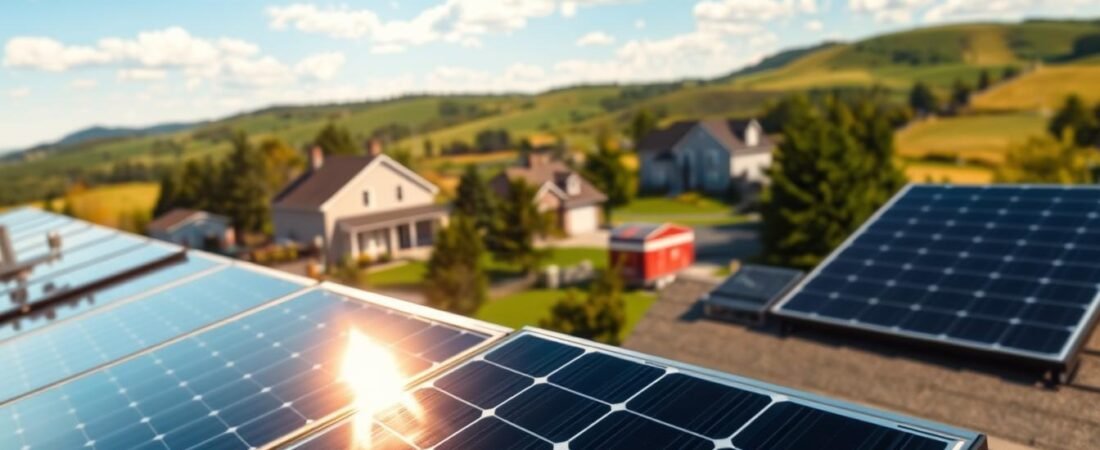
Thinking about a rooftop system? This guide gives clear, friendly facts to help homeowners decide. As of April 2026, the average solar panel installation price in the state is $2.59 per watt, which makes a full 13.34 kW system cost about $34,477 before incentives.
Most local families see strong returns over a 25–30 year lifetime. You can expect predictable energy bills and an average savings of about $66,294 on electricity across 25 years.
Key choices include roof orientation, system size, and which installers or companies you pick. Quotes from reputable companies show how a properly sized system reduces monthly utility bills and locks in long-term value.
In short: this is an investment that can lower bills, protect against rising utility rates, and tap local incentives. Read on to learn how price, incentives, and your home needs shape the final purchase decision.
Key takeaways: Average price $2.59/W; typical 13.34 kW install ≈ $34,477 pre-incentive; average 25-year savings ≈ $66,294; strong long-term returns for many homeowners.
Understanding the Average Solar Panel Cost in Pennsylvania
A clear picture of market averages gives you confidence when shopping for a system.
Current market averages:
- The typical residential system size in the state is about 13.34 kW, which drives most price estimates.
- Some 2026 reports list the average price at roughly $3.16 per watt for equipment alone.
- A 5 kW install averages $12,926 before incentives; a 10 kW will cost roughly twice that.
Impact of system size:
Larger installs often lower the per-watt rate because companies buy panels in bulk and spread labor costs over more capacity.
That means choosing the right size matters. Bigger systems raise upfront spending but can reduce long-term electricity bills and improve returns over the years.
Factors That Influence Your Total Installation Price
A handful of local conditions and product choices drive the final installation price.
Weather, site layout, and equipment shape how much a home system will run. Western parts of the state see more cloudy days than the east, and the region averages 179 sunny days per year. That lower sunshine affects how large a system you need to meet electricity goals.
Equipment type matters. Monocrystalline modules are the common, higher-efficiency option. Polycrystalline units cost less but deliver lower power per square foot.
| Factor | How it affects price | What to ask your installer |
|---|---|---|
| System size | Larger size raises labor and equipment needs | Will a bigger system lower my per watt price? |
| Roof orientation & shade | More shade requires more panels to reach goals | Can trimming or reorienting reduce panels needed? |
| Permitting & inspection | Standard fees and time add to installation totals | Who handles permits and final inspections? |
| Panel type | Higher-efficiency units cost more upfront but produce more energy over years | Which brand and warranty do you recommend? |
Knowing these factors helps you design a panel system that fits budget and long-term goals. Ask for itemized quotes so you can compare true costs and expected power output.
Comparing Cash Purchases, Loans, and Leases
Choosing how to pay for a home system shapes both short-term bills and long-term value.
Benefits of cash purchases
Paying in cash usually gives the fastest return. In Pennsylvania, a cash buy often reaches payback in about 10 years.
Owning the system outright lets homeowners claim incentives and keep all long-term savings.
Navigating loans
Many loans need $0 down and lower initial payments. But interest adds to the total price and can increase lifetime costs by thousands.
Loans make the purchase accessible while spreading payments over years.
Understanding leases
Leases require no money upfront and often lower monthly utility payments immediately. They do not transfer ownership.
“Leasing gives instant monthly savings, but the provider keeps tax credits and ownership benefits.”
| Option | Ownership | Typical benefit | Trade-off |
|---|---|---|---|
| Cash purchase | Yes | Max long-term savings, incentives | High upfront money |
| Loan | Yes | Spread payments, $0 down options | Interest raises total cost |
| Lease | No | Immediate monthly savings, maintenance handled | No tax credit, no ownership |
- Key takeaway: Your financing choice affects payback time, total investment, and who benefits from incentives.
Maximizing Your Savings with Federal and Local Incentives
Claiming available incentives is one of the fastest ways to lower what you pay for a rooftop energy system.
Federal Tax Credit Explained
The federal tax credit currently covers 30% of the total system value. Homeowners can claim the credit on the tax return filed the year after installation. If you don’t owe enough tax in that year, the unused portion rolls over for up to five years.
Note the credit schedule: it drops to 26% in 2033, 22% in 2034, and is set to expire after 2035. That timeline affects the net price you pay and the long-term savings you can expect.
- What counts: modules, inverters, and eligible batteries qualify for the credit.
- Local help: Pennsylvania does not offer a state tax credit, so local rebates or utility programs are the next best option.
- Pro tip: work with certified installers and consult a tax professional to ensure full credit and proper filing.
“Using federal and local incentives wisely will improve your system’s payback and increase household savings.”
The Role of Net Metering in Your Long-Term ROI
How your utility values exported electricity shapes the speed of your system’s payback.
Net metering lets homeowners send extra energy to the grid and withdraw it later, such as at night or on cloudy days. Investor-owned utilities in Pennsylvania must credit customers at the full retail rate. That full credit directly reduces monthly electricity bills and shortens the payback period.
A typical 8.5 kW system can produce close to 10 SRECs per year. In 2024, SRECs averaged about $45 each, creating modest extra income to offset system cost.
Net metering policies can change, and that risk affects projected long-term savings. Size your system to match household use so you export effectively and capture the most value from both credits and SRECs.
“Your payback period depends on how much energy you export and the credit rate your utility provides.”
- Tip: Ask your utility how exported energy is credited before finalizing system size.
Evaluating the Impact of Solar Batteries on System Costs
Including energy storage significantly alters upfront spending and long-term returns for most homeowners.
Adding a battery typically raises the total installation by about $10,000 to $20,000, depending on capacity and brand.
Batteries do qualify for the 30% federal tax credit, which lowers the net price and helps offset higher initial outlays.
Beyond dollars, storage offers reliable backup power during severe weather and outages. That is a clear benefit for many homes in the region.
As net metering rules shift, batteries can preserve a system’s financial edge by storing excess generation for peak-price use.
“A correctly sized battery improves independence and can protect long-term savings if export credits decline.”
- Match battery size to household energy use to ensure meaningful backup and peak-shift benefits.
- Use an installer to model payback and determine whether added savings justify the higher upfront cost.
- Consider warranties and replacement timelines—batteries add years to maintenance planning.
| Feature | Typical impact | What to ask |
|---|---|---|
| Upfront addition | $10,000–$20,000 | What’s the installed price for my desired capacity? |
| Federal tax credit | Reduces net price by 30% | Does this battery model qualify for the credit? |
| Backup capability | Provides outage power for critical loads | How many hours of backup will this size deliver? |
| Long-term savings | Improves value if net metering falls | Will stored energy lower my bills at peak times? |
How to Find and Vet Reliable Local Installers
Choosing the right installer is as important as choosing equipment—your roof and warranty depend on it.
With over 240 local companies available, start by collecting multiple quotes. Use marketplaces like EnergySage to gather vetted bids quickly.
Compare offers on a few key dimensions: clear per watt pricing, itemized installation fees, and expected system size and production.
Look for long-term support: installers that provide industry-best warranties and live system monitoring protect your savings and performance for decades.
Small or mid-size, family-owned companies often give better service and quicker response over a 25-year lifetime. Ask for references from nearby homes.
“Get at least three quotes and demand an itemized breakdown so you know exactly what you pay for.”
- Verify licenses, insurance, and local permitting experience.
- Confirm warranties, monitoring, and maintenance options.
- Choose an installer who explains incentives and how they affect final price.
Maintenance Expectations for Pennsylvania Homeowners
A little monitoring and occasional service keep your rooftop array producing reliably for decades.
Most systems need very little upkeep. They have no moving parts and are built for long life. Routine cleaning is rare in this region because regular rain washes away dirt.
If you do hire a professional wash, expect to pay about $75 to $150. That service is optional for many homeowners and is often skipped.
Roof repairs that require removing and replacing equipment usually run between $500 and $1,000. Choosing a trusted installer reduces the chance of damage during such work.
Watch system production with monitoring tools. Drops in output point to soiling or a faulty module and let you act before electricity bills rise.
- Minimal upkeep: frequent rainfall keeps panels clean most of the year.
- Removal/reinstall: budget $500–$1,000 for roof work that affects the array.
- Longevity: a well-made system should last 25–30 years with basic care.
“Regular checks and a quality installer are the best ways to protect performance and long-term savings.”
Conclusion
Quick tip: A well-planned home energy upgrade can pay back sooner than many expect.
Start by using the 30% federal tax credit and local net metering to lower your net price. Choose products and an installation that match your household needs so you convert dollars into lasting savings.
Get at least three quotes from vetted companies and compare itemized rates for panels, labor, and permits. That approach reveals true value and shortens the payback period.
Ready to compare estimates? Learn more about local pricing and incentives for Philadelphia by visiting Philadelphia solar cost 2026. Small upfront work today yields decades of cleaner energy and steady savings.